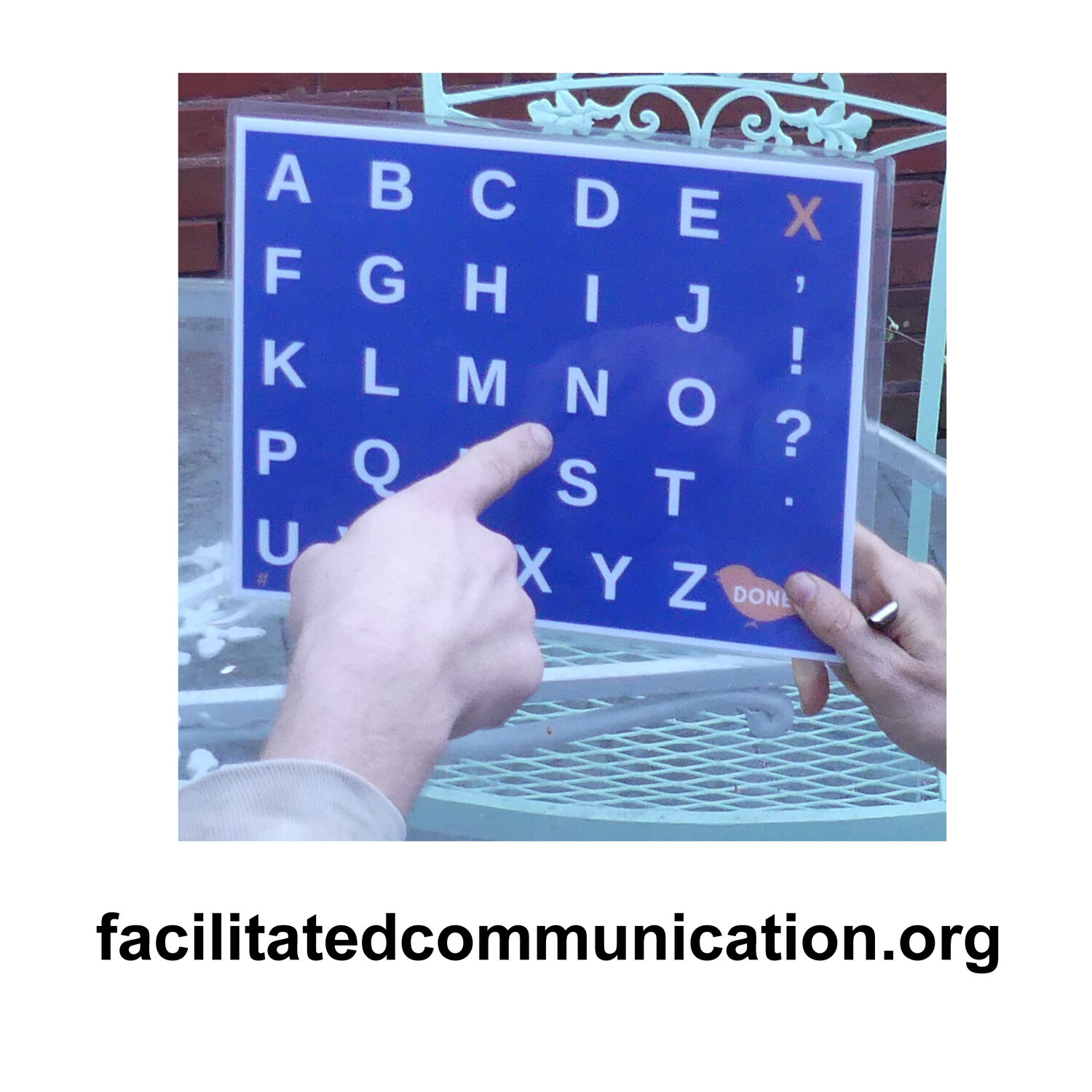
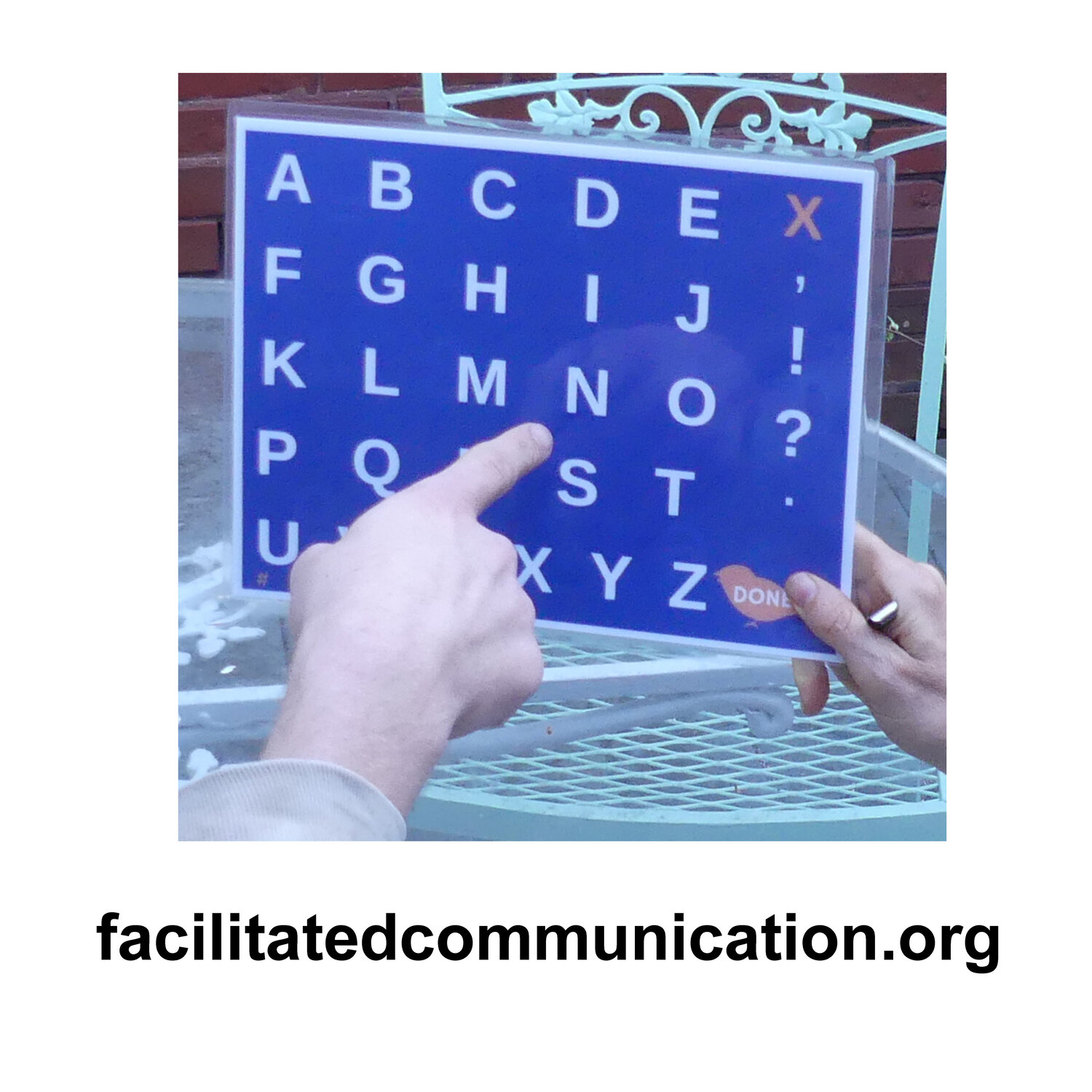
In my last two blog posts, I discussed FC/S2C/RPM authorship testing in some detail. I‘ll put links in the References and Recommended Reading section below.

A screenshot of Howard Shane conducting a “low tech” message-passing test using pictures and file folders. The facilitator stayed with the client throughout the testing (Prisoners of Silence, 1993)
I debated about whether to publish today’s blog post now or wait until a later date, but, since I’m on a roll (or a rant, depending on your perspective), I decided to go ahead and stick with the topic of message-passing for the third blog post in a row.
As a jumping off point, I’ve used a 2026 article titled “Why Facilitated Communication, Spelling to Communicate, Spellers Method, and variants warrant authorship testing: Countering Misinformation and applying a human rights lens in response to recent arguments against message-passing tests” by Howard Shane, Bronwyn Hemsley, Katharine Beals, and Russell Lang. The opinions expressed in this blog post are mine, not theirs, except where noted.
As always, I encourage you to read their article in full.
The Shane et al. article is a critical response to a pro-FC opinion piece published on Substack and written by autism parent, David Kaufer, titled “Why Message-Passing is Invalid: The test designed to fail non-speaking autistic people.”
As Shane et al. point out, parental concerns regarding any testing of their clients or loved ones are valid and should be addressed. However, Kaufer’s piece relied heavily on generative AI software for its “drafting, research organization, and editing” and the claims being made in the article about message-passing testing contain inaccuracies that could, as Shane et al. point out in their article, potentially, “affect clinical practice, educational placement, and legal testimony.”
Kaufer seems to have an exorbitant and unfounded fear of message passing tests that, in his article, he projects onto his nonspeaking or minimally speaking clients and loved ones—so much so that I wonder if he’s read the original studies.
As I discussed in my prior blog posts, message-passing tests are facilitator-focused, not client-focused. (And perhaps this is the real reason why facilitators don’t like it). That is, the tests serve to separate facilitator behaviors from those of their nonspeaking or minimally speaking clients to determine who is authoring the messages.
The only significant change during message passing tests as compared with informal FC sessions is that facilitators are prevented from accessing test stimuli (e.g., pictures, words, objects). This control is often referred to as “blinding” the facilitator and allows the clients an opportunity to spell out information without interference from the facilitators (if they are able to independently understand and use written language).
The role of the clients in these tests is to participate in facilitation with their usual support. For FC and its variants that means the facilitator holds their wrist, elbow or shoulder during letter selection while they identify common, everyday objects or answer questions about subjects with which they are familiar (it’s not an IQ test). For S2C/RPM and their variants, that means the facilitator holds a letter board in the air and, as is typical of these techniques, provides visual and auditory cues.

Researchers at the O.D. Heck Center used a table top barrier to “blind” facilitators from the pictures shown to their clients while the interaction between facilitator and client remained unimpeded (Prisoners of Silence, 1993)
Checking for communication independence should be a natural part of teaching someone what proponents claim to be an independent communication technique, not something to be feared. The origins of this fear-based attitude toward testing likely stems from the 1980s-early 1990s where the FC leadership framed authorship testing as “confrontational” or “adversarial.”
Back then (e.g., when I took the FC workshop in January, 1993), suggestions by workshop leaders not to test were lightly coercive, but over the decades, the pressures not to test for authorship seem to have intensified. Today’s proponents of FC/S2C/RPM have convinced themselves that testing for authorship is “unethical” even when court ordered in high-stakes situations like (false) allegations of abuse cases or guardianship disputes. (See Katharine’s series of blog posts called Spelling to Communicate Goes on Trial). I’ve also recently heard that at least one facilitator testified in a different court case that the person was afraid of losing a license to practice S2C if they participated in authorship testing. (There are, by the way, no state or government licenses for practicing FC/S2C/RPM, so this claim, too, seems to be fear-based rather than reality-based).
Note: I’ll include links to Katharine’s 7-part series about the Lower Merion Court case at the end of this blog post.
Contrary to what proponents would like people to believe, message-passing is an established, objective, data-collecting tool researchers have used for decades to separate facilitator behaviors from those of their clients’ behaviors during the FC-generated spelling activity. The goal of message-passing testing is to determine who is controlling letter selection: the facilitator or the person being subjected to the technique. If proponents were serious about promoting independent communication in nonspeaking or minimally speaking individuals with profound autism and other developmental disabilities, they would welcome testing instead of resoundingly rejecting it. Authorship testing—that is, making sure that the individuals are communicating their own thoughts not those of their facilitators—is an important and necessary step for fading facilitator support and safeguarding the communication rights of those being subjected to the techniques.
As we see from Kaufer’s opinion piece, current-day facilitators make all kinds of excuses not to participate in the testing. But, in the past, message-passing tests were regularly employed for two main reasons:
to determine whether claims of unexpected literacy in individuals being subjected to FC could be verified in the target populations (e.g., nonspeaking individuals with profound autism, cerebral palsy or other developmental disabilities), and
to determine authorship in cases of alleged abuse by FC-generated messaging. (See False Allegations)
And, while my personal experiences with FC fall within the latter category, I think it’s important to note that not all message passing tests were conducted because of false allegations of abuse.
Rather, most authorship tests, like the one featured in the 1993 documentary “Prisoners of Silence” at the O.D. Heck Center in Schenectady, NY, were conducted by Syracuse-trained facilitators (e.g. speech/language pathologists, psychologists, and other professionals) who wanted to rule out facilitator influence and control over letter selection.
Generally, validation testing is done within clinical settings and before introducing a “new” or “revolutionary” technique to the public, but early promoters of FC, like Rosemary Crossley and Douglas Biklen, chose to bypass the scientific community and go directly to the media, which credulously published feel-good miracles stories about previously “silent” individuals spelling out “love” a letter at a time. Promoters of the so-called “modern spelling methods” (e.g., variants of FC) have continued this practice: Soma Mukhopadhyay, Elizabeth Vosseller, Dawn-Marie Gaivin, Dana Johnson, and Barry Prizant, for example, all advise their clients not to test for authorship.
In the past, participants selected for message-passing tests were chosen for their “success” with FC in classroom and home settings and were, most often, paired with their preferred facilitator (or at least with someone known to them). Likewise, the tests generally took place in settings familiar to the participants, using test stimuli (e.g., pictures, objects, videos) selected from their everyday lives or academic programs. As Kaufer describes it in his article, in contrast, the students became so stressed out by the idea of being tested that they either lost the ability to spell or they purposely sabotaged the testing. Again, I wonder if he bothered reading the original studies where researchers followed ethical guidelines and assured the safety and comfort of study participants.
Kaufer claims that message-passing tests are “invalid” or “discriminatory” because, according to claims by FC-proponents, communication difficulties in autism are not due to cognition, language or other limitations, but instead are due to motor planning difficulties (a supposition that appeared early in the FC literature was that nonspeaking individuals with profound autism needed a facilitator’s physical support to overcome “apraxia” to “independently” spell out words on a letter board. Proponents have yet to prove this claim). In other words, Kaufer admits that nonspeaking individuals depend on facilitator “support” (e.g., visual, physical, and/or auditory cues) to spell out words using FC/S2C/RPM, but ignores the most obvious consequence of facilitator dependence: that is a learned helplessness that prevents individuals being subjected to the techniques from interacting with the letter boards without their facilitators being within physical, visual and/or auditory range.
It should be noted here that FC/S2C/RPM also prevents nonspeaking or minimally speaking individuals from accessing legitimate, evidence-based forms of Augmentative and Alternative Communication (AAC) which build independence, not dependence on a facilitator, assistant, or “communication regulation partner.”
Kaufer also describes message-passing tests as adversarial and purposefully stress-inducing on the individual being subjected to FC. Again, this fear-based stance against testing may have originated from workshop leaders who told their facilitators-in-training that the tests were “confrontational.” Having read the original studies and participated in message-passing tests myself, I believe Kaufer is both exaggerating and misinterpreting the type of activities used in many tests for authorship or “message-passing” tests.
When a person is shown a picture or object and then asked to name (or in the case of FC, spell) the picture or object, this is referred to as a “confrontational vocabulary test.” The purpose of this test design is to determine whether an individual can retrieve information (at the word level) and name the object (via spoken or written language), often without context clues. While this type of testing requires a person to identify a specific word “on demand” (e.g. cup, tree, boat), it does not mean that the test (or the evaluator) is aggressive or confrontational toward the clients themselves. Rather, a picture, word or object is presented to the person being tested and they’re asked to name (or spell out) what they see. There is no punishment for a wrong answer. The evaluator simply moves on to the next word, picture, or object.
In contrast, other types of testing can be more “conversational” and allow for the responses to contain phrases or information beyond specifically labeling the desired word or object using a single word. For example, in a message-passing activity designed for naming pictures or objects (e.g., a “confrontational” test), the desired response for a picture of a “shoe” would be a single word: “shoe.” Responses such as “loafer” or “sandal” or “sneaker” would be accepted as correct if the participant was able to specifically label the type of shoe shown in the picture.
In a conversational message-passing test, the individual might describe what the shoe was used for or other characteristics of the shoe (e.g., it has laces, I put it on my foot). In addition, the picture(s) shown to the individual might represent an activity (e.g., children jumping in a mud puddle) rather than a single word (e.g., shoe). Throughout the years, researchers have successfully developed test protocols that both blind facilitators from test stimuli and elicit both “confrontational” and “conversational” responses from the participants.
Had Kaufer read the existing controlled studies (available here on our website), he would understand that authorship tests often contain several different activities, only one of which would be considered a “confrontational” picture or object naming test. Within any given FC/S2C/RPM message-passing test protocol, there can be several different ways for the subjects to independently express their thoughts through spelling (if they have the comprehension skills to understand and use written language).
The key characteristic of controlled message-passing tests is that facilitators are prevented from accessing the test stimuli. This is, as I mentioned earlier, likely the true source of Kaufer’s anxiety, which makes me wonder why, if the FC-generated responses are independent and free from facilitator control, the facilitator would be so anxious about not knowing the target answers that they’d refuse to participate in the testing.
Regardless of the type of activity (e.g. confrontational or conversational), FC authorship tests often include activities tested under at least three conditions:
Condition A – both the client and the facilitator have access to the same test stimuli
Condition B – only the client has access to the test stimuli (called “blinding” the facilitator)
Condition C – the client and facilitator have access to different test stimuli (e.g., the facilitator is shown a picture of a shoe, the client is shown a picture of a tree).
If the FC-generated messages were truly independent (that is, based on the individual’s ability to understand and use written language), then the expected (correct) response to each condition would be as follows:
Condition A – A response based on the test stimuli provided to both facilitator and client
Condition B – A response based on the test stimuli provided to the client
Condition C – A response based on the test stimuli provided to the client
The problem with the authorship tests from the 1990s isn’t that the clients were too stressed out to respond to the test stimuli. If Kaufer or any of the current-day facilitators had read the existing authorship studies, they would know that evaluators recorded facilitated responses to thousands of trials with hundreds of facilitator/client pairs. In fact, Condition A (spelled responses when both the facilitator and the client have access to the same test stimuli), showed that FC-generated responses could be obtained under test conditions. In post-test interviews, many facilitators reported that their clients were “spelling” in usual ways (before receiving the results of the tests), but that they themselves were later devastated to learn that they (the facilitators), not their clients were controlling letter selection.
Rather, the “problem” for proponents with message passing tests was that the responses from Conditions B and C, where facilitators were blinded from test stimuli, clearly and reliably exposed facilitator influence and control over letter selection.
As I’ve discussed in previous blog posts, the results from reliably controlled message passing tests generally included responses that fell within three categories:
Unintelligible (the clients couldn’t spell)
Correctly spelled but based on information provided solely to the facilitator (facilitator controlled)
Correctly spelled but irrelevant to the test stimuli presented to the client (facilitator guesses)
Historically, it seems, facilitators in the 1990s were more likely than not to voluntarily participate in reliably controlled authorship testing because they understood the importance of testing the “new” and “revolutionary” technique. Many tests with rank-and-file facilitators were not conducted as a result of (false) allegations of abuse and included dozens of facilitator/client pairs. Examples of testing authorship in an attempt to confirm proponent claims of unexpected literacy (and in the hopes FC would work) can be found in the Controlled Studies section of our website, but include such studies as:
Wheeler, DL, Jacobson, JW, Paglieri, RA, and Schwartz, AA. (1993). An experimental assessment of facilitated communication. Mental Retardation. Vol 31 (1), 49-60.
Szempruch, J. and Jacobson, J.W. (1993). Evaluating facilitated communications of people with developmental disabilities. Research in Developmental Disabilities. Vol 14 (4), 253-264. DOI: 10.1016/0891-4222(93)90020-k
Smith and Belcher. (1993). Brief report: Facilitated communication with adults with autism. Journal of Autism and Developmental Disorders. 23 (1), 175-183. DOI: 10.1007/BF01066426
But as it became evident through the testing that facilitators, not their clients, were (often inadvertently) authoring the FC-generated messages, the facilitators started blaming the tests, not the techniques. Even the leaders of the FC movement couldn’t pass message passing tests (See my blog posts Truth Will Out and When Did the FC leadership know about the fatal flaws with their technique? Parts 1-4 listed below)
Since the mid-2000s, proponents have mythologized and demonized the purpose of message-passing tests and claim there is no standardized means of conducting authorship testing. As Shane et al. point out, there are valid and documented protocols designed to rule in or rule out facilitator cueing and control over letter selection. And as Katharine pointed out in a previous blog post, there are informal tests of authorship found even in pro-FC literature—and the results are not good.
But I’d also point out that if it’s true there are no standardized protocols for facilitators to extricate themselves from the facilitation process (e.g., fade support) as proponents like Kaufer claim, then the fault lies with FC/S2C/RPM proponents and not those who criticize the techniques for its lack of scientific rigor. Purposefully rejecting the existing scientific evidence against FC/S2C/RPM and adopting a fear-based approach to message-passing tests doesn’t solve the problem of facilitator control, nor does it make facilitator-dependent techniques any less flawed.
It’s up to proponents of FC/S2C/RPM to prove their claims of communication independence and, to the extent that Kaufer and other leading proponents of these techniques reject safeguards to protect the communication rights of nonspeaking and minimally speaking individuals by refusing to participate in message-passing tests simply because they don’t like how they turn out, I’d have to say that Kaufer’s (manufactured) fears regarding testing are not founded in reality but are, instead, pure falderal.
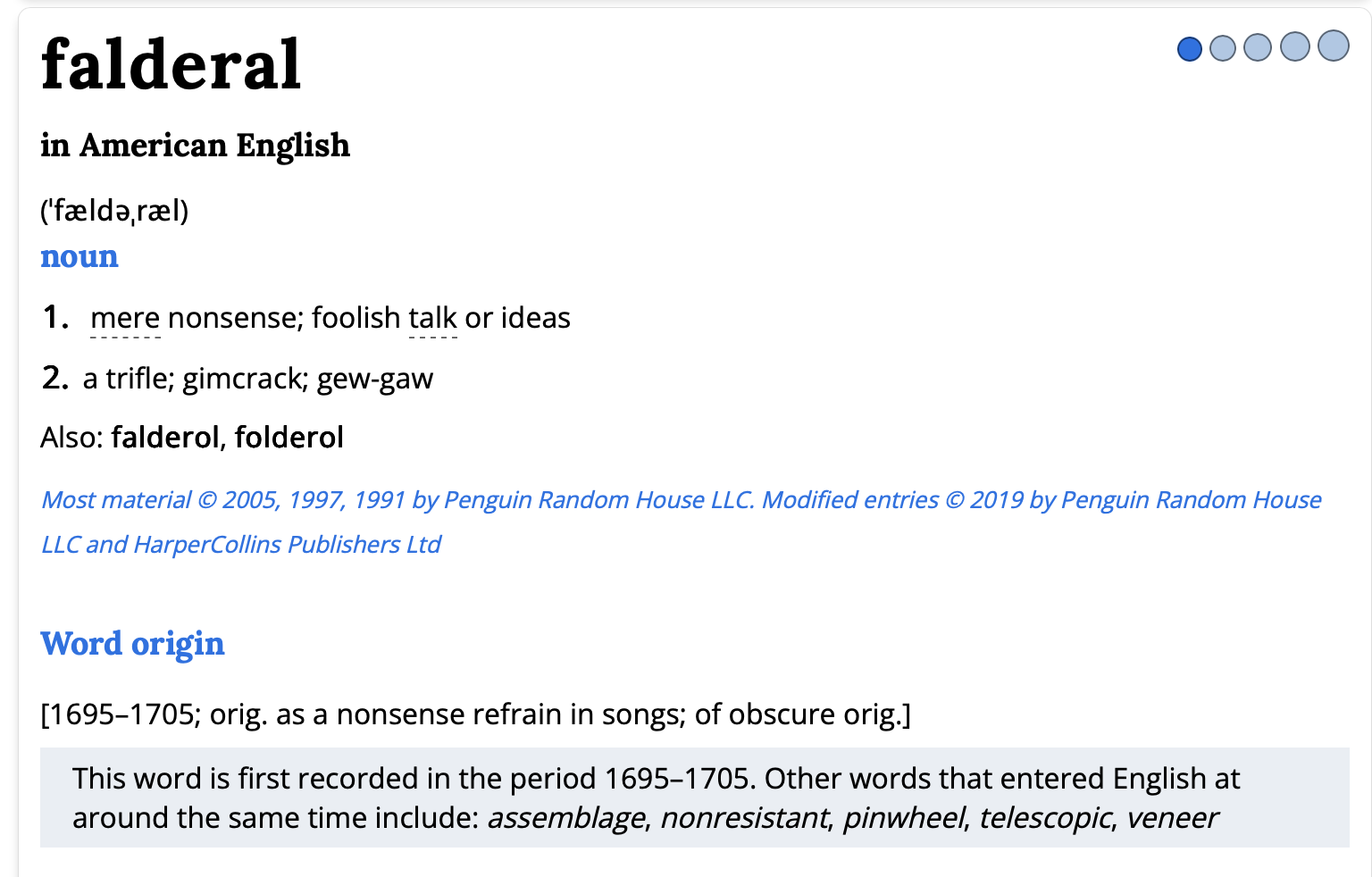
Screenshot from Collins Dictionary
References and Recommended Reading:
Hemsely, Bronwyn, Beals, Katharine, Lang, Russell, Schlossers, Ralf W., Shane, Howard, Simmons, William, Skinner, Sharon, and Todd, James. (2025, October 1): Safeguarding the communication rights of minimally- or non-speaking people who are vulnerable to Facilitated Communication, Rapid Prompting (Spellers Method) and variants, Research and Practice in Intellectual and Developmental Disabilities. Research and Practice in Intellectual and Developmental Disabilities. DOI: 10.1080/23297018.2025.2544116
Shane, Howard, Hemsley, Bronwyn, Beals, Katharine, and Lang Russell. (2026). Why Facilitated Communication, Spelling to Communicate, and Spellers Method and Variants Warrant Authorship Testing: Countering Misinformation and Applying a Human Rights Lens in Response to Recent Arguments Against Message-Passing Tests. Perspectives of the ASHA Special Interest Groups. American Speech-Language-Hearing Association. 1-6
Blog Posts
Do proponents know what “reliably controlled authorship testing” means? (Part 1)
Do proponents know what “reliably controlled authorship testing” means? (Part 2)
Spelling to Communicate Goes on Trial: Part 1
Spelling to Communicate Goes on Trial: Part II
Spelling to Communicate Goes on Trial: Part III
Spelling to Communicate Goes on Trial: Part IV
Spelling to Communicate Goes on Trial: Part V
Spelling to Communicate Goes on Trial: Part VI
Spelling to Communicate Goes to Trial: Part VII, The Conclusion
Strange Science In Iversen’s book “Strange Son”
Truth Will Out: Review of Portia Iversen’s “Strange Son”
When did the FC leadership know about the fatal flaws with their technique? (Part 1)
When did the FC leadership know about the fatal flaws with their technique? (Part 2 - IDRP)