Alarms have been sounding through the pro-FC/S2C/RPM community about the purportedly outsized control over the American Speech Language Association (ASHA) wielded by four individuals, including yours truly. The evidence for our control is the fact that we are authors on four FC-critical talks at the upcoming ASHA Convention this November in Indianapolis. And the suspicious nature of this control arises from the following claims:
We purportedly lack the credentials necessary to address the topics we’re presenting on, and
We purportedly have major conflicts of interest that impede our credibility.
Here, in the order in which they will be presented, are the four talks in question:
Guidelines on Authorship Testing for Speech-Language Pathologists Working with Minimally-Speaking Individuals Subjected to FC/S2C
Authors: Bronwyn Hemsley, Howard Shane, Katharine Beals, Diane Paul, Jaime Van Echo, and Russell Lang.The Myth of the Mind-Body Disconnects and the Non-Evidence-Based Practices It Has Inspired
Authors: Katharine Beals, Bronwyn Hemsley, and Howard Shane.The Top Myths that Support Facilitated Communication, Rapid Prompting Method, and So-Called Modern Spelling Methods
Authors: Katharine Beals, Bronwyn Hemsley, Howard Shane, and Russell Lang.Lived Experiences of Harms of Facilitated Communication and Variants: Critical Case Inquiry Informs Protective Actions
Authors: Bronwyn Hemsley, Howard Shane, Mary Busk, Mark Sherry, Janyce Boynton, Katharine Beals, James Todd, Karen Nankervis, Jeffrey Chan, Kevin Plantan, and Russell Lang.
As for the four people in question, interested readers who haven’t yet heard the alarm calls are invited to figure out the identities of the other three. And really interested readers are invited to explore the ASHA program to see if they can identify at least two more talks in which FC will be discussed.
But here what I’d like to address, primarily, isn’t the question of whether there are four people who wield an outsized influence over ASHA, but the question of whether any of us is disqualified either by a lack of credentials or by conflicts of interest to dominate ASHA’s program as much as we do, with talks, morning and afternoon, on every day of the convention.
Our alleged lack of credentials appears to be based on the following:
Some of us allegedly lack clinical experience
None of us is a neurologist
None of us specializes in motor planning, apraxia, or “the mechanics of how a signal breaks down between a person's intention and their hand.”
As far as lack of clinical experience goes, one person is generally singled out: Yours Truly. And it’s true that the only letters that go after my name, PhD, evoke armchairs rather than therapy tools. But it’s also true that we live in a society that is infamously obsessed with credentials and certifications, and that credentials and certifications aren’t the same as experience.
In my own particular case, I’ve been actively involved in devising and delivering autism therapies since my Level 2 son was diagnosed in 1998, particularly language-based therapies; I’ve worked directly or indirectly on language and literacy challenges with some dozen individuals across the autism spectrum; and, on a grant from the National Science Foundation, I’ve visited dozens of autism classrooms on both coasts and interviewed several dozen speech-language pathologists, behavior specialists, and special ed teachers who work with autistic individuals. Through parent friendships in the autism world, I’ve known several non-speakers, one since he was five.
Put in more general terms, one can have deep or wide experience working with autistic individuals without having a single official certification or credential, and one can be certified and credentialed up the wazoo without having deep and wide experience working with autistic individuals. Insisting on official certifications and credentials as a precondition for credibility is some combination of bureaucratic, elitist, and unwise.
Some sort of elitist mindset also seems to drive our reverence for neurology/neuroscience degrees: surely, if you’ve earned one of those, you’re super smart and super scientific in everything you do. But a PhD in neurology/neuroscience doesn’t, as such, qualify you to speak reliably about non-speaking autism. And as for being super smart and super scientific, two neuroscientists who regularly opine about non-speaking autism, Diane Hennacy Powell and Julia Mossbridge, also believe that non-speaking autistics are endowed with a whole host of paranormal abilities, including S2C-mediated telepathy.
What about the alleged lack of expertise, among the four of us, in motor planning, apraxia, and “the mechanics of how a signal breaks down between a person's intention and their hand”? One of us actually wrote a whole dissertation on apraxia; he finds it an implausible explanation for non-speaking autism. All of us are deeply familiar with the literature on motor planning and apraxia in autism; indeed, judging from the assertions made in pro-FC posts and articles, we’re actually much more familiar with this literature than FC proponents are. Which leads to my next point: given that there’s no evidence of an intention-to-hand “signal breakdown” in non-speaking autism, being an expert in “the mechanics of how a signal breaks down between a person's intention and their hand” isn’t qualifying, but disqualifying. It’s arguably as disqualifying as being an expert on telepathy in non-speaking autism.
Turning, now, to our alleged conflicts of interest, these are:
having a financial interest in products that allegedly compete with FC
having served as expert witnesses against FC in court cases
For a product to compete with FC, it would have to serve the same sorts of parents and clients. The product of mine that FC-proponents have harped on, the SentenceWeaver, presupposes language and literacy abilities that, unfortunately, are not found in most autistic non-speakers. This is evident, for example, from a recent recruitment announcement. In all the time that the SentenceWeaver has been available, only one autistic non-speaker has used it, and this person is highly unusual. He has long had an ability to type, completely independently, meaningful phrases and sentences that communicate messages to his parents: a skill that, unfortunately, eludes most autistic non-speakers.
Beyond the clients, there are the parents. FC appeals to a completely different set of parents than our products do: namely, parents who are less interested in evidence-based instruction that often brings very slow progress, and more interested (understandably) in miraculous breakthroughs. None of our “competing programs” provide, or claim to provide, such miracles.
The notion that someone who serves as an expert witness on a topic in which they are an expert thereby has a conflict of interest when they write on that topic strikes me as not just unwarranted, but confused. People are hired as expert witnesses because their work is perceived to be credible, and the fact of serving, or having served, or being about to serve, as an expert witness does not render that work non-credible. People who wish to serve or to continue to serve as expert witnesses have every incentive to produce work that is as credible and well-respected as possible.
Interestingly, those who make claims about conflicts of interest and deficient credentials on the part of FC critics don’t seem especially concerned about whether any of this applies to the spokespeople on their side. To many who look into the FC world from the outside, the abundance of conflicts of interest and deficits in credentials may be both obvious and unsurprising. Nonetheless, I find it quite shocking how uninformed those FC proponents who present themselves as experts on these topics are, or at least appear to be, about what the research on motor challenges and apraxia in autism actually says. They don’t even seem to be aware of the existence of much of what’s been published.
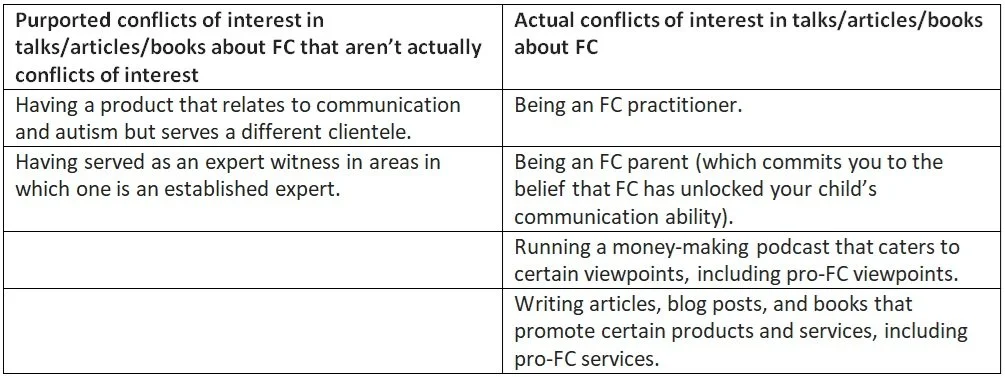
Let’s sum things up with another set of compare and contrast tables. As much of a pain in the neck as these are to create, I’ve grown rather fond of them.
Purported vs. actual conflicts of interest
Purported vs. actual disqualifying factors

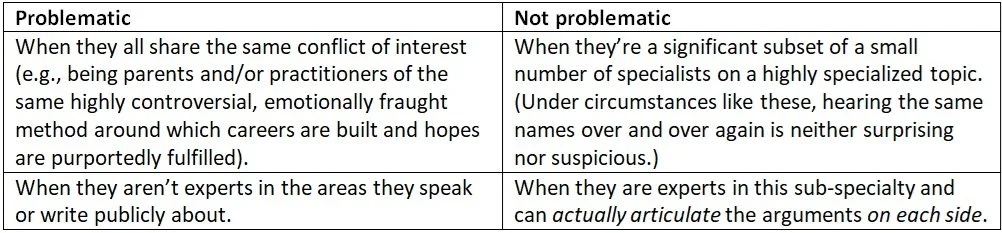
When a small group of influencers is vs. isn’t problematic