Whose Voice Is It?
A Family and Professional Guide to Facilitated Communication,
Rapid Prompting Method, Spelling to Communicate, and Authorship
Prepared by Tatyana Elleseff, MA, CCC-SLP, BCS-CL
Smart Speech Therapy LLC | Tatyana Elleseff Consulting | 2026
Purpose of this packet
This packet is designed to help families, clinicians, educators, advocates, and school teams protect authentic communication. It focuses on facilitator-dependent methods such as Facilitated Communication (FC), Rapid Prompting Method (RPM), Spelling to Communicate (S2C), letterboarding, assisted typing, supported typing, and related variants. The goal is not to doubt nonspeaking or minimally speaking people. The goal is to protect their own words from being replaced, shaped, or authored by another person.
Contents
1. Core Principle: Communication Rights Require Authorship Protection
2. What Are FC, RPM, S2C, and Related Methods?
3. AAC Is Not the Same as Facilitator-Dependent Spelling
4. Why Families Are Drawn to These Methods
5. The Authorship Question: The Central Clinical Issue
6. Red Flags Checklist
7. What “Independent Communication” Should Look Like
8. Questions to Ask Any Provider, School, or Program
9. How to Evaluate Authorship Safely and Fairly
10. What to Do If Your Child Is Already Using FC/RPM/S2C
11. School and IEP Safeguards
12. When Messages Make Allegations or Major Life Claims
13. What to Do Instead: Evidence-Aligned AAC and Communication Support
14. Parent and Professional Wording Bank
15. One-Page Decision Guide
16. Selected References
1. Core Principle: Communication Rights Require Authorship Protection
Nonspeaking and minimally speaking people have thoughts, emotions, preferences, knowledge, dignity, agency, and communication rights. This is not in dispute. The central question in facilitator-dependent communication is not whether a person has something to say. The question is whether the method verifies that the message is independently authored by that person.
This distinction is critical because FC, RPM, S2C, and related variants involve another person in the production of messages. That involvement may include touching, stabilizing, holding a letter board, moving a board, cueing, prompting, pacing, anticipating, redirecting, or otherwise shaping responses. When another person is necessary for the message to appear, authorship must be established before the message is treated as the person’s own communication.
Key principle
Presuming competence does not mean presuming authorship. A rights-based approach protects both access to communication and the authenticity of the person’s own voice.
Major professional organizations have reached similar conclusions. ASHA states that Facilitated Communication is discredited, should not be used, and that information obtained through FC should not be considered the communication of the person with a disability (ASHA, 2018a). ASHA also states that RPM is not recommended because of prompt dependency and lack of scientific validity, and that information obtained through RPM should not be assumed to be the communication of the person with a disability (ASHA, 2018b).
A 2026 AAIDD position statement similarly emphasizes that independent communication is essential for agency and states that FC and RPM may misrepresent or take away people’s thoughts and voices because of facilitator influence and displacement of scientifically valid AAC supports (AAIDD, 2026).
2. What Are FC, RPM, S2C, and Related Methods?
Different names are used in different settings, but the clinical concern is the same: a communication method depends on another person being actively involved in message production.
Name Used: Facilitated Communication (FC)
Common Features: A facilitator provides physical support, often at the hand, wrist, elbow, shoulder, sleeve, or another body part while the person points to letters, pictures, objects, a keyboard, or a device.
Authorship Concerns: Direct physical influence creates a serious authorship problem. Controlled studies have repeatedly shown facilitator authorship rather than independent authorship by the person with a disability.
Name Used: Rapid Prompting Method (RPM)
Common Features: An instructor typically holds or moves a letter board and uses repeated verbal, auditory, visual, or tactile prompts while the person points to letters or choices.
Authorship Concerns: Even without hand-over-hand support, the board holder and prompts can influence responses. ASHA identifies RPM as facilitator-dependent and not recommended.
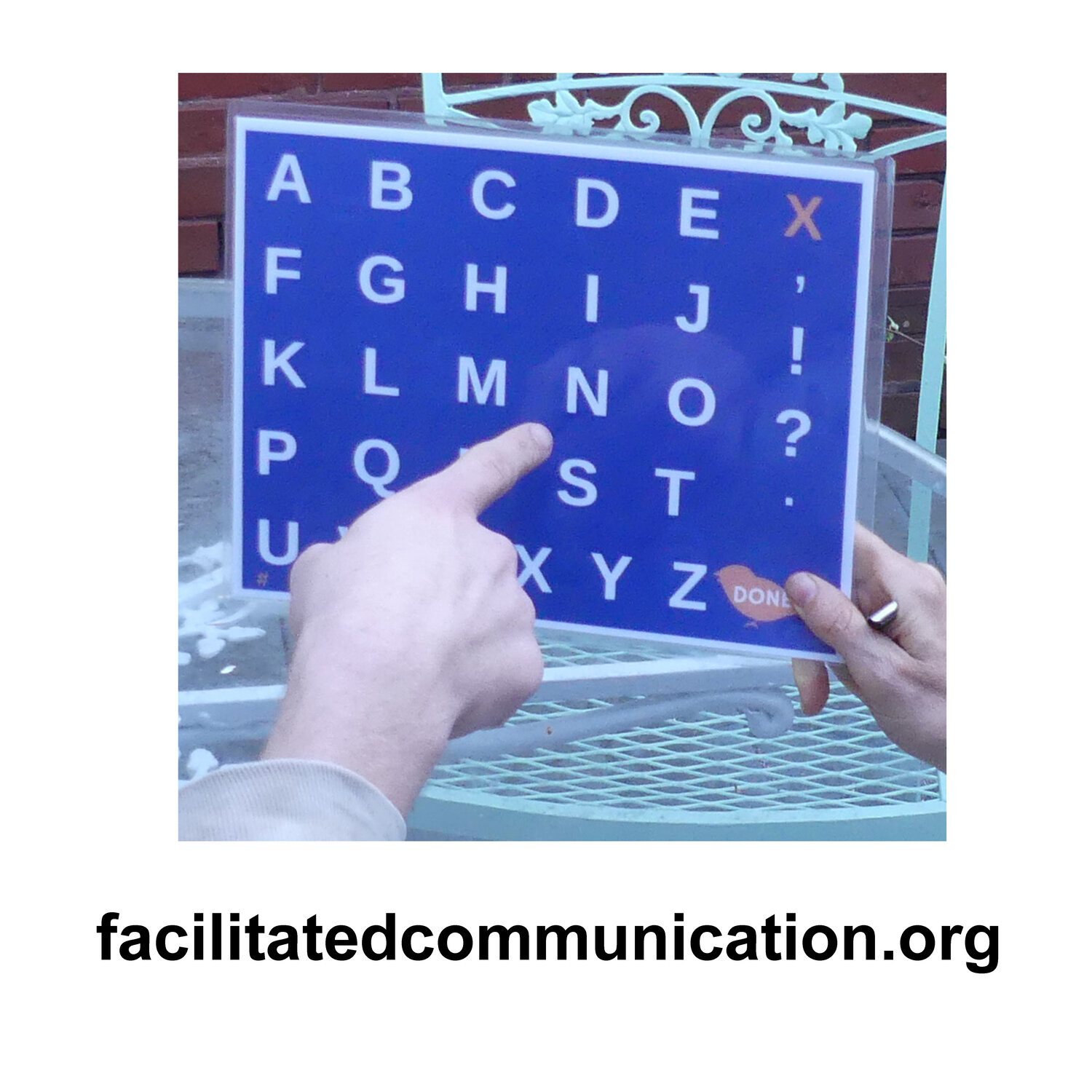
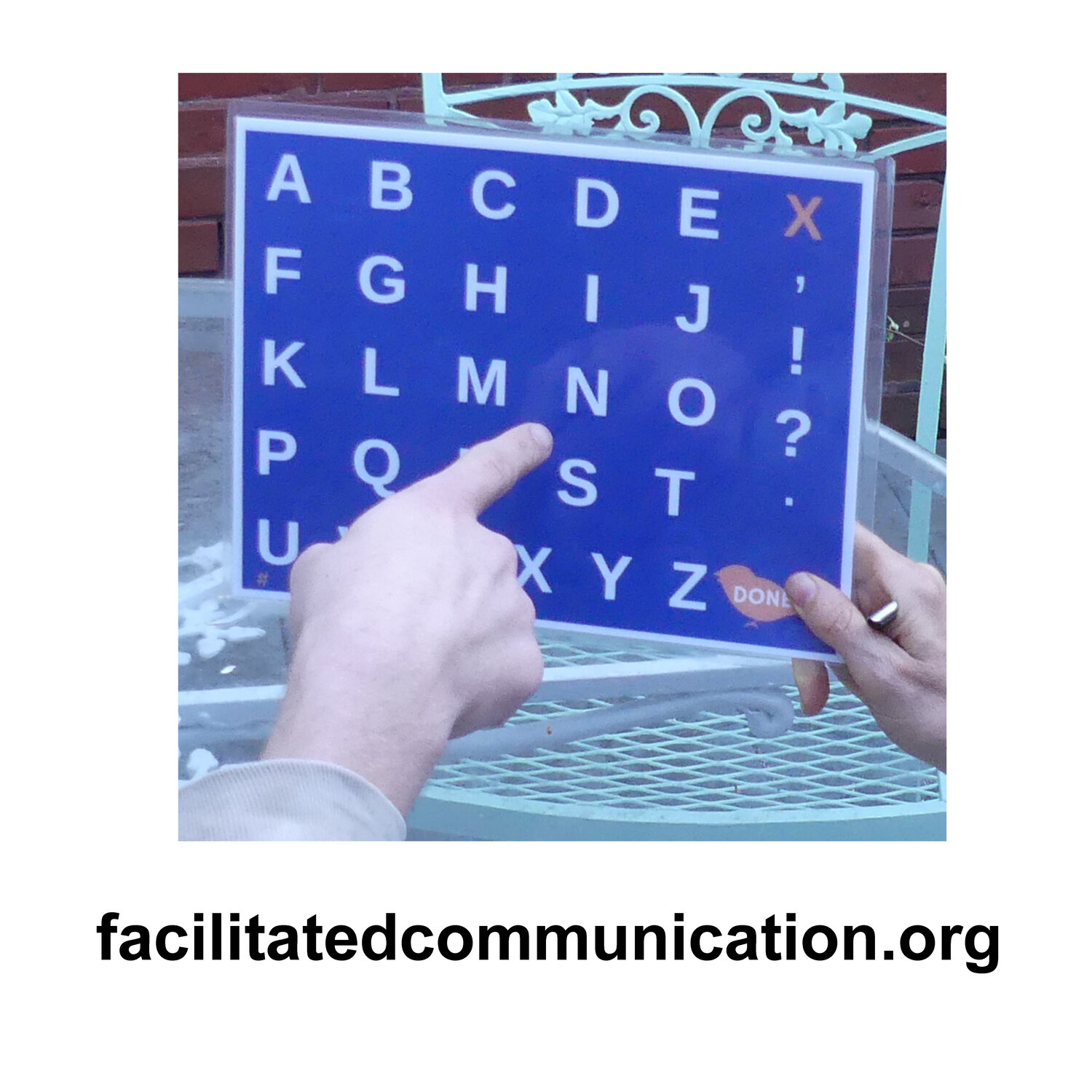
Name Used: Spelling to Communicate (S2C) / Spellers Method/ letterboarding
Common Features: A person spells on a letter board or stencil while a trained communication partner provides prompts, pacing, positioning, or board presentation. Names and procedures vary.
Authorship Concerns: Changing the name does not resolve the authorship question. If the helper is necessary and the helper can know, cue, or influence the message, independent authorship must be demonstrated.
Name Used: Supported typing / assisted typing / variants
Common Features: Terms sometimes used for methods that involve another person helping the individual type, point, spell, or select letters.
Authorship Concerns: A method should be evaluated by its procedures, not its label. Ask: Who controls the access? Who knows the target? Who could be cueing? What happens when the helper does not know the answer?
The key issue is not whether letters, typing, spelling, or AAC are appropriate. Many individuals can and do communicate authentically using typing, spelling, speech-generating devices, eye gaze, switches, partner-assisted scanning, signs, gestures, pictures, objects, or multimodal systems. The issue is whether the message is independently generated or facilitator-influenced.
3. AAC Is Not the Same as Facilitator-Dependent Spelling
A common source of confusion is the claim that criticism of FC/RPM/S2C is criticism of AAC. That is false. AAC is a broad, evidence-aligned area of practice that includes tools and strategies to support functional communication. Facilitator-dependent spelling methods are not the same as AAC simply because they use letters, boards, or devices.
Evidence-aligned AAC
Goal is independent, functional communication across people, settings, and routines.
Assessment includes feature matching: access method, vision, motor profile, language level, cognition, sensory needs, positioning, environment, and partner supports.
Communication partner supports access and language learning but does not author, steer, or know the target response.
Prompting is planned, transparent, faded when possible, and documented separately from independent performance.
Progress is measured through independent selections, functional communication, generalization, and maintenance.
The person’s autonomous access is the priority.
Facilitator-dependent spelling methods
Communication often depends on a specific helper, trainer, or communication partner.
The same letterboard/spelling pathway may be promoted broadly, even when access, language, literacy, or motor needs have not been fully assessed.
The helper may hold the board, move the board, cue the person, pace the selection, redirect errors, or know what answer is expected.
Prompt dependency may be normalized, preferred, or reframed as necessary for access.
Progress may be shown through emotional stories, videos, long messages, or impressive output without rigorous authorship controls.
The helper remains central to message production.
ASHA’s AAC Practice Portal describes AAC as a clinical area that supplements or compensates for speech-language production or comprehension needs, including spoken and written communication modes (ASHA, n.d.). RCSLT also emphasizes that FC/RPM variants should not be confused with evidence-based AAC supports (RCSLT, n.d.).
4. Why Families Are Drawn to These Methods
Families who pursue FC/RPM/S2C are often exhausted, hopeful, frightened, or desperate for access to their child’s inner life. Many have been told for years what their child cannot do. A method that promises sudden access to complex thoughts, academic knowledge, feelings, and personality can be intensely compelling.
This emotional reality is one reason these methods spread. However, compassion for families cannot be allowed to replace authorship verification. A child’s communication rights are not protected by believing every message that appears on a board. They are protected by ensuring that the message is truly the child’s own.
Family-centered but evidence-aligned
A parent can believe deeply in their child’s intelligence and still require proof that the message is independently authored. Those positions are not opposites. They belong together.
5. The Authorship Question: The Central Clinical Issue
The central question is whether the message produced through the method is authored by the person or influenced by the facilitator.
Authorship must be tested because facilitator influence can be conscious or unconscious. The facilitator may sincerely believe they are helping while unintentionally guiding selections through touch, movement, timing, gaze, facial expression, board position, verbal cues, pacing, reinforcement, anticipation, or subtle correction. ASHA’s RPM position statement identifies expectancy bias and ideomotor movements as confounds in FC and RPM procedures (ASHA, 2018b).
The ideomotor effect refers to unconscious movement influenced by expectation or thought. It is not an accusation that the facilitator is lying. It is a reason to use controlled conditions when two people are involved in letter selection.
A fair test is not an insult
If a method produces independent communication, it should survive conditions in which the facilitator does not know the answer and cannot cue the response. Authorship testing protects the communicator, the family, and the integrity of the message.
6. Red Flags Checklist
Use this checklist when a school, therapist, coach, online group, documentary, social media account, or training promotes FC, RPM, S2C, spelling, letterboarding, or a similar method.
Check | Red flag
[ ] A helper must be present for the person to produce messages.
[ ] The helper holds, moves, tilts, repositions, or stabilizes the letter board, stencil, keyboard, or device.
[ ] The helper touches the person’s hand, wrist, elbow, shoulder, sleeve, back, or another body part during message production.
[ ] The helper gives ongoing verbal, auditory, visual, tactile, rhythmic, emotional, or behavioral prompts during selection.
[ ] The helper knows the expected answer, topic, lesson, or emotional content before the person responds.
[ ] The person cannot produce comparable messages with neutral partners or under blinded conditions.
[ ] Authorship testing is described as insulting, abusive, ableist, traumatic, or unnecessary.
[ ] Failure during testing is blamed on anxiety, dysregulation, motor issues, lack of trust, skepticism, or the testing environment, while the method itself is protected.
[ ] The method claims sudden advanced literacy, academic knowledge, poetry, complex self-reflection, or accusations without prior independent evidence of those skills.
[ ] The provider discourages independent AAC evaluation, feature matching, speech-language assessment, or use of alternative AAC systems.
[ ] The method requires expensive training, certification, coaching, or specialized insider knowledge before anyone is allowed to question it.
[ ] Progress is shown primarily through emotional videos, testimonials, or dramatic messages, not independently verified communication data.
[ ] The method is said to work for almost everyone, across diagnoses, ages, cognitive profiles, language levels, and motor profiles.
[ ] The child is treated as incompetent when not using the method but suddenly highly literate only when the facilitator is involved.
[ ] Messages are used for school placement, therapy decisions, family conflict, legal issues, medical decisions, sexuality, or abuse allegations without independent authorship verification.
Interpreting the checklist
One red flag does not prove intentional wrongdoing. Multiple red flags mean the burden of proof is higher, not lower. The more another person is involved in message production, the more important independent authorship testing becomes.
7. What “Independent Communication” Should Look Like
Independent communication does not mean a person receives no support. Many AAC users need environmental supports, positioning, motor access accommodations, visual supports, wait time, device programming, partner training, and language modeling. Independence means the message is selected, generated, and controlled by the communicator rather than authored or steered by the helper.
Feature: Access
Evidence-aligned expectation: The individual can select messages through a reliable access method such as direct selection, eye gaze, switch scanning, partner-assisted scanning with transparent rules, signs, gestures, objects, pictures, or a speech-generating device.
Feature: Authorship
Evidence-aligned expectation: The message can be produced when the communication partner does not know the expected answer or target message.
Feature: Prompting
Evidence-aligned expectation: Prompt levels are documented. Independent selections are separated from prompted selections. Prompts are faded or minimized when appropriate.
Feature: Generalization
Evidence-aligned expectation: Communication occurs across people, settings, routines, and topics, not only with one trained facilitator or in one method-specific context.
Feature: Error handling
Evidence-aligned expectation: Errors are accepted as communication attempts, not silently corrected by the helper or explained away.
Feature: Measurement
Evidence-aligned expectation: Progress is tracked through baseline, repeated data, functional use, generalization, and maintenance.
Feature: Respect
Evidence-aligned expectation: The individual has access to communication for needs, wants, refusals, choices, social connection, self-advocacy, pain, emotions, questions, and consent.
8. Questions to Ask Any Provider, School, or Program
These questions are appropriate for parents, clinicians, educators, administrators, advocates, and attorneys. They are not hostile questions. They are basic safeguards.
Who holds, touches, moves, or positions the board, keyboard, stencil, or device?
Can the person produce messages when the helper does not know the answer?
Can the person produce messages with more than one neutral communication partner?
Can the person answer personally meaningful questions when the facilitator is blind to the answer?
Can the person communicate about novel information that only the person knows and the facilitator cannot infer?
Are sessions video recorded from angles that show the board, the person’s hand or eyes, the facilitator’s hands, and the facilitator’s gaze?
Are independent selections counted separately from prompted selections?
What is the plan for reducing or eliminating facilitator dependence?
What happens when the person selects an unexpected letter or wrong answer?
What data show generalization outside the trained facilitator and method-specific setting?
Has a comprehensive AAC assessment been completed by a qualified SLP or AAC specialist who is not financially or ideologically tied to the method?
Will the provider agree to independent authorship testing under blinded conditions?
If the provider refuses authorship testing, what is the reason?
Are any messages being used for major life decisions, allegations, consent, medical decisions, legal matters, or school placement?
Rule of thumb
A provider who truly cares about the communicator’s voice should welcome fair authorship safeguards. Refusal to test authorship is itself clinically meaningful.
9. How to Evaluate Authorship Safely and Fairly
Authorship testing should be conducted carefully, respectfully, and preferably by an independent professional team. It should not be designed to humiliate the child or family. It should be designed to answer one question: can the person communicate accurate information when the facilitator does not know the answer and cannot cue the response?
Minimum safeguards for authorship testing
Use an independent evaluator who is not invested in proving the method works or does not work.
Ensure the facilitator does not know the target answer, stimulus, event, or message content.
Ensure the communicator has full sensory access to the target information while the facilitator does not.
Prevent the facilitator from seeing, hearing, inferring, or receiving information about the answer.
Record sessions from multiple angles, including the communicator, the board/device, and the facilitator.
Use repeated trials, not one dramatic success or failure.
Compare performance when the facilitator knows the answer versus when the facilitator does not know the answer.
Measure independent selections separately from prompted selections.
Predefine what counts as success, failure, prompting, correction, and nonresponse.
Do not allow failed trials to be retroactively explained away without also considering facilitator influence.
Examples of fair authorship tasks
Task Type: Hidden object or picture
How it protects authorship: The communicator sees an object or picture that the facilitator cannot see. The communicator identifies it through the method.
Task Type: Personal information unknown to facilitator
How it protects authorship: The communicator answers a question where the facilitator truly does not know and cannot infer the answer.
Task Type: Novel event description
How it protects authorship: The communicator observes a brief event or video that the facilitator does not observe and then reports what happened.
Task Type: Known-answer control
How it protects authorship: The same task is run when the facilitator does know the answer to compare performance under unblinded versus blinded conditions.
Task Type: Neutral partner trial
How it protects authorship: A trained but neutral partner who does not know the expected answer supports access using transparent prompts and minimal influence.
Important safeguard
Simply bringing in a different or ‘neutral’ facilitator does not automatically establish independent authorship. Any authorship check must be blinded and controlled. Whether using one or more than one facilitator, the facilitator or facilitators participating in authorship testing should not know the stimulus, question, expected answer, or topic being discussed before or during the testing. This is to make sure the person being facilitated has every chance to communicate his or her thoughts independently and without (witting or unwitting) interference from the facilitator(s).
In high-stakes situations, including abuse allegations, medical decisions, legal matters, educational placement, or major family decisions, facilitated messages should not be treated as independently authored unless authorship has been demonstrated under properly blinded conditions and supported by independent corroborating evidence.
Do not use unverified facilitated messages for abuse allegations, medical decisions, legal statements, custody matters, sexuality, consent, school placement, guardianship, or major educational decisions.
10. What to Do If Your Child Is Already Using FC/RPM/S2C
Families who are already invested in these methods may feel frightened, embarrassed, angry, or grieving when authorship concerns are raised. The goal is not shame. The goal is to protect the child’s authentic communication and redirect time, money, and energy toward supports that can be verified.
Pause major decisions based solely on facilitated messages until authorship has been independently verified.
Request a comprehensive AAC evaluation by a qualified SLP or AAC team not tied to the method.
Ask the current provider to participate in fair blinded authorship testing.
Separate the child’s observed behaviors, preferences, gestures, vocalizations, signs, device use, and independent selections from facilitated messages.
Document which messages are independent, which are prompted, and which require the facilitator to know the topic or answer.
Do not remove all communication supports abruptly. Replace facilitator-dependent methods with evidence-aligned AAC and language supports.
Protect the relationship with the child. The child is not responsible for an adult-controlled method.
If messages include allegations, threats, legal claims, or medical information, consult appropriate safeguarding and legal professionals immediately.
If a provider refuses all authorship testing and insists that questioning the method is discriminatory, that should be treated as a serious clinical warning sign. Respect for the child includes verifying that the words being attributed to the child are truly theirs.
11. School and IEP Safeguards
Schools are sometimes pressured to accept FC/RPM/S2C output as evidence of academic knowledge, consent, preference, placement need, or participation. Teams should protect the student’s communication rights by separating unsupported facilitated messages from independently verified communication.
Issue: IEP goals
Safeguard: Do not write goals that require FC/RPM/S2C. Write measurable AAC, language, literacy, access, participation, and functional communication goals based on independent performance.
Issue: Assessment
Safeguard: Do not use facilitated messages as valid assessment responses unless authorship has been independently verified under blinded conditions.
Issue: Accommodations
Safeguard: Provide access to evidence-aligned AAC, communication supports, wait time, positioning, visual supports, and motor access accommodations.
Issue: Data collection
Safeguard: Track independent selections, prompted selections, prompt type, partner, setting, and generalization separately.
Issue: Placement decisions
Safeguard: Do not use unverified facilitated output to make placement, curriculum, or service decisions.
Issue: Staff training
Safeguard: Train staff to distinguish AAC access support from facilitator influence and authorship risk.
Issue: Family communication
Safeguard: Respond respectfully but clearly: the team supports communication access but cannot treat unverified facilitated output as independently authored.
School documentation sentence
The team supports the student’s right to communication and will provide evidence-aligned AAC supports. At this time, messages produced through facilitator-dependent methods will not be treated as independently authored unless authorship is verified through appropriate blinded procedures.
12. When Messages Make Allegations or Major Life Claims
The risk becomes urgent when facilitated messages include allegations of abuse, reports of trauma, statements about sexuality, accusations against family members or staff, medical information, consent, suicidal thoughts, violence, custody preferences, or major life decisions. These messages may carry serious consequences for the person, family, school staff, caregivers, and accused individuals.
Concerns must never be ignored. At the same time, unverified facilitated messages should not be treated as independently authored evidence. The appropriate response is safeguarding plus authorship control, not uncritical acceptance and not dismissal of potential risk.
Follow mandatory reporting and safeguarding laws when there is a reasonable concern for safety.
Do not rely solely on facilitated messages to determine what occurred.
Seek corroborating evidence through appropriate investigative channels.
Ensure the person has access to independent, evidence-aligned communication supports during any interview or investigation.
Do not allow the alleged facilitator-author to control the person’s communication during questioning.
Use neutral, trained professionals and authorship-protected procedures.
Document exactly how the message was produced: who was present, who held or touched what, what prompts were used, and whether the facilitator knew the content.
Critical point
Protecting authorship is not protecting abusers. It is protecting the communicator, the integrity of the investigation, and the rights of everyone involved.
13. What to Do Instead: Evidence-Aligned AAC and Communication Support
Rejecting facilitator-dependent methods does not mean rejecting communication access. It means redirecting support toward methods that protect autonomy, independence, and measurable progress.
Need: AAC assessment
Evidence-aligned actions: Complete feature matching: motor access, vision, hearing, language comprehension, symbolic understanding, literacy, positioning, sensory needs, communication partners, routines, and environments.
Need: Access method
Evidence-aligned actions: Consider direct selection, eye gaze, switch scanning, partner-assisted scanning with transparent rules, head pointing, joystick, touch screen, keyguard, stylus, adapted keyboard, or other access routes.
Need: Language learning
Evidence-aligned actions: Use aided language input, modeling, expansions, recasts, responsive interaction, vocabulary instruction, core and fringe vocabulary, literacy instruction, and repeated meaningful opportunities.
Need: Functional communication
Evidence-aligned actions: Teach communication for refusal, request, protest, choice, comment, question, greeting, repair, pain, emotion, self-advocacy, consent, and social connection.
Need: Partner training
Evidence-aligned actions: Teach communication partners to wait, model, respond, honor all communication forms, reduce pressure, avoid overprompting, and collect useful data.
Need: Measurement
Evidence-aligned actions: Track independent communication, prompt level, functions expressed, partners, settings, generalization, and maintenance.
Need: Emotional support
Evidence-aligned actions: Acknowledge family grief and hope while redirecting toward communication systems that protect the person’s own voice.
The goal is not to make communication harder. The goal is to make it real, independent, and attributable to the person.
14. Parent and Professional Wording Bank
Situation: Parent concerned about S2C/RPM/FC
Wording: I believe my child has thoughts and a right to communicate. That is exactly why I want authorship verified before I treat these messages as my child’s own words.
Situation: Provider says testing is ableist
Wording: Testing authorship is not doubting the person. It is protecting the person’s voice from possible facilitator influence.
Situation: School wants to accept facilitated output
Wording: We can support communication access while also requiring independent authorship verification before using facilitated messages for assessment, placement, or services.
Situation: Provider refuses blinded testing
Wording: If the method produces independent communication, it should survive fair conditions where the helper does not know the answer. Refusal to test authorship is a serious concern.
Situation: Family is worried about losing hope
Wording: This is not about taking away hope. It is about redirecting hope toward communication supports that can be verified and generalized.
Situation: Professional documentation
Wording: Messages produced through facilitator-dependent procedures should not be treated as independently authored unless authorship has been verified under appropriate blinded conditions.
Situation: AAC alternative
Wording: The recommendation is not to remove communication support. The recommendation is to provide evidence-aligned AAC assessment and intervention that maximizes independent access.
15. One-Page Decision Guide
Before you accept a facilitated message as the person’s own communication, ask these five questions:
Could the helper know, infer, anticipate, or influence the answer?
Does the person produce the same level of communication when the helper does not know the answer?
Can the person communicate with neutral partners across settings?
Are independent responses separated from prompted responses in the data?
Has a qualified, independent AAC professional evaluated communication access alternatives?
If the answer is “yes” If authorship has been verified under fair blinded conditions, continue to prioritize independence, generalization, transparent data collection, and access to robust AAC supports.
If the answer is “no” or “we do not know” Do not treat facilitated messages as independently authored. Do not use them for major decisions. Request independent authorship testing and comprehensive AAC assessment.
If someone says questioning authorship is harmful Respond: The harm is not in verifying authorship. The harm is in attributing words to a person without knowing whether those words are truly theirs.
Bottom line: Communication rights are not protected by accepting every message that appears on a board. Communication rights are protected by ensuring that the person has access to authentic, independent, evidence-aligned communication.
16. Selected References
American Association on Intellectual and Developmental Disabilities. (2026). Facilitated Communication and Rapid Prompting Method [Position statement]. https://www.aaidd.org/news-policy/policy/position-statements-2/facilitated-communication-and-rapid-prompting-method
American Speech-Language-Hearing Association. (2018a). Facilitated communication [Position statement]. https://www.asha.org/policy/ps2018-00352/
American Speech-Language-Hearing Association. (2018b). Rapid prompting method [Position statement]. https://www.asha.org/policy/ps2018-00351/
American Speech-Language-Hearing Association. (n.d.). Augmentative and alternative communication [Practice Portal]. https://www.asha.org/practice-portal/professional-issues/augmentative-and-alternative-communication/
American Speech-Language-Hearing Association. (n.d.). ASHA warns against Rapid Prompting Method or Spelling to Communicate. https://www.asha.org/slp/asha-warns-against-rapid-prompting-method-or-spelling-to-communicate/
Australasian Society for Intellectual Disability. (2024). Position statement on Facilitated Communication and Rapid Prompting Method. https://asid.asn.au/wp-content/uploads/2024/09/Sept-2024-Final-Position-Statement-on-FC-and-RPM-13-July-202475.pdf
Boynton, J. (2012). Facilitated communication: What harm it can do: Confessions of a former facilitator. Evidence-Based Communication Assessment and Intervention, 6(1), 3-13.
Chan, J., & Nankervis, K. (2014). Stolen voices: Facilitated communication is an abuse of human rights. Evidence-Based Communication Assessment and Intervention, 8(3), 151-156.
Finn, P., Bothe, A. K., & Bramlett, R. E. (2005). Science and pseudoscience in communication disorders: Criteria and applications. American Journal of Speech-Language Pathology, 14(3), 172-186.
Hemsley, B., Bryant, L., Schlosser, R. W., Shane, H. C., Lang, R., Paul, D., Banajee, M., & Ireland, M. (2018). Systematic review of facilitated communication 2014-2018 finds no new evidence that messages delivered using facilitated communication are authored by the person with disability. Autism & Developmental Language Impairments, 3, 1-8.
Hemsley, B., Beals, K., Lang, R., Schlosser, R. W., Shane, H., Simmons, W., Skinner, S., & Todd, J. (2025). Safeguarding the communication rights of minimally- or non-speaking people who are vulnerable to Facilitated Communication, Rapid Prompting (Spellers Method) and variants. Research and Practice in Intellectual and Developmental Disabilities.
International Society for Augmentative and Alternative Communication. (2014). ISAAC position statement on Facilitated Communication. Augmentative and Alternative Communication, 30(4), 357-358. https://doi.org/10.3109/07434618.2014.971492
Lilienfeld, S. O., Ammirati, R., & David, M. (2012). Distinguishing science from pseudoscience in school psychology: Science and scientific thinking as safeguards against human error. Journal of School Psychology, 50(1), 7-36.
Mostert, M. P. (2010). Facilitated communication and its legitimacy: Twenty-first century developments. Exceptionality, 18(1), 31-41.
Royal College of Speech and Language Therapists. (n.d.). Facilitated communication. https://www.rcslt.org/members/delivering-quality-services/facilitated-communication/
Schlosser, R. W., Balandin, S., Hemsley, B., Iacono, T., Probst, P., & von Tetzchner, S. (2014). Facilitated communication and authorship: A systematic review. Augmentative and Alternative Communication, 30(4), 359-368. https://doi.org/10.3109/07434618.2014.971490
Schlosser, R. W., Bryant, L., Beals, K., Todd, J., Lang, R., Skinner, S., & Hemsley, B. (2026). Systematic review of authorship in Rapid Prompting Method, Spelling to Communicate, and variants: Outcomes, significance, and clinical implications. Open Research Newcastle. https://openresearch.newcastle.edu.au/articles/journal_contribution/Systematic_Review_of_Authorship_in_Rapid_Prompting_Method_Spelling_to_Communicate_and_Variants_Outcomes_Significance_and_Clinical_Implications/32153271
Tostanoski, A., Lang, R., Raulston, T., Carnett, A., & Davis, T. (2014). Voices from the past: Comparing the Rapid Prompting Method and Facilitated Communication. Developmental Neurorehabilitation, 17(4), 219-223.
Wombles, K. (2014). Some fads never die: Facilitated communication is not and never will be augmentative and alternative communication. Evidence-Based Communication Assessment and Intervention, 8(3), 181-186.
These guidelines (Copyright ©2026 Smart Speech Therapy LLC) are for educational use and used here with permission.