Today’s blog post is a continuation of a discussion about the meaning of reliably controlled testing. Last time, I talked about the history of FC and critics’ concerns that the FC-generated messages were influenced and controlled—however inadvertently—by the facilitators, not those being subjected to the techniques. I also talked about how touch-based FC evolved over the years to so-called no-touch forms of FC, namely S2C/RPM and their variants, as well as the purpose for reliably controlled testing: that is, to determine who is controlling letter selection—the client or the (literate) facilitator.

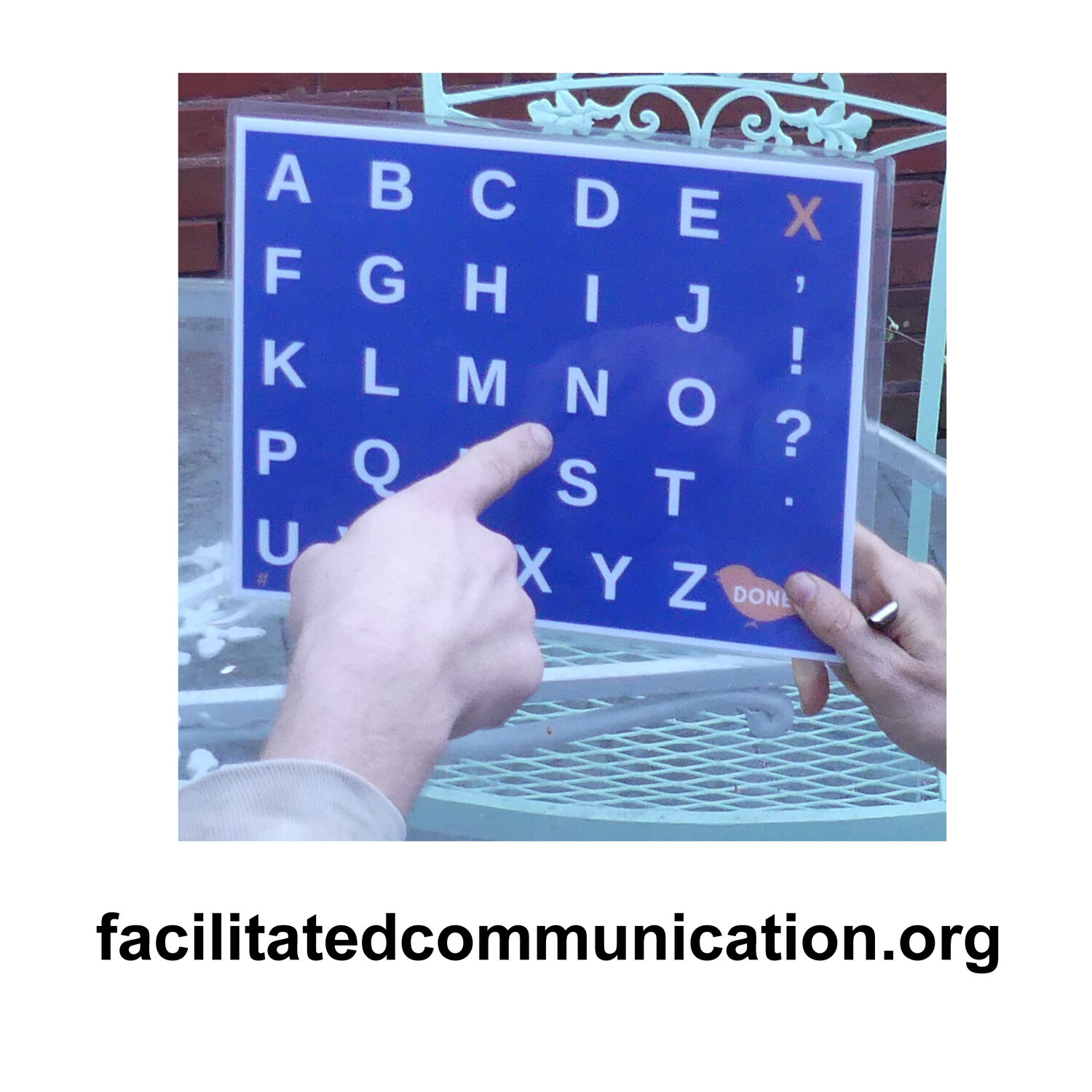
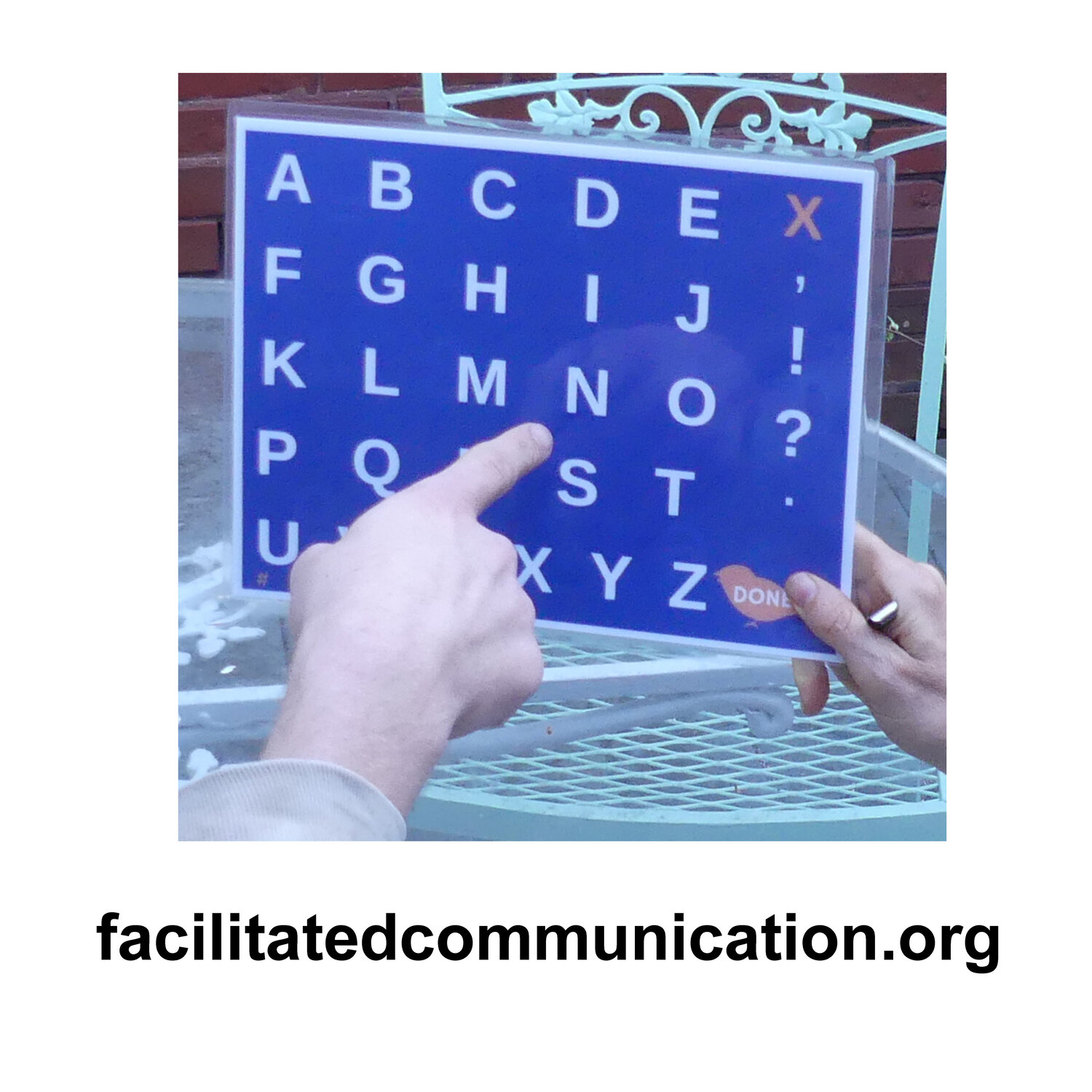
Images of facilitators using FC/S2C/RPM over the years and “supporting” their clients through touch and/or holding the letter board in the air.
Facilitators in the United States from roughly 1990 to 1998, for the most part, voluntarily participated in reliably controlled testing in reaction to questions being raised about facilitator cueing and control. While some of the testing was court ordered in conjunction with false allegations of abuse cases, most of the authorship studies completed during this time were by educators, speech/language pathologists, psychologists and other researchers who were intrigued by FC and its claims of unexpected literacy in people with profound autism and other developmental disabilities. Among the facilitators tested were professionals who had been trained at Syracuse University’s “Facilitated Communication Institute,” so it’s interesting to me when I read proponent claims that people who participated in and failed authorship testing were “poorly trained.” That doesn’t say much for Syracuse University’s FCI training program. (See Prisoners of Silence.)
One way the scientific community keeps track of the progress (or perhaps lack of progress) in the development of experimental or emerging techniques (as was the case with FC in the 1980s and 1990s) is through periodic systematic reviews. The process is arduous and involves collecting authorship studies and other information about a particular topic and analyzing the existing data based on specific inclusionary and exclusionary data. The expectation is that proponents of an emerging or experimental technique would, over time, conduct studies that would either validate their findings or prove them to be insufficient (e.g., not scientifically valid). In the case of FC/S2C/RPM, researchers interested in conducting a systematic review were searching for information that would prove—or disprove—proponent claims of communication independence with facilitator-dependent techniques.
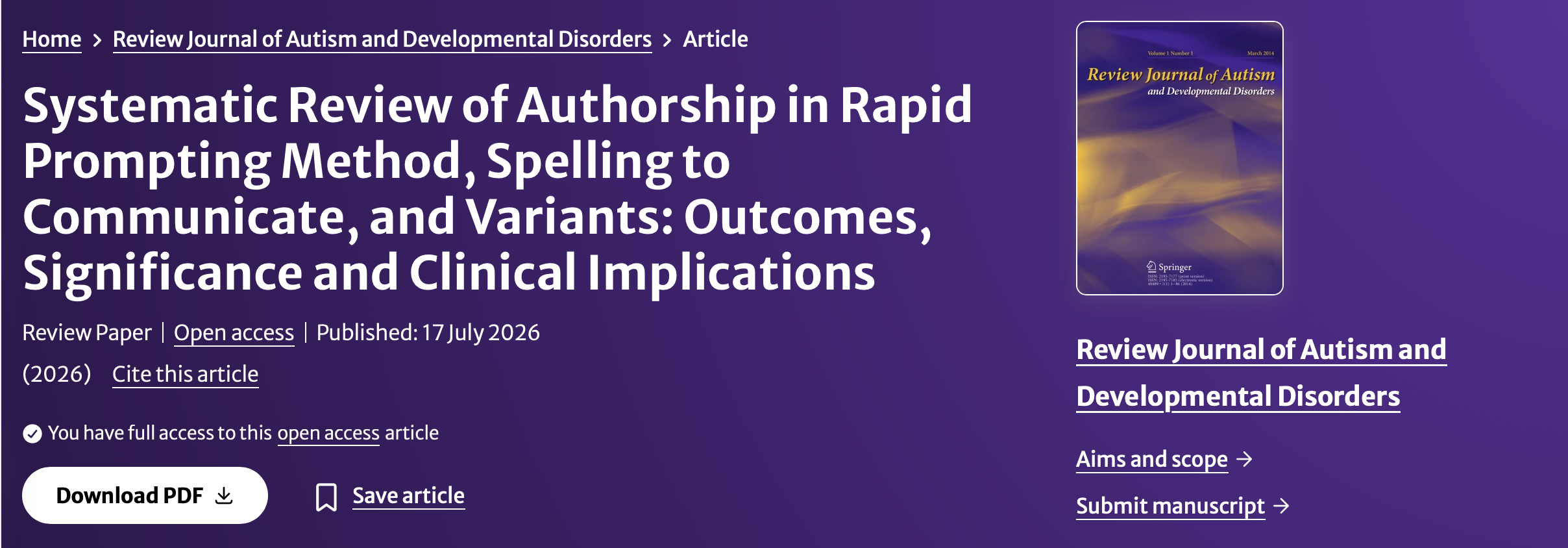
A 2026 systematic review of authorship in RPM/S2C and their variants came up empty and showed there have been no valid authorship studies conducted since the last systematic review conducted in 2019 (which also came up empty).
From as early as 1992 to the present, researchers have consistently raised concerns—based in part on these systematic reviews—about the veracity of proponent claims that facilitator-dependent techniques lead to independent communication. There were enough reliably controlled authorship studies of “old-school,” touch-based FC involving hundreds of facilitator/client pairs with thousands of trials by 2014 to clearly demonstrate that the FC-generated responses were correct only when the facilitators knew the answers. The collective (and replicable) results of these authorship studies lead the scientific community to consider FC thoroughly discredited. Proponents like to blame the American Speech-Language-Hearing Association for this stance, but many organizations have conducted their own studies and systematic reviews that support ASHA’s opposition to the technique. (See Opposition Statements).
Although the scientific community has been satisfied that FC is not a valid communication technique to use with nonspeaking or minimally speaking autistic individuals for decades, proponents have continued to use FC. Their tactic has been to rebrand the technique by using terms like “supported typing,” “saved by typing,” and other pseudonyms.
Perhaps in a natural progression of events, some factions within the FC community wittingly or unwittingly developed so-called “no touch” forms of FC (e.g., S2C/RPM) in response to criticisms about the role of physical touch with the technique. (See my blog post Truth Will Out: Review of Portia Iversen’s “Strange Son”). I’ve also seen these techniques dubbed “modern spelling methods” even though they have roots in traditional touch-based FC.
Rather than participate in reliably controlled authorship studies like their FC-counterparts, proponents of S2C/RPM and their variants have refused to participate in empirical studies designed to rule out facilitator interference. So, when a systematic review was completed in 2019 that included RPM-style forms of FC, the review came up empty, meaning there were no authorship studies to prove or disprove proponent claims of communication independence. (See Schlosser, et al., 2019). As a result of that systematic review, researchers called upon the FC/S2C/RPM community to conduct such testing.
Yet another systematic review of Facilitated Communication was published in July 2026. This time, the authors focused on Rapid Prompting Method (RPM), Spelling to Communicate (S2C), Spellers Method, and their variants. These are forms of FC characterized by the facilitator holding a letter board in the air (rather than holding onto the person’s wrist, elbow, or shoulder) and are, arguably, the most popular forms of FC today. This systematic review also came up empty.
An empty review means that, technically, there are no reliably controlled studies of authorship available to prove or disprove proponent claims of communication independence with RPM-style FC. But that does not mean that the techniques are suitable to use with nonspeaking or minimally speaking individuals. As Schlosser mentioned in a guest blog post recently, empty reviews are not context-free.
Sometimes an empty systematic review means that an intervention (such as a communication system, method or technique) is in the experimental or “emerging” stages of development. In theory, proponents of the target intervention would take the information from the systematic review, which often includes an accounting of the strengths and weaknesses of a particular intervention, and correct the errors. But this is not the case with FC/S2C/RPM.
Proponents have been using S2C and RPM-style FC for decades with very little variance in technique and without any rigorously controlled empirical evidence to back up their claims of communication independence. However, S2C/RPM and their variants share characteristics (namely facilitator cueing and prompt dependency) with the discredited, touch-based form of FC. This raises serious questions about facilitator interference with letter selection.
So, what is going on? Why aren’t there any reliably controlled authorship studies available for review?
Screenshots from FC/S2C/RPM sessions showing facilitator cueing via touch and by holding the letter board in the air.
Note: I’m highlighting some key points from the most recent systematic review, but I encourage you to read the study in full.
By looking at the exclusionary criteria from this current systematic review, we can see that proponents produced plenty of material about RPM-style FC since the last systematic review in 2019—much of it in support of these new “modern” spelling methods. Over 7000 records about S2C/RPM showed up in database searches, but none of the articles qualified as a reliably controlled authorship test. The articles excluded from the systematic review fell into one or more of these categories::
Studies with no participants with communication disabilities
Studies where traditional touch-based FC was used
Studies using RPM-style FC but omitted controls to rule out facilitator interference with letter selection (linguistic or stylistic analysis of FC-generated output)
Studies using qualitative research methods (observations, interviews). These tools are not designed to address facilitator cueing or control
Studies that inferred authorship based on behaviors associated with letter selection (eye movements or finger movements) but did not control for facilitator influence (physical, visual or auditory cues)
Anecdotal reports purportedly written by individuals using RPM-style FC
Anecdotal reports from facilitators, former facilitators, and others (pro or con) sharing their perspectives on the use of FC/S2C/RPM or their variants
Discussion papers, editorials, conference proceedings or abstracts (e.g., non-controlled studies)
Materials available only as video or audio recordings (video or audio recordings can be manipulated to make it seem like the facilitators are not cueing their clients through careful editing or positioning of the cameras)
As I mentioned in my last blog post, I get the sense many proponents (at least the ones who comment on my posts) have a poor understanding of the difference between an anecdote and a reliably controlled study. To them, seeing is believing. And, while anecdotes (e.g., lived experiences) are important, they are not reliably controlled evidence. As the controlled authorship studies of the 1990s proved, facilitators can sincerely believe they aren’t controlling letter selection, when, in fact, they are doing just that.
I hope that by sharing the inclusionary criteria from the 2026 systematic review with proponents they will start to understand the type of information required to meet the standards of a reliably controlled authorship study of FC/S2C/RPM.. All three of the following criteria would be needed to meet this standard:
Studies that report on populations with disability or health conditions associated with communication disabilities (To ensure the target population for FC/S2C/RPM is represented in the review).
Studies that report on the use of RPM-style FC: Rapid Prompting Method, Spelling to Communicate, Spellers Methods or variants—where a letter board or communication device is held by a facilitator or communication partner (To ensure the technique in question is represented in the review).
Studies that employ quantitative experiment designs intended to control for facilitator access to test stimuli (e.g., pictures, objects) and empirically establish who was authoring the spelled messages produced using RPM/S2C and its variants. (To meet the standards of a scientific systematic review).
These empty results of the 2019 and 2026 systematic reviews further raise questions about:
The authorship, agency, and representation of nonspeaking or minimally speaking individuals being subjected to these techniques
The Inherent risks that facilitators are (wittingly or unwittingly) substituting their own voices for those of their clients or loved ones
The erosion of autonomy, dignity, and the right to authentic self-expression of nonspeaking or minimally speaking individuals subjected to these techniques
The ongoing use of techniques which share significant characteristics with touch-based FC and the high-stakes ethical implications of misattributed communication
The growing concern that professionals like Speech/Language Pathologists, Occupational Therapists, certified behavior analysts and others, are using their credentials to give the impression that FC/S2C/RPM are evidence-based techniques, which they are not
The growing concern that professionals tasked with recommending appropriate treatment options to their clients do not understand or care about what constitutes scientifically rigorous, evidence-based Augmentative and Alternative Communication and instead opt for FC/S2C/RPM – techniques that organizations like the American Speech/Language/Hearing Association, the American Association on Intellectual and Developmental Disabilities, the Association for Science in Autism Treatment, and many others oppose. (See Opposition Statements)
Given that the onus is on those promoting FC/S2C/RPM to provide evidence to back up their extraordinary claims, it seems that moving forward parents, educators, and other professionals should:
Avoid adopting RPM/S2C and variants and/or discontinue their use
Be warned that the anecdotal reports of successes with FC/S2C/RPM may or may not reflect the lived experiences of nonspeaking or minimally speaking individuals being subjected to these techniques, and that the only way to determine authorship in facilitator-dependent techniques is through reliably controlled testing.
Conduct reliably controlled testing to address concerns about authorship. Since the FC community seems incapable of monitoring and regulating themselves, perhaps these tests need to be mandatory.
In closing, I don’t know how many proponents of FC/S2C/RPM understand which components make up a reliably controlled study. I suspect that at least the rank-and-file facilitators are just taking on faith the word of whatever the leadership says about authorship testing. But, even so, I have a sense that most, if not all proponents understand on some level what would happen if they participated in such studies. Why else would they so aggressively avoid them?
References and Recommended Reading
Schlosser, R.W., Shane, H., Bryant, L. et al. (2026). Systematic Review of Authorship in Rapid Prompting Method, Spelling to Communicate, and Variants: Outcomes, Significance and Clinical Implications. Review Journal of Autism Development and Disorders. https://doi.org/10.1007/s40489-026-00569-7
Schlosser, R.W., Hemsley, B., Shane, H. et al. (2019). Rapid prompting method and autism spectrum disorder: Systematic review exposes lack of evidence. Review Journal of Autism and Developmental Disorders, 6, 403–412.
Blog posts in this series:
Do proponents know what “reliably controlled testing” for authorship means? (Part 1)