Empty Reviews are not Context-Free: Implications for RPM and S2C
In a recent podcast (“Uniquely Human”), Dr. Prizant suggested that my work on empty reviews is inconsistent: that one cannot draw conclusions in the absence of evidence, yet I discourage the use of RPM/S2C, for which there is currently no evidence. This essay addresses that claim and clarifies how empty reviews should be interpreted in the context of facilitator-dependent techniques.

Image by Sasun Bughdaryan
What are Empty Reviews?
First, we define what we are talking about. A review is considered "empty," when a search to address a well-built research question yields no eligible studies (e.g., Lang et al., 2007; Yaffe et al., 2012).
Empty Reviews in the Context of an EBP Journal
In his argument, Dr. Prizant referred to an editorial in Evidence-Based Communication Assessment and Intervention written by the then-Editors Schlosser and Sigafoos (2009). The purpose of this Editorial was to discuss the role of empty reviews for EBP broadly speaking and particularly for commentary practices as an EBP journal. As Editors we had come across a couple of empty reviews and were wondering whether we should have these appraised and under what conditions. To be clear, the Editorial did not mention FC/RPM/S2C nor did it discuss the role of empty reviews vis-a-vis these practices. It is unclear why this particular editorial was selected, given that it does not address facilitator-dependent techniques directly and that more relevant and recent sources are available.

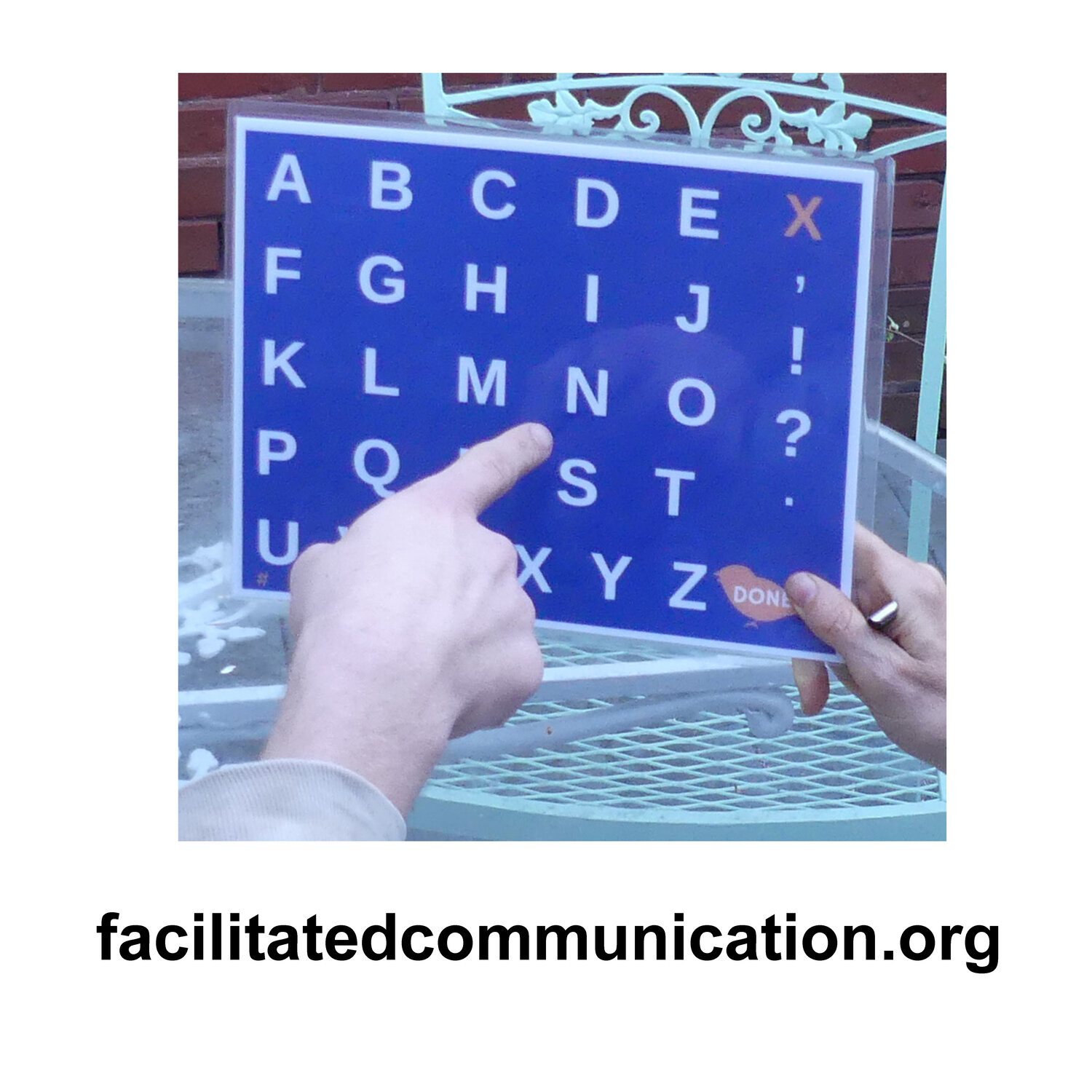
Images of “support” provided by facilitators who promote FC/S2C/RPM
Empty Reviews and Facilitator-Dependent Techniques - Context matters
An international author team from the US and Australia set out to do a systematic review, pre-registered with PROSPERO, on the effectiveness of RPM/S2C, published in the Review Journal of Autism and Developmental Disorders (Schlosser et al., 2019): "No studies met the inclusion criteria, resulting in an empty review that documents a meaningful knowledge gap" (p. 403). We noted that it is quite concerning that there is still no evidence given that many years have passed since the development of RPM. We also noted that an empty review refers to an absence of evidence rather than evidence of absence of an effect. Importantly, an updated pre-registered review, solely focused on authorship, is currently under review. This review also yielded no eligible studies.
By choosing an editorial unrelated to pseudoscience (intentionally or not), the result is that an important nuance regarding the implications of empty reviews was left out from his argument. Although empty reviews are typically interpreted as neutral, such neutrality is not context-free. The key issue is not what an empty review shows, but how it should be interpreted in context.
When adjacent evidence raises credible concerns about harm, the absence of direct evidence does not justify neutrality—it shifts the burden toward precaution.
In the case of RPM/S2C, two critical contextual factors alter that interpretation: (a) compelling evidence from a closely related intervention—Facilitated Communication—demonstrating lack of independent authorship, and (b) the high-stakes ethical implications of misattributed communication. Together, these considerations shift the appropriate stance from neutrality to caution, and ultimately, to non-adoption.
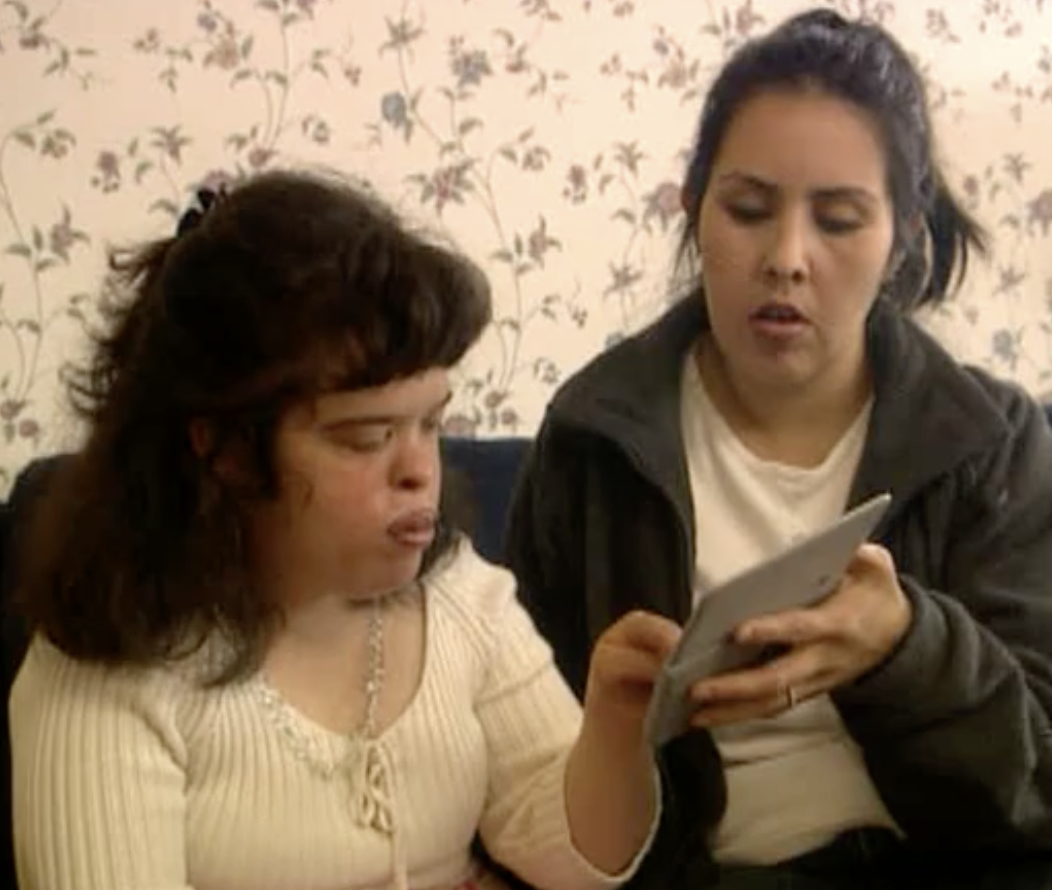
Screenshot from the pro-FC film “Autism is a World” (2004). The filmmakers state the technique used in the film was “facilitated communication,” but it shares characteristics with what is now known as “spelling to communicate” or “rapid prompting method.” All these techniques rely on the “assistance” of facilitators who maintain constant eye contact with the letter board, hold the board in the air and/or control access to it.
Contextual Aspect # 1 - Compelling evidence from a closely related method
Systematic reviews have shown that it is the facilitators who control the messages in FC and not the autistic individual (Hemsley et al., 2018; Schlosser et al., 2014). Although proponents of RPM and S2C often argue that these methods are fundamentally different from Facilitated Communication, multiple authoritative sources suggest otherwise. As Schlosser and Prabhu (2024) note, “there is little that suggests any differences in terms of features that would be critical to the validity of the intervention (i.e., authorship)" (p. 45) and “these facilitator-dependent techniques are prone to the same biases associated with facilitator control. (p. 45).” The American Speech-Language-Hearing Association (2018) similarly warns that messages produced via RPM “should not be assumed to be the communication of the person with a disability,” underscoring persistent authorship concerns. The National Council on Severe Autism (2020) has gone further, explicitly referring to the “striking similarities between RPM and Facilitated Communication.” Mechanistically, critiques have shown that removing physical touch does not eliminate facilitator influence: Beals (2021) argued that the Jaswal et al. (2020) study failed to rule out facilitator influence because the moving display was a fatal flaw and because the design did not adequately test authorship.
Taken together, these sources converge on a central point: the superficial differences between FC and RPM/S2C do not alter the underlying mechanism of facilitator dependence, and therefore do not resolve the fundamental question of authorship.

Screenshot from the film Spellers (2024) where the individual being facilitated is not looking at the letter board while his facilitator holds the board in the air and calls out letters.
Contextual Aspect # 2 - High-stakes ethical implications of misattributed communication
As mentioned earlier, the stakes could not be higher. According to Schlosser and Prabhu (2024), "if we admit the evidence that FC does not provide access to the voice of the person/s purportedly speaking, we would be committing 'epistemic violence' against these persons by continuing these techniques [i.e., FC/RPM/S2C; added by this author]. That is, we might do violence by distorting the will and desire of the very people that we seek to understand and include" (p. 41). In such cases, the error is not merely scientific; it is moral, because it risks substituting another person’s voice for that of the individual.
Related to the notion of absence of evidence, Dr. Prizant criticizes Dr. Shane's stance against RPM/S2C as hypocritical given that he (Dr. Shane), on the one hand promotes the Visual Immersion System (Shane et al. , 2015), for which there is no evidence as a package, while speaking against the use of RPM/S2C, for which there is also no evidence. The authors of the VIS communicated to their readers that the package as a whole had not been tested; they also said that many components of the Visual Immersion System, however, are evidence-based (importantly, preliminary evidence on this package is now available - see Schlosser et al., 2020).
Crucially, the ethical stakes differ in kind. At worst, the use of an unvalidated intervention such as the Visual Immersion System may result in inefficiency or delayed progress. In contrast, the use of RPM/S2C raises the possibility of misattributed authorship, which directly implicates autonomy, consent, and fundamental rights. Thus, this is a false equivalence!
Conclusion
Dr. Prizant's assertions regarding contradictions and hypocrisies related to empty reviews (and lack of evidence) rely more on rhetoric than on full consideration of the issues.
While empty reviews are typically interpreted as neutral in terms of implications for practice, this case is qualitatively different. In such contexts, neutrality is not a defensible default. When adjacent evidence raises serious concerns about authorship and the stakes involve the integrity of a person’s voice, the burden shifts.
Abstaining from judgment is not neutrality—it is acquiescence to risk. The appropriate stance is therefore not indifference, but caution, and ultimately, non-adoption.
In contrast, proponents of RPM/S2C continue to interpret the absence of direct authorship evidence for RPM/S2C as a green light to continue to promote these techniques. "Such a stance is indefensible" (Schlosser & Prabhu, 2024, p. 46). Dr. Prizant's interpretation of the absence of evidence is unfortunately further affirmation of this stance. The onus for establishing proof is with the developers/proponents, at least initially (Schlosser & Prabhu, 2024). When evidence is not available but there are plausible and potentially grave risks and harms, particularly risks to authorship and autonomy, clinicians ought to compensate for this lack of research evidence by collecting data directly with the person and engaging in authorship testing (Schlosser & Prabhu, 2024) rather than hiding behind a misguided interpretation of presuming competence (Tavers & Ayres, 2015).
Guest blog post by
Ralf W. Schlosser, PhD
Schlosser Consulting LLC, Boston Children's Hospital, Northeastern University
References and Recommended Reading
American Speech-Language-Hearing Association. (2018). Rapid Prompting Method (RPM) [Position statement].https://www.asha.org/policy/ps2018-00351/
Beals, K. (2021). A recent eye-tracking study fails to reveal agency in assisted autistic communication. Evidence-Based Communication Assessment and Intervention, 15(1), 46–51. https://doi.org/10.1080/17489539.2021.1918890
Hemsley, B., Bryan, L., Schlosser, R., Shane, H., Lang, R., Paul, D., Banajee, M., & Ireland, M. (2018). Systematic review of Facilitated Communication (FC) 2014-2018 finds no new evidence that messages delivered using FC are authored by the person with disability.Autism and Developmental Language Impairments, 3, 1-8. https://doi.org/10.1177/2396941518821570
Higgins, J. P. T., & Green, S. (Editors) (2011). Cochrane handbook for systematic reviews of interventions Version 5.1.0. The Cochrane Collaboration. Available from http://handbook.cochrane.org. Accessed March 2011.
Jaswal, V. K., Wayne, A., & Golino, H. (2020). Eyetracking reveals agency in assisted autistic communication. Scientific Reports, 10(1), 7882. https:// doi.org/10.1038/s41598-020-64553-9
Lang, A. , Edwards, N., & Fleiszer, A . (2007). Empty systematic reviews: Hidden perils and lessons learned. Journal of Clinical Epidemiology, 60, 595 – 597. https://doi.org/10.1016/j.jclinepi.2007.01.005
National Council on Severe Autism. (2020). Position statement on facilitated communication and rapid prompting method.https://www.ncsautism.org
Schlosser, R. W., Balandin, S., Hemsley, B., Iacono, T., Probst, P., & von Tetzchner, S. (2014). Facilitated communication and authorship: A systematic review. Augmentative and Alternative Communication, 30, 359-368. https://doi.org/10.3109/07434618.2014.971490.
Schlosser, R. W., Hemsley, B., Shane, H. C., Todd, J., Lang, R., Trembath, D., Mostert, M., Fong, S., & Odom, S. (2019). Rapid Prompting Method and autism spectrum disorder: Systematic review exposes lack of evidence. Review Journal of Autism and Developmental Disorders, 6(4), 403-412. https://doi.org/10.1007/s40489-019-00175-w.
Schlosser, R. W., & Prabhu, A. (2024). Interrogating neurotypical bias in facilitated communication, rapid prompting method, and spelling 2 communicate through a humanistic lens.Current Developmental Disorders Reports,11, 41–51.
https://doi.org/10.1007/s40474-024-00296-w
Schlosser, R. W., Shane, H. C., Allen, A., Benz, A., Cullen, J., Chiesa, L., Miori-Dinneen, L., Koul, R., & Pasupathy, R. (2020). Coaching a school team to implement the Visual Immersion System™ in a classroom for children with autism spectrum disorder: A mixed methods proof-of-concept study. Advances in Neurodevelopmental Disorders, 4(4), 447-470. https://doi.org/10.1007/s41252-020-00176-5.
Schlosser, R. W., & Sigafoos, J. (2009). ‘Empty’ reviews and evidence-based practice. Evidence-Based Communication Assessment and Intervention, 3(1), 1–3. https://doi.org/10.1080/17489530902801067
Travers, J., & Ayres, K. M. (2015). A critique of presuming competence of learners with autism or other developmental disabilities. Education and Training in Autism and Developmental Disabilities, 50(4), 371-387.
Yaffe, J., Montgomery, P., Hopewell, S., & Shepard, L. D. (2012). Empty reviews: a description and consideration of Cochrane systematic reviews with no included studies. PloS one, 7(5), e36626. https://doi.org/10.1371/journal.pone.0036626