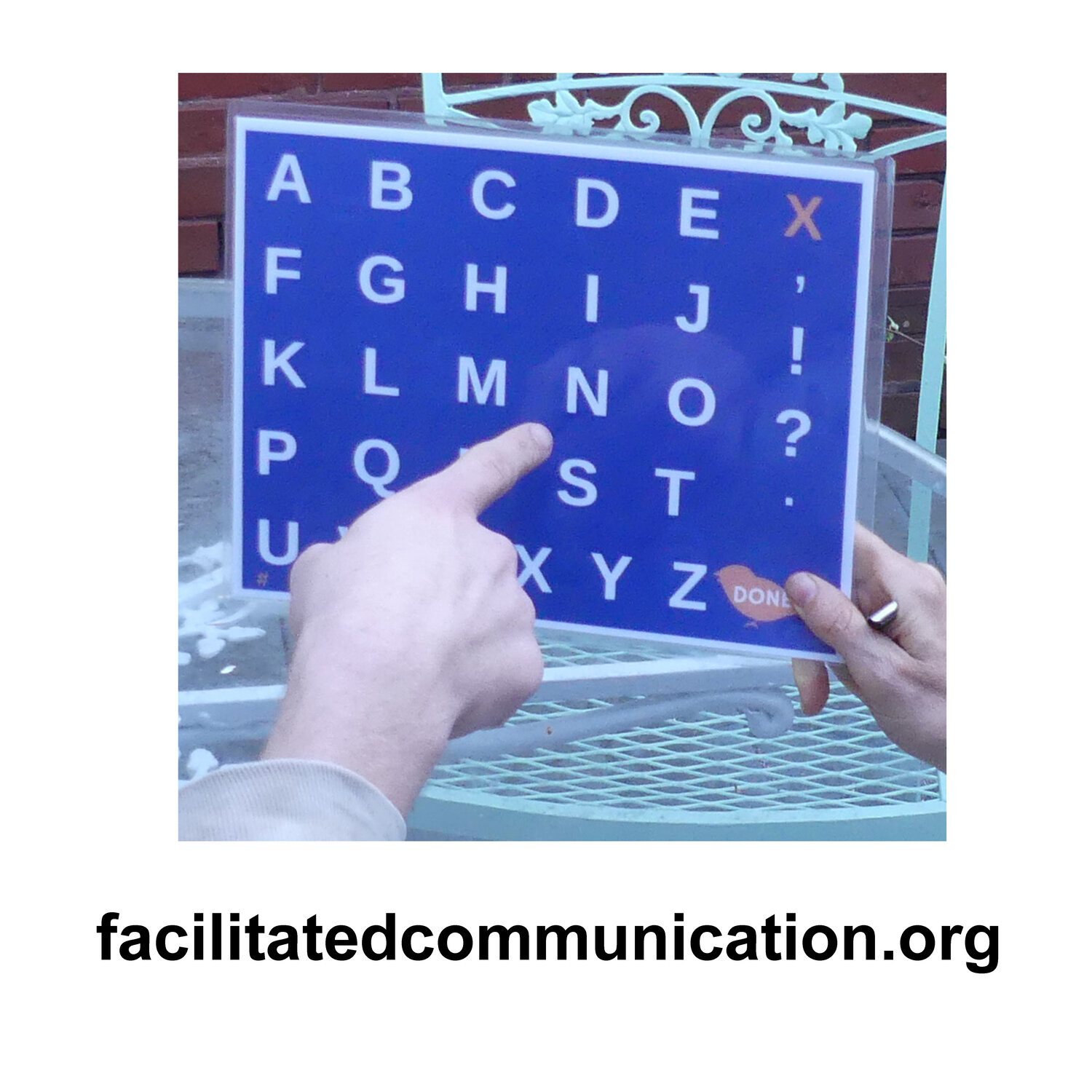
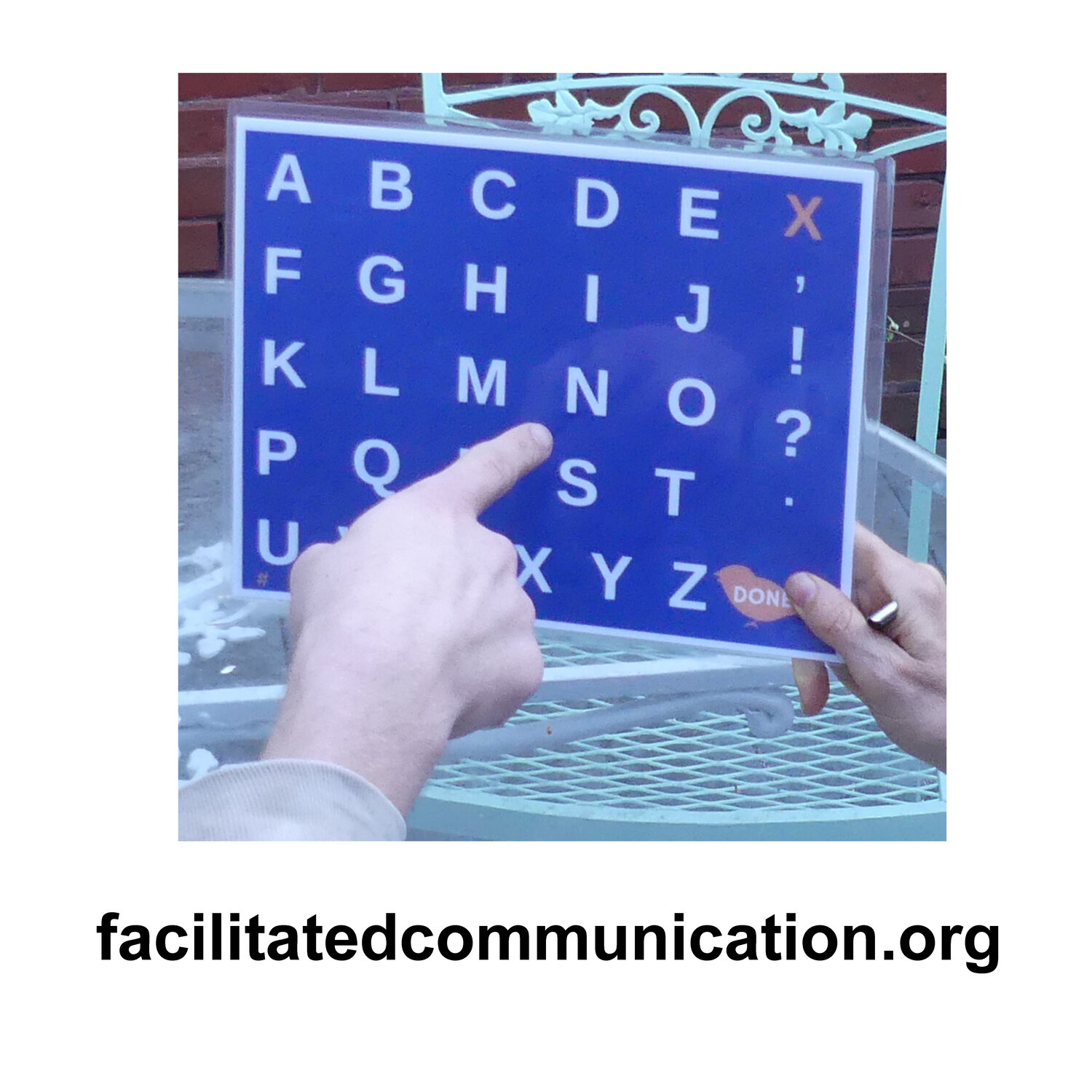
Few topics in disability and communication have generated as much controversy as assisted communication methods such as Facilitated Communication and related approaches including Rapid Prompting Method and Spelling to Communicate. At the center of the debate lies a fundamental question: Who is actually authoring the messages?

A young man extends a hand toward a letter board held in the air by his facilitator, purportedly, to spell out words using RPM/S2C-style FC, but is he looking at the board?. (Screenshot from Spellers 2023)
Over time, the controversy has largely organized itself around two broad camps. One camp believes the communication originates with the disabled individual. The other camp believes the facilitator is the true source of the messages. Within the second camp, however, several distinct explanations may account for how and why facilitator influence occurs.
Understanding these different possibilities helps clarify the discussion. Before I comment on and define the two camps, I want to offer a broader observation that may help frame the discussion. What strikes me is that these two camps are often not just disagreeing about evidence. They are operating from fundamentally different interpretations of what they are seeing and experiencing. Where one group emphasizes authorship, objectivity, and the risk of misattribution while the other emphasizes access, hidden competence, and the moral importance of believing in the individual. Understanding this divide doesn’t resolve it, but it may help explain why conversations around FC and its variants can become so polarized, and why each side often feels that the other is missing something essential.

Dr. Howard Shane from Boston Children’s Hospital conducts authorship testing to determine who is authoring FC-generated messages. In this case, all the FC-generated messages were based on images the facilitator was shown and not the images the student was shown. (screenshot from Prisoners of Silence 1993)
Possibility One: Authorship Originates With the Disabled Communicator
The first position maintains that the words, ideas, and messages produced during facilitated communication originate from the disabled communicator themselves. In this view, the facilitator’s role is primarily supportive rather than directive. The facilitator may provide emotional reassurance, physical stabilization, or help the individual overcome ‘motor planning difficulties’ that interfere with independent typing or pointing. However, proponents of this position maintain that the facilitator does not guide the hand, move the keyboard, select letters, or determine the content of the message. Supporters of this perspective often believe that some individuals with severe communication disabilities possess substantial intellectual, cognitive, and linguistic abilities that are not outwardly visible through speech, behavior, or traditional assessments. According to this view, facilitation simply allows these hidden capacities to be expressed.
If this position is correct, then the sophisticated language sometimes produced through facilitated communication represents the authentic voice and intellect of the disabled individual, finally made accessible with the right support. However, this explanation is widely considered highly unlikely by most researchers who have studied facilitated communication. Across many controlled studies examining methods such as Facilitated Communication, investigators have found that when the facilitator is unaware of the correct information or when independent authorship is tested through message-passing procedures, the resulting communication typically reflects what the facilitator knows rather than what the disabled communicator has seen or been told. In addition, close observation of facilitated encounters frequently reveals subtle cueing or motor guidance that can influence letter selection. For these reasons, the weight of empirical research has generally concluded that the facilitator rather than the disabled communicator is most often the source of the messages.

Researchers at the O.D. Heck Center preparing to conduct reliably controlled authorship testing - among the first tests of its kind in the United States. Here they used a partition to block the facilitator from seeing pictures their clients were shown during the testing. All the FC-generated responses in the study were based on images the facilitators saw, not those shown to the clients. (Prisoners of Silence 1993)
Possibility Two: Authorship Originates With the Facilitator
The second major position holds that the communication produced during facilitated encounters originates from the facilitator rather than the disabled communicator. A substantial body of research examining facilitated communication has repeatedly found that when authorship is tested under controlled conditions, the facilitator often appears to be the source of the messages rather than the person being supported. Researchers have also documented subtle forms of cueing or guidance during facilitated communication sessions that may influence letter selection or typing. Within this position, I believe there are three distinct explanations for why a facilitator may influence communication. At the risk of oversimplifying a complex and emotionally charged issue and recognizing that what I am about to say may not be popular, I want to offer a framework that may help explain some of the differences between the two camps surrounding facilitated communication (FC) and its variants. Again, my intention is not to accuse or diminish the sincerity of individuals involved, but rather to better understand the underlying dynamics that may be at play.
Group 1: Unintentional Facilitator Influence (Ideomotor Effect)
A first possibility is that the facilitator influences the communication without realizing it. This explanation draws on what psychologists refer to as the ideomotor effect, a phenomenon in which subtle motor movements can occur outside conscious awareness. Under this model, facilitators may genuinely believe that the disabled communicator is selecting letters independently, while their own unconscious motor movements subtly guide the typing or pointing process. In this scenario, the facilitator is not intentionally producing the messages. Instead, they are unknowingly influencing the communication through expectation, anticipation, or subtle physical guidance. A 1998 study provides strong support for the unconscious facilitator influence explanation. In that study, all participants (college students trained as facilitators) produced messages they attributed to a non-speaking individual, even though those messages reflected information only they had received. We found that 89% of the responses matched facilitator-only knowledge, and this pattern, along with the correlation to ideomotor test performance, demonstrates that the communication was driven by unconscious facilitator influence (Burgess, C. A., Kirsch, I., Niederauer, K. L., Graham, S. M., Bacon, A., & Shane, H. C. (1998). Facilitated communication as an ideomotor response. Psychological Science, 9(1), 71–74).
Group 2: Conscious Facilitation
A second possibility is that the facilitator knows they are controlling the communication. The motivations behind this situation are difficult to fully understand and may vary widely from case to case. In some instances, the facilitator may believe they are serving a larger purpose by advocating for the communicator or demonstrating hidden abilities. In other situations, the reasons may involve psychological reinforcement, personal beliefs, or dynamics that are not easily explained. While this possibility is uncomfortable to discuss, it remains as a potential explanations when facilitator authorship is questioned.
Group 3: Proxy Authorship Syndrome (PAS)
The third possible explanation involves a dynamic I view as the Proxy Authorship Syndrome (PAS). In this framework, the facilitator may consciously or unconsciously produce the communication attributed to the disabled individual, while deriving psychological reinforcement from the process. The facilitator may experience a sense of recognition, meaning, or even admiration when the communication is perceived as sophisticated, poetic, insightful, or intellectually impressive. Importantly, even when the praise is directed toward the disabled communicator, the facilitator may internally experience that recognition as validation of their own abilities. This may occur because they believe they have uniquely “unlocked” the communicator’s hidden competence or, in some cases, because the output reflects their own intellectual or creative contribution. Over time, this dynamic can become self-reinforcing. The more remarkable the communication appears, the more affirmation is generated, and the less incentive there may be to critically examine questions of authorship. In thinking about this, I am reminded, cautiously, of parallels to what is described in the literature as Munchausen by proxy (more formally, Factitious Disorder Imposed on Another or FDIA). I do not mean to suggest equivalence or intent to harm. Rather, the comparison lies in the psychological mechanism of an adult deriving emotional or psychological benefit through a dependent individual, with that individual serving, in effect, as the vehicle through which needs for recognition, purpose, or validation are met. To be clear, I believe that in many cases this process is not deliberate or deceptive in a conscious sense. Instead, it may reflect a complex interplay of hope, belief, reinforcement, and identity, all factors that can make objective evaluation extremely difficult.
Conclusion: Who Is Really Communicating?
The entire facilitated communication debate ultimately returns to one central question, namely who is really communicating? If the first position were correct, then facilitated communication would represent a profound discovery for it reveals hidden intellectual and linguistic abilities in individuals whose capacities had previously gone unrecognized. Such a discovery would fundamentally reshape how we understand communication in people with severe disabilities.
However, decades of controlled research have repeatedly pointed in another direction. Studies designed to test authorship have consistently shown that when information is known only to the facilitator, the resulting communication reflects the facilitator’s knowledge rather than that of the disabled communicator. Observational analysis has also documented subtle cueing and motor guidance during facilitated interactions. For these reasons, the prevailing scientific conclusion has been that facilitator influence whether intentional, unconscious, or reinforced through psychological dynamics most often explains the messages that emerge in facilitated communication.
This discussion reflects the perspectives of both camps in the facilitated communication debate. One side holds, as a core belief, that the communication is authentic and originates from the disabled communicator, while the other relies on a substantial body of research suggesting facilitator influence. However, it has long been noted that most if not all strong proponents of facilitated communication decline to participate in controlled authorship testing designed to determine who is actually producing the messages. This position makes it effectively impossible to definitively resolve the core or central question and end the decades long debate. Without a willingness to examine authorship through some reliable method, the debate will continue indefinitely. Yet the stakes are not merely academic. Decisions influenced by facilitated communication can carry legal, financial, emotional, and medical consequences. For that reason, determining whether the communication is authentic or influenced by the facilitator remains an essential question before such decisions can responsibly be made.
A simple challenge, therefore, remains open to those who are confident both that the communication is genuinely authored by the disabled communicator and that the standard message-passing procedures are somehow suboptimal: Propose and demonstrate a clear, reliable method for showing that authorship is independent of the facilitator. It is not unreasonable to ask that extraordinary claims be supported by some form of objective verification rather than resting solely on confidence or belief. It is the responsibility of proponents to bring their collective thinking together and work toward a credible, transparent solution to what has now been a decades-long question.
Guest blog post by Howard C Shane, Ph.D. - Harvard Medical School, Boston Children's Hospital, Boston, MA