It’s Not A Matter of “Which Voices”: All Voices Should Be Heard
...but to ensure that all voices are heard, we need to find out who’s doing the talking.
Jennifer Binder-le Pape, perhaps best known in these pages as one of the plaintiffs in the Lower Merion FC (Spelling to Communicate) Court Case, has just published a piece on the I-ASC blog entitled Who Decides Which Voices Should Be Heard? This post is the latest installment in a suite of pieces criticizing the arguments and motives of FC critics. Binder-le Pape’s last post, which I critiqued here, was published nearly three years ago; the one before that, which I critique here, three years earlier, back in 2021.
Originally I was going to quote extensively from Binder-le Pape’s post, but I-ASC, for some reason, makes it impossible to copy text directly from their website. I’ve never seen any other site that responds with the kind of pop-up message illustrated by this screenshot every time you attempt to copy something, and I can’t help wondering what their motives are:

So I’ve decided to paraphrase, condense, and insert everything that’s response-worthy, along with my responses, into tables.
Binder-le Pape’s claims fall into seven categories:
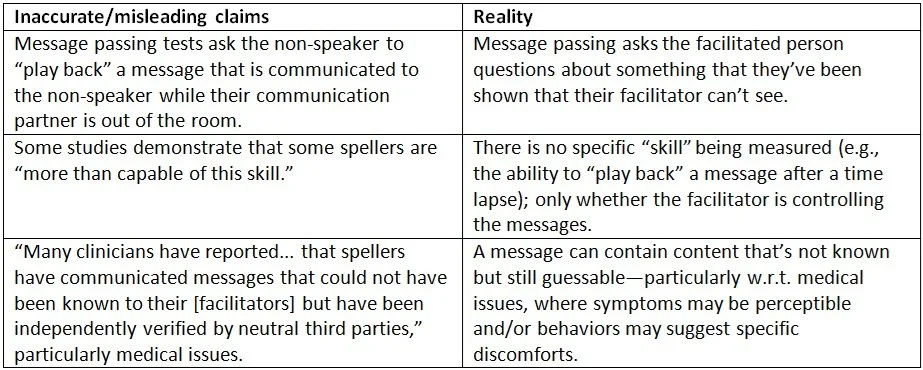
Inaccurate/misleading claims about message-passing tests
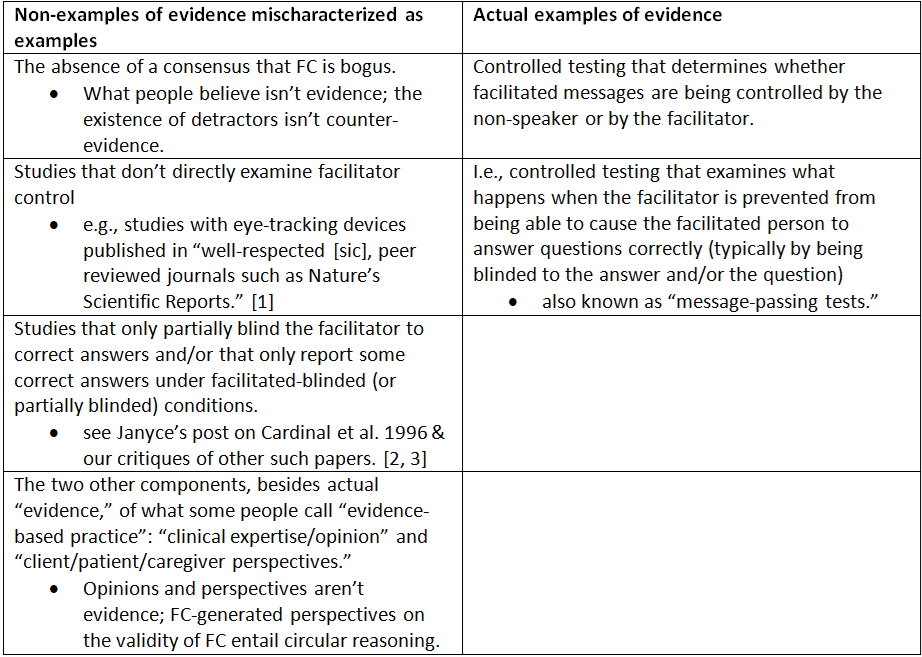
Faulty claims about evidence for FC
Faulty rhetoric
Misconceptions about FC-related harms
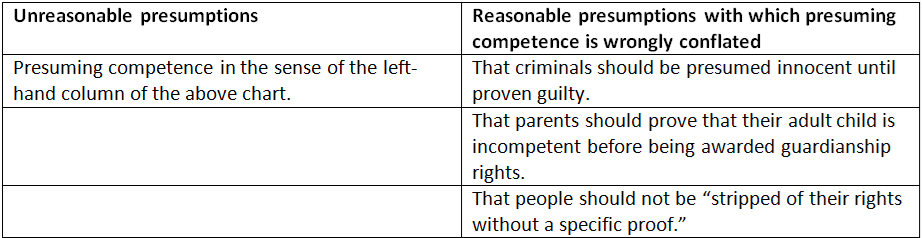
Conflating unreasonable and reasonable presumptions
Reasonable-sounding demands that aren’t reasonable
False accusations against skeptics
For each of these, I’ve made a table. S2C promoters are invited to read, carefully, the rebuttals in the right-hand columns and to actually engage with those rebuttals going forward.
Inaccurate/misleading claims about message-passing tests
Faulty claims about evidence for FC
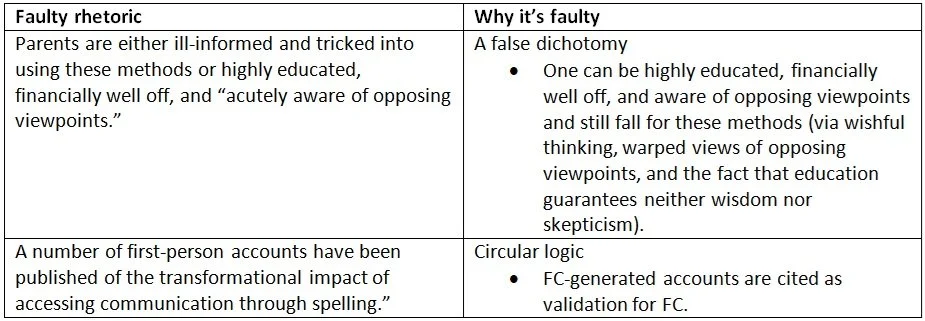
Faulty rhetoric
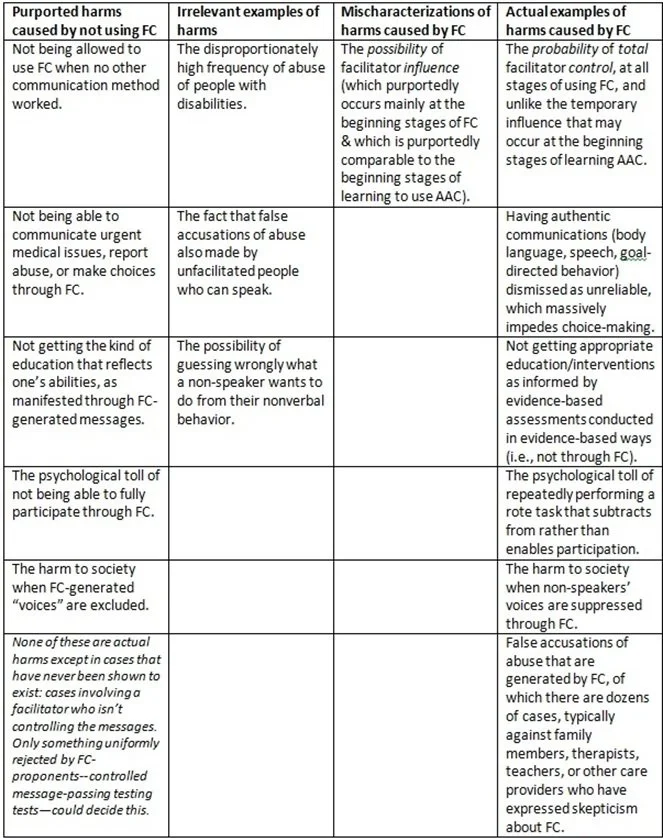
Misconceptions about FC-related harms
Conflating unreasonable and reasonable presumptions
The unspoken presumption here is the “presumption of competence” that has become practically synonymous with accepting FC on face value. So here’s a chart I published earlier on reasonable and unreasonable presumptions:
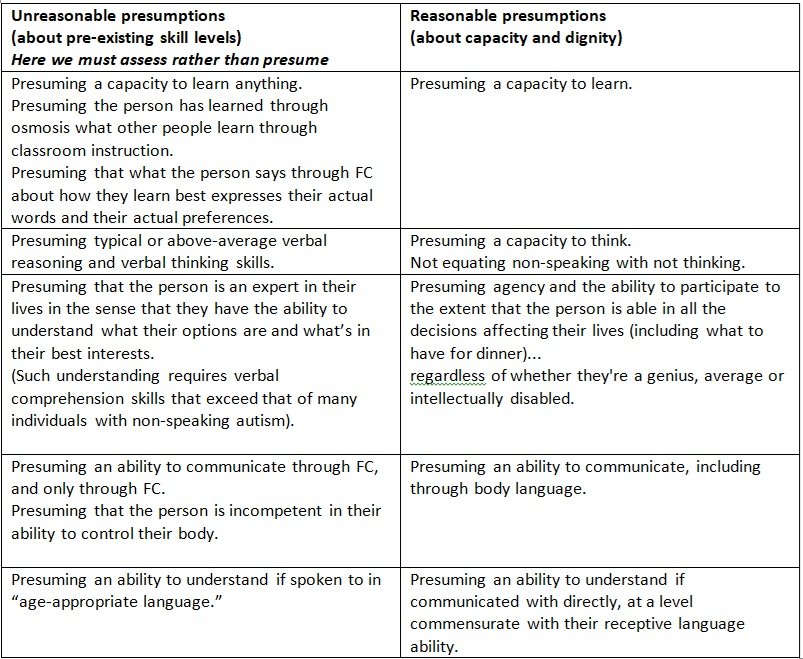
Some of the material in the left-hand column comes from recent statements made by Binder-le Pape that I addressed in an earlier blog post.
In her I-ACC post, however, Binder-le Pape does not spell out what she means by presume competence; that doesn’t stop her, however, with conflating it with a different set of reasonable assumptions.
Reasonable-sounding demands that aren’t reasonable
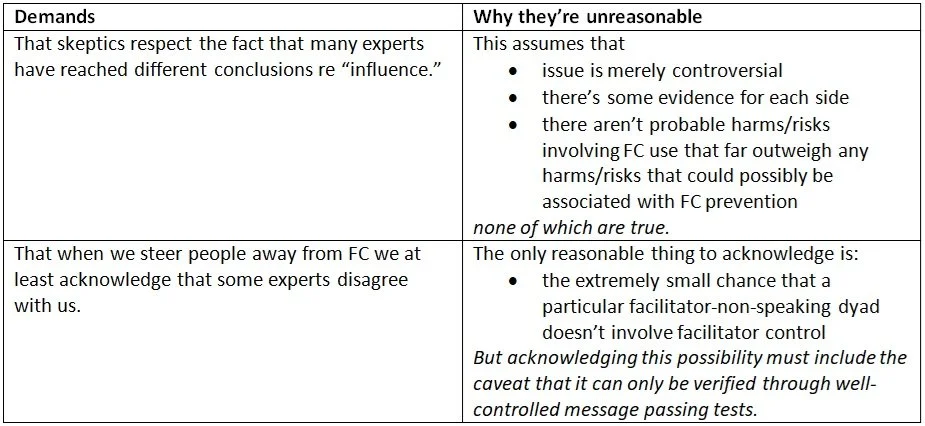
False accusations against skeptics
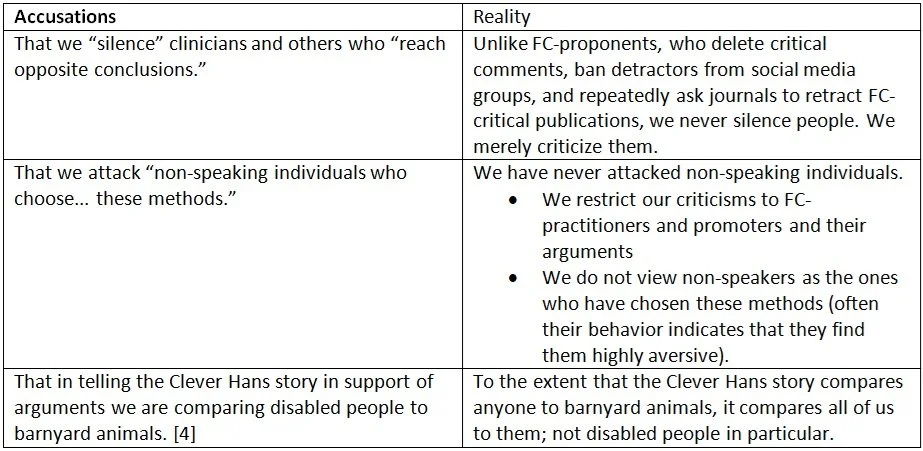
Again, S2C promoters are invited to read, carefully, the rebuttals in the right-hand columns and to do something they haven’t yet done: actually engage with these rebuttals.
END NOTES
1. On the reliability of Scientific Reports: https://retractionwatch.com/category/by-journal/scientific-reports/
2. Janyce’s post on Cardinal et al. 1996: https://www.facilitatedcommunication.org/blog/does-cardinal-hanson-and-wakehams-1996-study-prove-authorship-in-fc-part-1
3. Location of our critiques of studies of occasional message-passing success under conditions in which facilitators are not fully blinded: https://www.facilitatedcommunication.org/critiques-of-pro-fc-articles
4. On how the Clever Hans Effect extends from horses to humans: https://en.wikipedia.org/wiki/Clever_Hans
