Does Cardinal, Hanson, and Wakeham’s 1996 Study Prove Authorship in FC? Part 1 (Rudimentary Information)
Today’s blog post is the first in a series featuring a 1996 article titled “Investigation of authorship in facilitated communication.” The article was sent to us by an FC proponent (thank you!) as “proof” that FC is a valid and independent form of communication. This study by Donald Cardinal, Darlene Hanson, and John Wakeham is included on many of the pro-FC websites we’ve looked at and is listed on our website in at least two places (see Systematic Reviews and Critiques of Pro-FC Articles). In fairness to the reader, I have reread the study and offer my critiques here just as I would any other article.

“Touch-based” FC: The facilitator holds the child’s hand and types out answers to a math problem while the student looks somewhere off camera. (Prisoners of Silence, 1993)
First, let’s take a quick look at the authors of this study. Darlene Hanson appears on a Syracuse University Master Trainer’s list that, until around the beginning of 2020, was posted on the Facilitated Communication Institute (FCI) website. The FCI was renamed the Institute for Community Inclusion around 2010 and was later rebranded as Inclusion and Communication Initiatives. (See my blog post here). The master trainers list no longer appears on the website.
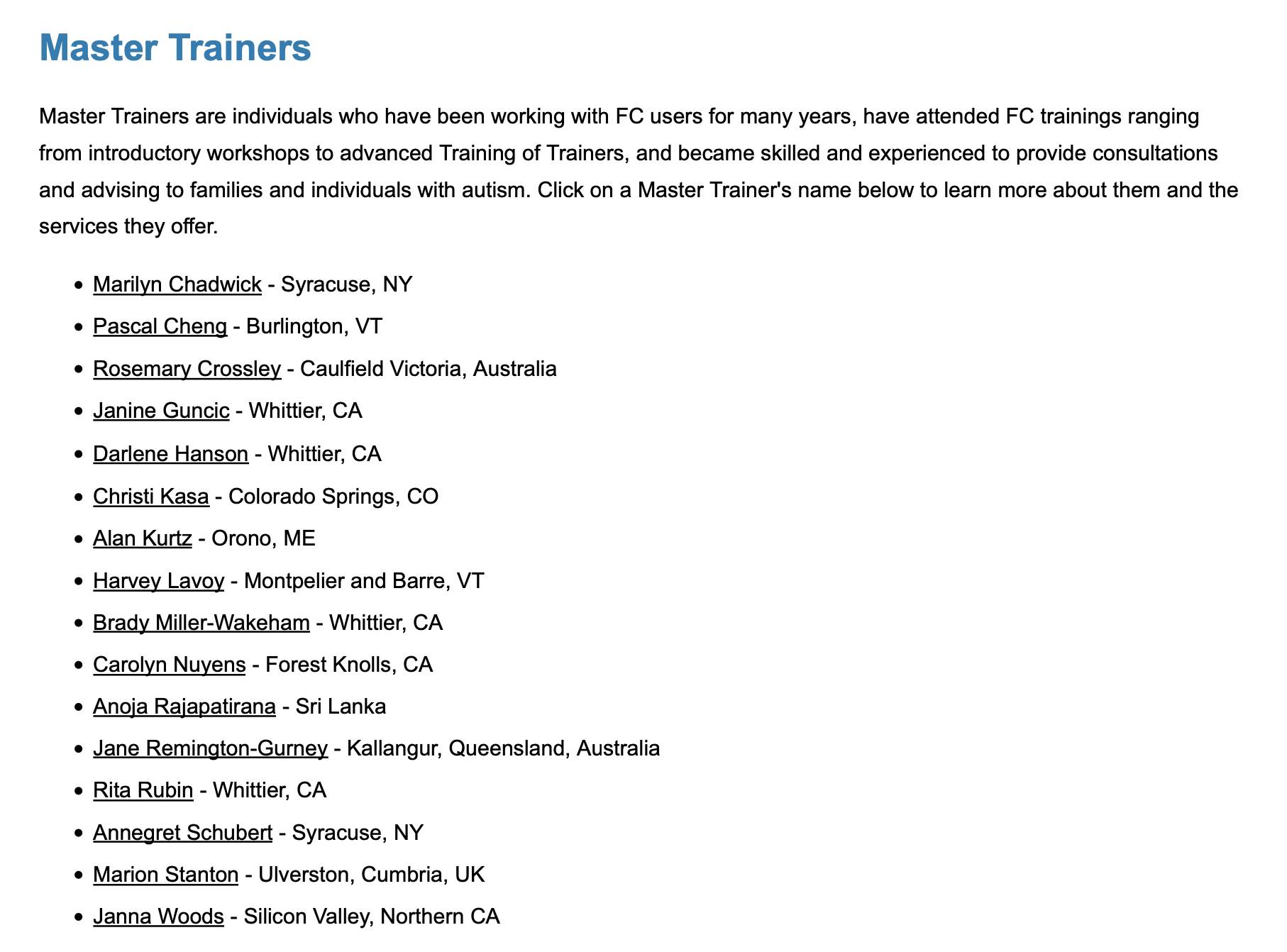
Syracuse University’s “Master Trainers” list - Image from the university website circa 2019(?)
Hanson received a master’s degree at Whittier College and a Bachelor of Arts from Chapman College, both in Communication Disorders. I believe she was once a member of the American Speech-Language-Hearing Association (ASHA) and held a Certificate of Clinical Competence (known as CCCs). Although I do not believe she is currently a member of or certified by ASHA. That may be a personal choice, since ASHA opposes the use of FC. I believe Hanson continues to practice speech/language therapy as indicated on this bio page from a website called The Autism Community in Action (TACA).
Donald Cardinal, at the time of the 1996 study, was a professor of special education at Chapman University. He “discovered” FC after seeing the technique being used on Sue Rubin, who was featured in a pro-FC film called “Autism is a World” (See Katharine’s review of the film here). Despite evidence against the technique, Cardinal viewed FC as a “social justice issue” and co-presented workshops with FC founder Douglas Biklen of Syracuse University (Di Rado, 1994). In 1997, Cardinal and Biklen edited a pro-FC book called Contested Words, Contested Science, which I reviewed in an earlier blog post. Cardinal also co-wrote an article in 2014 with Mary Falvey called “The Maturing of Facilitated Communication: A Means Toward Independent Communication.” In a personal email with Cardinal in November of 2025, I learned he is now retired and is Professor Emeritus from Chapman University, Dean Emeritus from Attallah College of Educational Studies, and Leadership Coach at Thompson Policy Institute on Disability. All indications from the email exchange we had are that he still believes in FC.
I could not find much information about John Wakeham, except that he assisted Cardinal and Hanson with their investigation of FC. If anyone has additional information about Wakeham, please let me know.
In this study, Cardinal et al. chose forty-three “severely handicapped” students and 31 facilitators to participate in a six-week study to see if the FCed individuals could “transmit rudimentary information” in the form of single-word answers to a “naïve” facilitator (or a facilitator who is “blinded” from the content being explored during testing). The number of participants (43), facilitators (31), and trials in the study (approximately 3800) seems to appeal to proponents and may, in part, be why this study is popular among those who support FC.
But “transmitting rudimentary information” is an odd way to describe what should be occurring in an independent spelling session. The form of FC Cardinal et al.’s facilitators used in their study was touch-based. With this form of FC, facilitators are tasked with “supporting” participants physically and emotionally during letter selection without interfering in the participants’ independent production of spelled words. If FC was a legitimate form of Augmentative and Alternative Communication (AAC), there shouldn’t be any “transmission” of anything. Participants would type out their own thoughts directly onto a keyboard or letterboard without any interference (in the form of physical, visual, or auditory cues) from the facilitator. And, unless facilitators (erroneously) believe FC works via telepathy or psychic powers, their role isn’t to “transmit rudimentary information” but to hold their clients’ wrist, elbow, shoulder, or other body part so the client can type—supports that can just as effectively be provided without human touch.
Note: I asked Cardinal about his thoughts regarding telepathy claims and FC. His response was that FC works by trust and that the claims of telepathic abilities in FCed individuals “wasn’t his cup of tea.”

A facilitator tugs at her client’s shirt sleeve during “touch-based” FC and claims the communications are “independent”. (Image from Prisoners of Silence, 1993)
Cardinal et al. mentioned in their 1996 report that they were aware of numerous reliably controlled studies refuting proponent claims that FC is an independent form of communication (see links to these studies below). Further, Cardinal et al. were aware that the controlled studies raised concerns about authorship. In the email exchange, Cardinal claimed that his study was not intended as an authorship study, but in the journal article, the authors’ stated goals were:
to develop a protocol that controlled for variables that could threaten the study’s validity (e.g., “blind” the facilitator);
to allow participants to communicate their thoughts without over-controlling the situation and jeopardizing the user-facilitator relationship; and
to promote a “naturally” controlled environment during testing.
For me this raises a question. If the study was not an authorship study, then why blind the facilitators during the testing? In designing the study, Cardinal et. al seemed to have an awareness that the FC-generated messages should be controlled somehow, but perhaps didn’t understand (or didn’t want to understand) the importance of limiting facilitators’ behaviors when establishing communication independence. As the reliably controlled studies of the early 1990s showed, when facilitators are blinded from test stimuli (e.g., words, pictures), the FC-generated messages are 1) unintelligible (e.g., the individual being facilitated does not know how to spell) or 2) spelled correctly but incorrect in terms of identifying target words or pictures (e.g., facilitator guesses).
For their authorship study, Cardinal et al. designed the following conditions or “controls”: Baseline 1, Facilitated Condition, and Baseline 2. Baseline 1 and Baseline 2 were conducted 6 weeks apart with the practice “facilitated” condition in the middle.
Baseline 1
Under this condition, participants were shown a word on a flashcard, told what the word was (and its meaning) and then asked to independently spell the word without the visual reference. Presumably, this activity established each participants’ ability to spell words from memory and without physical touch from the facilitator. However, the facilitator was present during the spelling session and, it appears, the tests did not control for visual or auditory cueing.
Each of the 43 participants had the opportunity to spell out a total of 10 words (or “trials”) conducted on two separate days with 5 trials each session. Participants completed a combined total of 430 trials.
Cardinal et al. did not disclose in their report the total number of correct or incorrect responses for the 430 trials but did report that none of the participants who were chosen for the study had a score of more than one in five correct words in the Baseline 1 condition.
When I asked Cardinal about the exact numbers of correct responses vs. incorrect responses in each of the trials, he told me that a lot of data had been omitted from the published version of the study. He was sure they had those numbers at the time, but was unable to provide me with any of the omitted data (including how many correct responses there were in each of the trials).
We can’t know for sure from the data presented in the study, but If each of the 43 participants correctly spelled 1 words out of 5 in two separate sessions (or 2 words each participant), then there would be 86 correct responses out of 430 (or 20%). Of course, this number would be less than 20% if not all participants could spell out the target words independently and without physical touch as required by Baseline 1. This percentage seems remarkably low, considering facilitators reported that the participants were using FC “successfully” to complete coursework in their regular educational programs.

Here, Sue Rubin is being facilitated by a facilitator who holds the letter board in the air in the 2004 film “Autism is a World.” It’s difficult to tell from this image if Rubins is actually looking at the letter board, but, in a hallmark characteristic of FC (in any form), her facilitator is. The filmmakers referred to this as “Facilitated Communication” although it has a remarkable likeness to the so-called “no touch” forms of FC. Rapid Prompting Method (RPM) was brought to the United States by Soma Mukhopadhyay around 2001. The other forms of no-touch FC followed (e.g., Spelling to Communicate, Spellers Method). Could “Autism is a World” mark the transition between touch-based and no-touch forms of FC?
Facilitated Condition
Under this condition, participants were shown a word on a flashcard by a “recorder.” The recorder showed the participant the flashcard, said the word aloud, and explained its meaning before setting the card aside (face down and out of visual range). The recorder then invited the facilitator into the testing room where the two (facilitator and participant) were asked to spell the word as seen on the flashcard. The recorder was responsible for writing down the words called out by the facilitator during letter selection. Besides blinding the facilitator from the test stimuli (e.g., target word), there was no documented attempt to control for visual or auditory cues by the recorder.
According to my calculations, each of the 43 participants had the opportunity to spell out 5 words (or “trials) in three separate sessions per week (5 trials per session) for six weeks. That means there were 90 trials per participant (15 trials per week times 6 weeks) for a total of 3870 trials.
Cardinal et al. reported that 70 of the trials were eliminated because of inaccuracy of data collection and/or failure to use the proper technique for random word selection. The total number of trials in the Facilitated Condition was, presumably, 3800.
Note: in their report, Cardinal et al. sometimes stated there were “more than 3800 trials.” Sometimes they referred to the total as “approximately 3800 trials.” For this review and for the sake of consistency, I will be using 3800 trials to discuss test results based on the narrative in the report as I’ve explained above.
Like in Baseline 1, the researchers failed to report the number of correct vs. incorrect responses per testing session in this, the “facilitated condition” and I continue to wonder why the authors obscured the actual numbers in their reporting. If, as Cardinal claims, there were problems with the published version of the study why didn’t the authors clarify this point at a later date? The database search I conducted came up empty. And, as I stated earlier, Cardinal was unable to provide me with the information when I asked in my 2025 email exchange with him.
My understanding is that this 6-week facilitated condition was meant as practice for the participants. I’m not sure what the lesson was if the facilitators were not teaching their clients the vocabulary words used in the test (or other literacy skills, like letter recognition and grammatical structure). It seems that the only reliable skill that could come from this exercise was learning to point to a letter board on cue.
Baseline 2.
This condition, conducted after the first two conditions were complete, was identical to Baseline 1 in that facilitators were present when participants were asked to spell out target words, but did not physically touch the participants. The purpose of this condition was to determine if there were any changes to the participants’ ability to spell out words independently and without physical assistance from a facilitator after the 6-week facilitated condition. For me, this raises a couple questions:
1) If the number of correct responses were not recorded by the researchers, how could they compare responses from Baseline 1 to Baseline 2 after the 6-week interim?
2) if there was any change in participants’ ability to spell (memorized) words correctly, how could they determine whether it was the 6-week “practice” period using FC that caused the changes or other factors not related to FC (e.g., maturity, class or home instruction).
As with Baseline 1, each of the 43 participants had the opportunity to spell out a total of 10 words (in two separate sessions of 5 trials each) for a total of 430 trials.
Note: A caption under Figure 2 in their report indicated that only 41 of the participants completed Baseline 2, but this was not clearly spelled out in the body of the report. The numbers, then should be adjusted to 41 participants, 10 words/trials, two sessions of 5 trials each for a total of 410 trials.
As with Baseline 1 and the Facilitated Condition, the researchers failed to report the number correct out of the 410 trials. Instead, they reported the mean percentage of change from Baseline 1 to Baseline 2. Without the exact numbers scored as correct, it's difficult to figure out on what numbers the authors are basing their findings.
At face value, the structure of this study seems reasonable. In fact, the study shares some commonalities with the reliably controlled studies we have listed on our website, but two major problems arise that make the study results questionable:
The researchers opted to include percentages of correct or incorrect responses in their charts instead of actual numbers of correct vs. incorrect responses, making it difficult to analyze the test results. I wonder, for example, how they were able to compare Baseline 1 responses to Baseline 2 responses if they didn’t have an exact word count? It seems to me that by using percentages instead of actual word counts (correct v. incorrect responses), the authors obscured the results and, perhaps, made the study sound more successful than it was.
Despite the stated intent of the researchers to blind facilitators from the word list used as test stimuli in the study, they gave facilitators open access to it. In his email exchange, Cardinal claimed that the study was never intended to be an authorship study. According to him, the intent of the study was to see if practicing spelling using FC would increase participants’ ability to spell independently (e.g., without facilitator influence or control). If true, then why give the pretense of blinding the facilitators? Why not be open about the fact that, during each of the conditions, facilitators were given access to the word list and that, in the facilitated condition, the facilitators were physically cueing their clients during spelling? And,
Why call the study “An investigation into authorship in facilitated communication?” if authorship wasn’t the primary goal of the study? In the brief email exchange I had with him, Cardinal claimed that the study was never meant to be an authorship study, but I couldn’t find any follow-up to this study where Cardinal or his co-authors disputed the claims. If his work was being misrepresented by the FC community (it’s among the most frequently cited studies on pro-FC websites), then it seems to me he’d want to clarify his position in subsequent articles.
If, as Cardinal et al. would like people to believe, participants can achieve independence with spelling with only six weeks of practice (and no instruction by the facilitators), then why have individuals with profound autism been subjected to their facilitators’ “support” for 20+ years? (FC doesn’t “work” unless the facilitators are within physical, visual, and auditory range). To date, I have yet to find standardized protocols for fading facilitator support (including physical, visual, and auditory cues) in the pro-FC literature.
In my next blog post, I will explore whether Cardinal et al.’s facilitators were truly blinded from test stimuli (e.g., the word list) and how loosening of controls (whether by mistake or by design) when it comes to facilitator behaviors raises serious concerns about the validity of this authorship test.
References and Recommended Reading
Controlled Studies
Systematic Reviews
Opposition Statements
Auerbach, D. (2015, November 12). Facilitated communication is a cult that won’t die. Slate.
Bligh, S., & Kupperman, P. (1993). Evaluation procedure for determining the source of communication in facilitated communication accepted in a court case. Journal of Autism and Developmental Disorders, 23, 553-557. DOI: 10.1007/BF01046056
Di Rado, Alicia. (1994, December 11). The Sunday Profile: Justice for All: Don Cardinal is passionate in his belief that facilitated communication markedly improves the lives of the autistic. And he’s standing firm even as criticism mounts.” Los Angeles Times.
Hemsley, B., Shane, H., Todd, J.T., Schlosser, R., and Lang, R. (2018, May 22). It’s time to stop exposing people to the dangers of facilitated communication. The Conversation.
Hudson, A., Melita, B. and Arnold, N. (1993). Assessing the validity of facilitated communication: A case study. Journal of Autism and Developmental Disorders, 23, 165-173. DOI: 10.1007/BF01066425
Jacobson, J.W., Mulick, J.A., and Schwartz, A.A. (1995, September). A history of facilitated communication: Science, pseudoscience, and antiscience. Science Working Group on Facilitated Communication. American Psychologist. 50 (9), 750-765.
Kezuka, E. (1999). Review of (ed.) D. Biklen & D. N. Cardinal, Contested Words Contested Science: Unraveling the Facilitated Communication Controversy. Autism, vol. 3, 205- 207.
Klewe, Lars. (1993). Brief report: An empirical evaluation of spelling boards as a means of communication for the multi-handicapped. Journal of Autism and Developmental Disorders. Vol. 23 (3). 553-557. DOI: 10.1007/BF01046057
Lilienfeld, S., Marshall, J., Todd, J., & Shane, H. (2014). The persistence of fad interventions in the face of negative scientific evidence: Facilitated Communication for autism as a case example. Evidence-Based Communication Assessment and Intervention, 8(2) 62-101. https://doi.org/10.1080/17489539.2014.976332
Montee, B. B., Miltenberger, R. G., & Wittrock, D. (1995). An experimental analysis of facilitated communication.Journal of Applied Behavior Analysis, 28, 189-200.
Moore, Donovan and Hudson. (1993). Brief report: Facilitator-suggested conversational evaluation of facilitated communication. Journal of Autism and Developmental Disorders. Vol 23 (3); 541-552. DOI: 10.1007/BF01046055
Mostert, M. (2010). Facilitated communication and Its legitimacy — Twenty-first century developments. Exceptionality: A Special Education Journal, 18 (1), 31-41. DOI: 10.1080/09362830903462524
Mostert, M. (2001, June). Facilitated communication since 1995: A review of published studies. Journal of Autism and Developmental Disorders, 31 (3), 287-313. DOI: 10.1023/A:1010795219886
Wheeler, DL, Jacobson, JW, Paglieri, RA, and Schwartz, AA. (1993). An experimental assessment of facilitated communication. Mental Retardation. Vol 31 (1), 49-60.
Facilitated CommunicationauthorshipDonald CardinalDarlene HansonJohn WakehamSyracuse UniversityFacilitated Communication InstituteChapman UniversityDouglas BiklenContested Words Contest Sciencemessage-passingcontrolled studiescontrolled testingblind testing
Blog posts in this series (Links will be added once the blog posts are published)
Does Cardinal, Hanson, and Wakeham’s 1996 Study Prove Authorship in FC? Part 2 (Test Design)
Does Cardinal, Hanson, and Wakeham’s 1996 Study Prove Authorship in FC? Part 3 (Competing for words)
Does Cardinal, Hanson, and Wakeham’s 1996 Study Prove Authorship in FC? Part 4 (Facilitator Behaviors)
Does Cardinal, Hanson, and Wakeham’s 1996 Study Prove Authorship in FC? Part 5 (What FCed Errors Tell Us about Facilitator Influence)