Today’s blog post is the third in a series exploring when the FC leadership became aware of the significant (and fatal) flaws in their technique (e.g., facilitator cueing and control over letter selection). I’ve been using a May 1993 newsletter article published by Syracuse University’s Institute on Communication and Inclusion titled “Issues of Influence: Some Concerns and Suggestions” as a jumping off point for this discussion. Specifically, I’ve been using the references cited in the newsletter to explore the veracity of their statements. Links to prior blog posts in this series are listed below.

I’m taking a slight detour away from the newsletter in this blog post to discuss a 1992 Cummins and Prior article titled “Autism and Assisted Communication: A Response to Biklen.” This critical article was not listed as a reference in the newsletter.
Cummins and Prior seemed to have inside knowledge about an investigation by Australia’s Intellectual Disabilities Review Panel (IDRP) into the use of facilitated communication (discussed in my last blog post).
As a quick recap, the IDRP was tasked with investigating extraordinary claims of success with FC made by its founder, Rosemary Crossley of the DEAL Centre in Melbourne, Australia, as well as growing concerns about false allegations of abuse cases brought against family members of clients being subjected to the technique, including Crossley and eight of her trained facilitators. (See Paul Heinrich’s coverage of the “Carla” case in the false allegations of abuse section of our website).
I find it quite shocking to learn just how much the leaders of FC (and the researchers conducting the reliably controlled testing) knew about facilitator cueing and control in the late 1980s to early 1990s—perhaps even earlier than that.
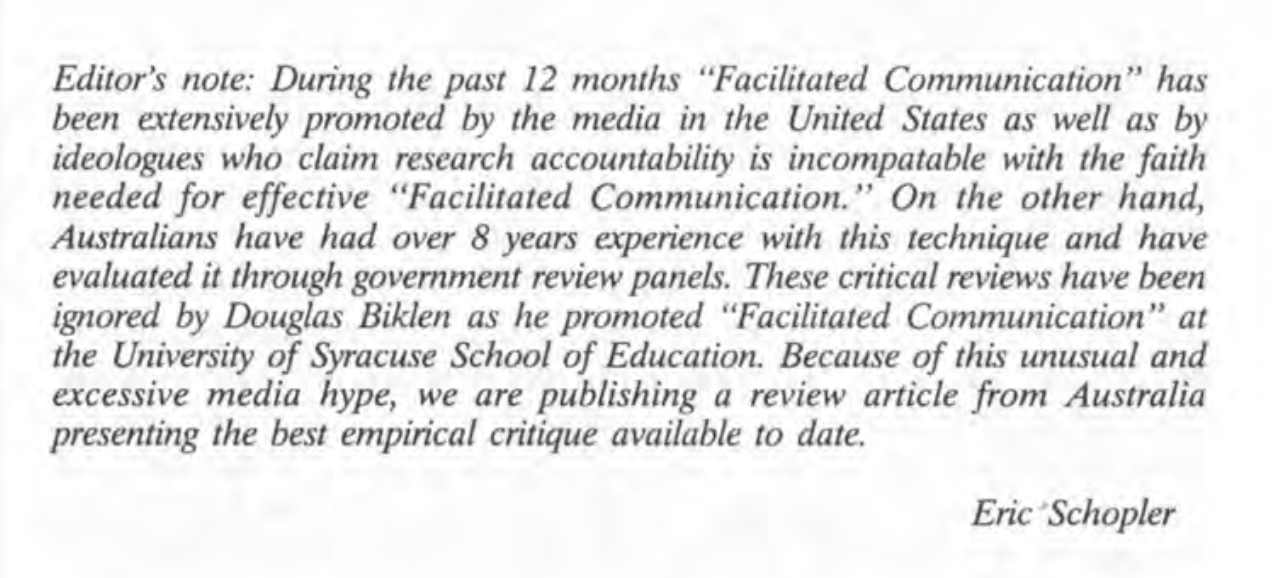
Editor’s note from the 1992 Cummins and Prior article titled “Questions About Facilitated Communication and Autism” indicating that Douglas Biklen, founder of Syracuse University’s Facilitated Communication Institute, ignored critical reviews about FC while heavily promoting the technique in the United States.
The ICI newsletter acknowledged the “experimental studies” that clearly demonstrated facilitator influence over letter selection. The ICI even admitted in the newsletter that such studies “abound” (their word, not mine). But then the (unnamed) author of the newsletter tempered the scientific evidence and misled the ICI’s readers by telling them that facilitator influence only occurred “sometimes” and under “constrained conditions.” That’s not what the testing showed. The testing showed that none of the facilitated responses in the reliably controlled studies were independently produced by those being subjected to FC.
In other words, the ICI candy coated the results of the early authorship studies and gave their readership the impression that independent communication via FC was not only possible but proven in their own research and autobiographical documents.
I understand that newsletters are designed to build brand loyalty. The choices the ICI made in 1993 to include or exclude certain references demonstrates how adept the ICI was at downplaying issues with facilitator influence and control over letter selection and building a base of FC believers. On the one hand, the ICI acknowledged the long-standing problem of facilitator cueing (even by their own trained facilitators). On the other hand, they gave their readership just enough information to appear to be addressing the issue without revealing how fatal these flaws were.
However, two authorship studies cited in the newsletter (Wheeler et al. and Hudson et al.) and several other studies conducted in the 1980s-early 1990s, demonstrated that there was absolutely no evidence of independent authorship via FC when facilitators were blinded from test stimuli.
Current-day FC proponents describe these failed authorship studies as the result of poorly trained and overzealous facilitators and claim (erroneously) that the testing was unethical.
However, many of the early authorship studies involved Syracuse-trained or DEAL-trained facilitators working directly under FC founders Douglas Biklen and Rosemary Crossley. Hundreds of facilitator/client pairs were tested with thousands of trials.
Before the testing, the facilitators believed in the technique and wanted to prove that FC “worked” as an independent form of communication. Participants chosen for the testing included the facilitators’ most successful clients and researchers took care to conduct the testing in the clients’ regular school or day care environments and to use test stimuli (e.g., pictures, objects, videos) that were familiar to the clients.
It is quite clear from reading the Controlled Studies that the facilitators involved in the testing were both surprised and devastated by the results. (And probably why current day facilitators won’t participate in the testing).
In their responses to Biklen, Cummins and Prior didn’t hold back on their concerns regarding FC. According to them, both Rosemary Crossley (credited with “inventing” FC in Australia) and Biklen were aware of the negative reports regarding FC by 1989 (if not earlier). If true, that means Biklen knew about the problems with facilitator cueing and control over letter selection before he introduced FC to the United States in 1990. That’s a rather sickening thought. It also makes me wonder how it is Syracuse University embraced FC so credulously and wholeheartedly. (See A long history of derision and embarrassment for Syracuse University’s Support of FC)
Below, I’ve summarized the concerns Cummins and Prior had regarding the (credulous) adoption of FC for nonspeaking individuals with profound autism and/or severe developmental and intellectual disabilities namely:
The degree to which facilitators (intentionally or unintentionally) assist the movement of their clients during letter selection
The intrusiveness of facilitator-dependent communication techniques
The degree to which the facilitator (intentionally or unintentionally) moves a communication board or similar device in front of a head-pointer (for at least two clients)
The degree to which physical contact can (inadvertently) affect letter selection and raise questions about the validity of a client’s communicative competence
The degree to which Rosemary Crossley’s clients at the DEAL Centre met the requirements for a diagnosis of autism and/or the level of independent communication these individuals had before being introduced to FC
Reports of unexpected literacy skills, including the use of language structures not common to the Australian youth culture
The degree to which political topics were included in FC-generated messages (e.g., injustices, misunderstandings, and shoddy treatments of people with disabilities by their caregivers or others). Cummins and Prior wrote: “One could be forgiven for wondering if these are not the views of the facilitating adults”
The absence of adequate subject descriptions in pro-FC literature
The absence of empirical data to back up Biklen’s claims of communication independence with FC use
The dependence on physical support (and cueing) by facilitators even when the FC-generated messages indicated a desire for independent communication (See a modern-day version of this in Katharine’s blog post “No more! No More!”)
A concern about facilitator cueing and control over letter selection (e.g., if cues aren’t provided by the facilitator, the individuals can’t communicate via FC)
The lack of fading physical support even after being “assisted” for eighteen months to two years
The discrepancy between the facilitated output and the “impoverished use of English” while communicating independently or when communicating information unknown to the facilitator
Clients’ abilities to interact with a keyboard independently (e.g., without facilitator support), but who exhibit an inability to spell out meaningful words by themselves
Clients using head-pointers during FC sessions who lacked sufficient head control to engage in letter selection. (Note: Rosemary Crossley is seen on the 1993 documentary film Prisoners of Silence facilitating with a person in a coma).
In addition to these concerns (and more), Cummins and Prior pointed out the degree to which facilitators in the IDRP report failed to take responsibility for their own behaviors (even in the face of incontrovertible evidence of facilitator influence over letter selection). These excuses and rationalizations included suggestions by the facilitators that
Their client(s) had superhuman hearing (and could hear the assistant’s questions through headphones) – a possibility that was ruled out by the researchers through audiometric testing of the headphones
Their client(s) had intuitive or telepathic abilities and could “read” the assistants’ thoughts
It was “much easier to facilitate communication when the expected answer was known to the assistant”
I read the Cummins and Prior study in preparation for inclusion to this website, but that was several years ago. What astonishes me, now, as I reread these early studies, is just how much critics understood the implications of facilitator-dependent techniques on the lives of individuals with profound communication difficulties and just how many of these concerns are relevant today.
Proponents have had 35+ years to address these issues but, sadly, have chosen to follow Biklen’s and Crossley’s lead in ignoring or downplaying the fact that the techniques they’re promoting (FC/S2C/RPM and their variants) are facilitator-dependent and, by their design, cannot produce independent communication.
In my next blog post, I will return to the 1993 ICI newsletter and explore the “tips” Rosemary Crossley gave facilitators who were concerned about how their own behaviors were influencing letter selection and her reaction to claims of telepathic abilities in individuals being subjected to FC.
Thank you to those of you who have sent information regarding earlier uses of FC than what I have reported here. I appreciate it and will address those reports in upcoming blog posts.
Note: Over the years, the Facilitated Communication Institute has changed its name several times. The first name change occurred circa 2010 when the FCI changed its name to the Institute on Community Inclusion in response to what a NYT article described as a “spate of negative press” after several FC-generated false allegations of abuse cases came to the public’s attention. Later, (circa 2020?) the ICI changed its name to “Inclusion and Communication Initiatives.” And, I’m told by sources at Syracuse University that the ICI has (allegedly) dropped its FC training program (or at least they scrubbed their website of all reference to it). This seems to have occurred around the end of 2025.
Screenshots of comments I received from former facilitators when I talked to Professor Dave in May 2026 about FC, copyright strikes, and the Telepathy Tapes.

Comment from a former facilitator 6/6/2026
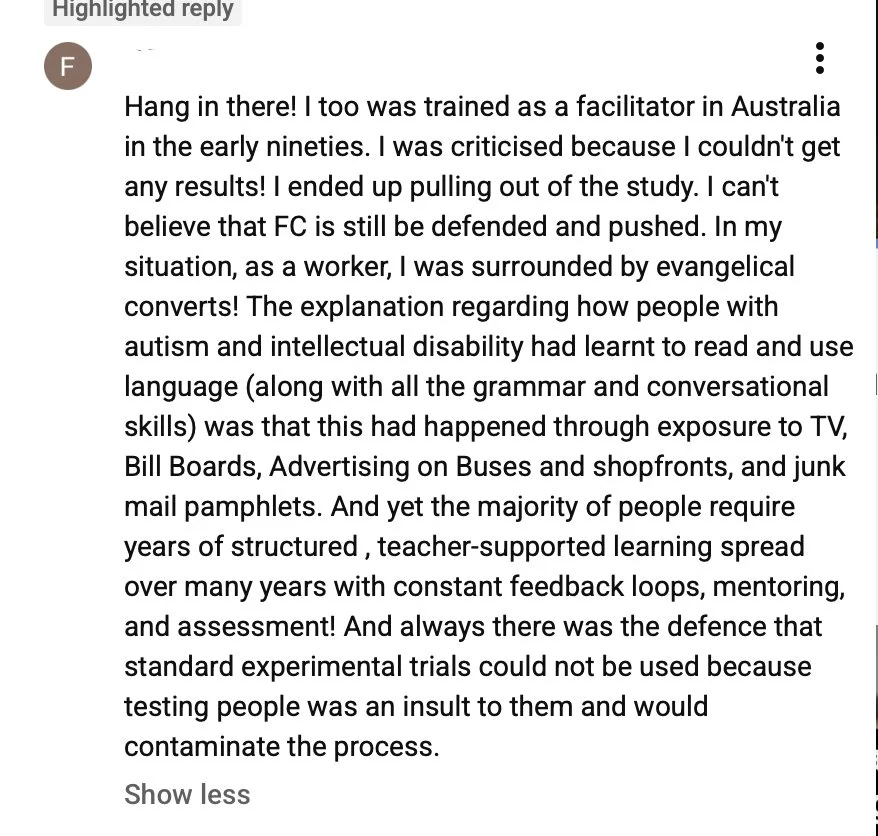
Comment from a former facilitator 6/6/2026
Blog posts in this series:
When did the FC leadership know about the fatal flaws in their technique (Part 1)
When did the FC leadership know about the fatal flaws in their technique (Part 2 - IDRP)
References and Recommended Reading
Cummins, R. and Prior, M. (1992, Summer). Autism and Assisted Communication: A Response to Biklen. Harvard Educational Review. Vol. 62 (2), 228-241.
Gorman, B.J. (1998). Facilitated communication in America: Eight years and counting, 6 (3), 64. Skeptic.
Institute on Community and Inclusion. (1993, May). Issues of Influence: Some Concerns and Suggestions. Facilitated Communication Digest. Vol. 1 (3), pp. 11-12.
Intellectual Disability Review Panel (IDRP). (1989). Investigation into the reliability and validity of the facilitated communication technique. Melbourne: Department of Communication Services, Victoria
Prior and Cummins. (1992). Questions about Facilitated Communication and Autism. Journal of Autism and Developmental Disorders, Vol. 22 (3), 331-338