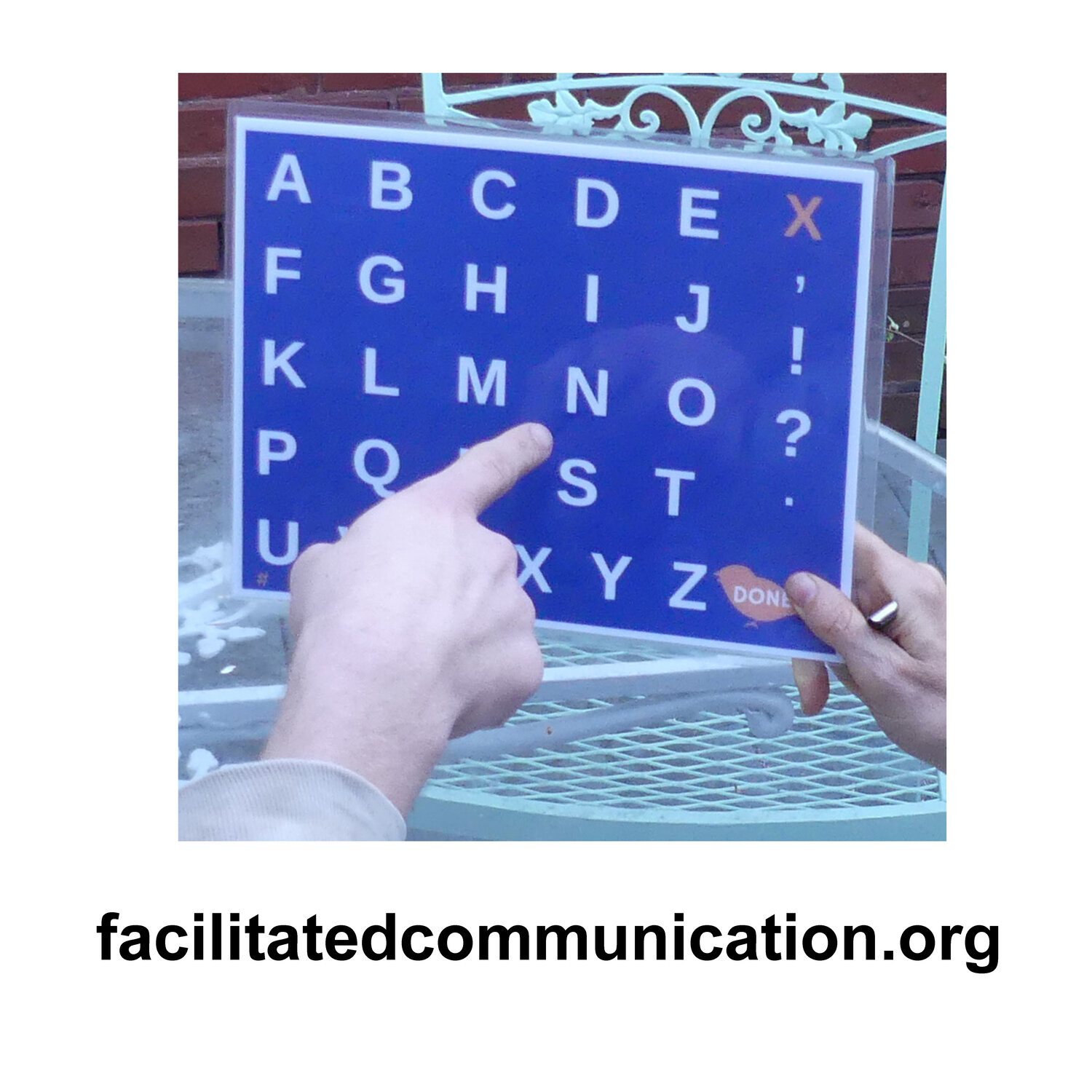
A conversation about cueing with someone involved in the Telepathy Tapes who wishes to remain anonymous
Last spring someone who has been involved in the Telepathy Tapes podcast reached out to me, and we had a phone call primarily centered on the role of cueing in facilitated communication. We spoke, in particular, about Akhil, one of the non-speaking participants in the podcast. My interlocutor felt that Akhil’s typing was so rapid that it could not have been influenced by any cues that his mother might have been providing, and that, therefore, his accurate answers to questions about pictures he couldn’t see were more likely to have been due to telepathy.
Following our phone call, my interlocutor and I had an email exchange that I found interesting enough that I decided, as the release of the Telepathy Tapes documentary movie approaches, that I wanted to reproduce it in a blog post. So I reached out to see if it was OK to use their name when quoting from the email exchange. This resulted in a long phone call in which, having established that I hadn’t changed my mind about telepathy, the person told me that they preferred not to have their name used. So I said I’d refer to them instead as “someone who has been involved in the Telepathy Tapes who wishes to remain anonymous.”
Our email exchange opened with this person, whom I’ll abbreviate as “TT Supporter,” sending me a link to a video of Akhil, one of the few purportedly non-speaking autistic telepaths who appears in videos made public by the Telepathy Tapes podcast.
Image by ChatGPT
TT Supporter on April 11th
Thank you so much for speaking with me! It's all so interesting! Here is the video of Akhil, just thinking of what I know about the ideomotor effect, it's a subtle physical movement that could not be providing complex information (Morse Code or specific directions like 2 up 3 down), his finger moves so quickly to the letter, then he hovers a bit, but his finger is moved to the letter he is selecting so quickly. I'd say this is THE video that's got me the most perplexed.
[Curiously, the video she sends is this one, from Janyce’s FCIsNotScience YouTube Channel, where she analyzes videos of FC/RPM/S2C for signs of facilitator influence.]
Then there's the footage from the Spellers movie, specifically watching Jamie spelling with his dad, the speed he goes to each letter, there's no scanning or awaiting a cue. I'm not saying there's no scientific explanation. But I am having a hard time being convinced that it is physical cues from the facilitator, just in these cases where the spelling is so fast.
KB on April 17th
A new podcast on the Telepathy Tapes has just come out that you might find interesting: Telepathy: Is It For Real? Science Vs
I'm on, and so is Jim Todd, who provides a commentary on one of the more subtle instances of cueing. He is someone you should check in with about the more subtle cases that are on your mind.
Oh, and re Jamie in Spellers, some seemingly independent typing may simply be a memorized and practiced series of letters (without any comprehension of what they spell). Autistic individuals are quite good at that sort of rote memorization. What we need, again, are spontaneous responses to spontaneous questions with all facilitators out of the room--out of auditory, visual, and tactile cueing range.
TT Supporter on April 17th
Thank you for sending this! I listened, and it was clear. What concerns me is that the failed FC studies did not account for telepathy (of course, because telepathy wasn't being claimed or evaluated for). But we can't scientifically rely strictly on studies that could have failed due to the phenomenon we're trying to disprove..
When I really investigated the ideomotor effect, the published research that has nothing to do with FC, I found it to be subtle and inconsistent. The ideomotor effect is simply incapable of sending as much information as we're assuming in these minor arm movements from Akhil's mom. Basic psychophysics and cue/response times tell us it would take at least 1 second for the cue to be understood and acted upon. Akhil moves faster than that. Information theory tells us only 1 bit of information could be sent per cue, and a letter would require 5 bits....
I know this is getting into the weeds, but the details are critical. I'm getting it all written up as soon as possible, with sources.
KB on April 17th
I look forward to seeing your piece and your references! For now, I'll just say a couple of things:
If telepathy explains all of the failed FC studies from the 1990s, then we have to wonder why every single individual who was tested opted to type an answer based on a telepathic message that every single facilitator apparently sent about the picture they (the facilitator) saw rather than based on the picture that they (the facilitated person) saw. Why wouldn't at least some of these individuals type out what *they* saw, not what their facilitator saw, even if they were receiving a telepathic message about a different picture? If, on the other hand, only *some* of the failed FC studies from the 1990s involved telepathy, then we still have a lot of evidence for facilitator control.
Second, subconscious cueing, which is what is most likely in FC, does not require a second-long response time for interpretation and action. The effects of subconscious cues are much faster than that--a matter of milliseconds. To my knowledge, the only person to make the 1-second claim about cues in FC is the same person who didn't tell you about his enormous conflict of interest that inevitably massively warps his judgments: Vikram Jaswal.
Third, subtle cues (especially directional cues, e.g., from moving torsos), especially when combined with years of conditioning and practice with common letter sequences and common messages, can provide enough information about where to point, and pointing can occur quite quickly. Have you talked to Jim Todd about this? If you haven't, you should.
Fourth, the podcast I linked to finds the independent evidence for telepathy to be weak and problematic. A lack of independent evidence for telepathy, of course, makes it problematic as an alternative explanation for facilitator control.
Hope you find this helpful—
TT Supporter on April 17th
Thank you so much for engaging with me on this! I really do want to understand. This does all come down to subconscious cueing, processing times, etc. I will definitely contact Jim Todd. If he can show me evidence of subconscious cues sending such specific information at the speeds we are observing, that will be fascinating! Currently, the only evidence I have found is the failed FC studies.
All the research I've found is the ideomotor effect telling the non-speaker “select now,” essentially. Nothing like Manisha's hand in Akhil's peripheral vision, slightly moving to the right, and that being sufficient for him to type a word. Practice cannot undo the limitations of how quickly the brain can sense, decide, and act on a subtle cue. The cue being subconscious would also mean it would be inconsistent, and would require time for Manish to provide. Akhil also deletes letters when he makes mistakes without her cueing him to.
I know this communication seems miraculous for many more reasons than how quickly and accurately Akhil responds to Manisha's subconscious cues. The language and comprehension is much more advanced than some moderately autistic people.
But what if something more than the ideomotor effect is occurring? We can't claim what, but I'm not convinced we already know. I know this sounds arguably insane.:-) I'll keep thinking and writing on this.
We have a short exchange about Jim Todd’s contact info before resuming the conversation.
KB on April 23rd
In this article (just out!) there's a description of an uncurated session with Akhil that doesn't look nearly so impressive:
https://www.thecut.com/article/telepathy-tapes-families-autism-ky-dickens.html
TT Supporter on April 23rd
Thanks for sending this! It's very well written, and I totally get her points. Still, it's the same argument around the Ideomotor Effect controlling the communication, which isn't supported by the research when you really dig in. It's given as an explanation, an assumption, but it's not proven. Just because something is technically possible doesn't mean it's happening, and honestly, I'm not convinced it's technically possible. I'm very aware of mentalists' methods, but non-speakers are not mentalists, and mentalists do not have this level of skill we see in some proficient spellers. Do you believe all Spellers are being controlled by their communication partners? What are your thoughts on Elizabeth Bonkers [sic]?
Thank you so much for engaging with me and humoring my outlook. I've been trying to convince myself otherwise, but I cannot. What if more is going on than meets the eye, and some of these non-speakers are indeed “in there”?
KB on May 6th
I've read your two recent pieces [on cueing] and am hoping you can share some references with me.
In your first piece, you state that “even the simplest cue-response cycle tak[es] about one second.” Can you share your best reference for that finding?
In your second piece you state: “I found over 100 published papers supporting spelling." Can you tell me where you found those papers? I.e., in which publications? Might you have a list you can share? In the systematic reviews of FC/S2C, even if you count the papers supporting FC/S2C that didn't meet the inclusion criteria, the total number of FC/S2C-focused papers is nowhere near 100. (And that total, of course, includes papers that find evidence against S2C).
I'm happy to keep the conversation open and keep sharing information.
TT Supporter on May 6th
Thank you so much for reading both pieces and for reaching out. I really appreciate your openness.
You're absolutely right to request clarity on both of those points.
On the cue-response cycle timing, this was a rough estimate, and the wording wasn't precise. By “simplest cue-response time” I was just using what we know from Hicks law without accounting for the cue being subconscious or the responders unique neurocognition. Assuming typical times, it estimates that for tasks requiring a choice between 26 options (like letters on a board), the average reaction time is around 900–1000 milliseconds, = a + b log2(n+1): a is base reaction time 200 ms, b is time/bit of info typically 150 ms/bit, n=26, RT= 200+150*4.76 = 914 ms. Classic studies by W.E. Hick (1952) and Ray Hyman (1953) are the foundations for this, but I used the following. This was loose and simplistic. I'm not an expert on reaction times, and the a and b values would be unique to non-speakers, but I didn't see any research on their response times. However, the literature review on reaction times mentions that “students with a history of language and/or reading difficulties had slower reaction times.”
I was using this as a baseline to show that it seems exceedingly unlikely a non-speaker who is believed to be incapable of spelling could have such consistent and speedy reaction times.
So this only applies if the cue is directing them to the letter. If we're assuming it's a hot/cold or "select now" type of cue, as the research suggests (Kezuka 1997, Wegner 2003 Clever Hands), the cue/response time could be the standard 200ms base reaction time. However, the non-speaker would need to be closest to the desired letter when receiving the cue, and many spellers go directly to the letter without awaiting a cue.
I'm also looking into how much information could be contained in a single cue; I don't think it's sufficient to control the non-speaker. But again, I'm not an information theory expert either, so I'm definitely out of my depth and learning as I go.
Regarding the “over 100 papers supporting spelling” comment, I appreciate you catching that. I should have worded that more carefully. What I meant to convey was that there are claims from proponents that over 100 studies exist in support of Spelling/FC, but I did not vet or reference all of those myself. Because I knew the bulk of that research was not considered valid due to methodology concerns, inclusion criteria, etc., I focused instead on the more rigorous and widely accepted body of research evaluating FC. And then of course the papers by Vikram Jaswal and a few others that were peer-reviewed. I regret the way I phrased it, and I corrected it to just state "several". Interesting, I hear that “100 peer-reviewed studies” often, and I see that's not the case, so thank you for noting that!
Thanks again for pointing these out. I really value this kind of critical engagement and am happy to continue the conversation.
KB on May 7th
Thanks for your response. I appreciate your willingness to update the information you present as you learn more. The "over 100 studies" claim has indeed become a meme in the Telepathy Tapes world. It seems to originate with Diane Henacy Powell. Her source seems to be a pro-FC paper by Heyworth et al. (2022); Heyworth et al.'s source is a pro-FC paper by Cardinal & Falvey. Cardinal & Falvey simply make the “over 100 studies" claim without any citation. One of my colleagues emailed both Cardinal and Falvey requesting a citation several days ago, and neither one has replied. One thing I've learned over the years is that you can't trust the peer review process to ensure that citations are accurate. It's essential to chase down people's references, particularly in the case of big claims like this one.
On that note, I appreciate the references and explanation you gave me for how you calculated reaction time. But I'm unclear on where you are getting the values for the base reaction time and information bit/time figures--i.e., 200 ms and 150 ms/bit, I see general formulas, but not any specification of (or justification for) any specific reaction time values in the papers/documents you cite. Also, how do you define a “bit”? Thanks for the clarifications!
By the way, it looks like your statement "When I dug deeper, I found over 100 published papers supporting Spelling" is still there on your post. I agree with you that it would be good to change 100 to "several"--or whatever number represents the actual number of papers you found.
TT Supporter on May 7th
I forgot about [the other post]. I updated that one, too. I will also watch for people trying to use that misleading 100 number. Thanks!
This is a loose estimate, and I may be completely off. The base reaction time for a non-speaker is unknown. And the ms/bit (b) for Spelling is also unknown. I'm assuming using “standard” times is conservative, but they may be gifted in this area and have faster response times and/or processing times, but it doesn't seem likely.
I believe the more compelling case for Spelling is in the cues: how much information would need to be provided by the cue to get the non-speaker to the correct letter, and how quickly? Particularly because this cue is subconscious. I can't determine how that could be possible, considering the speeds and the fact that they are not scanning each letter like in the Kezuka study.
Thanks again for engaging with me, it means a lot.
KB on May 8th
Thanks for these clarifications. It's much clearer to me now where you are getting your numbers.
Since neither of us is an expert in reaction times, I thought I'd run this past someone who is: Jim Todd. Here's what he has to say:
Basic reaction times are down in the 200 ms range, if an overt physical response is required, maybe a little bit faster for a well-practiced single stimulus and response. But, she is wrong that multiple stimuli would always require at least a second each. Once the stimulus is learned, and learned in a context, the reaction time isn’t too much greater than it would be given in isolation. Four or five distinct responses per second, to sequential auditory stimuli, could be done. When you’re doing Morse code at 20 words per minute, you’re doing a little short of two letters per second. I can do 30 to 35 words per minute in certain situations while I’m listening to static and other things going on in the environment, like people having a conversation in the background.
He adds:
A moderately practiced person could respond easily to two or three distinct cues per second. The limiting factor would then be the ability to type them that fast given the output.
Morse code transcription may be the best comparison case for a conception of S2C in which there's one discrete cue per letter of the alphabet (setting aside for now the question of whether that's how cuing generally works in S2C). I (back to me, as in Katharine) have looked into Fred Keller's Morse code transcription training experiments from 1943. In these experiments, college students progressed from "a code speed of five words per minute (5 w p m) to speeds as high as 20 w p m [words per minute] in less than fifty-five hours of instruction" (fifty minutes of daily training, five afternoons a week, for 10 weeks). This training period is much shorter than the period of time (if not the daily intensity) of the Spelling to Communicate sessions of the "spellers" on the Telepathy Tapes, who have been at it for years. And, of course, only some spellers spell at rates of 20 words per minute. Many are much slower than this. In fact, in Jaswal's eye tracking paper, whose participants had been using S2C “for at least 2.25 years” (I'm quoting directly from the paper) “pointed to about one letter per second.”
All this is to say that there are some good reasons for you to rethink “one second” as your minimum time for cued letter selection, and also to rethink your assumption that spellers are typing too fast for cueing to be the explanation.
Happy to keep the conversation going!
TT Supporter on May 8th
This is helpful, so the cue/response cycle for the non-speaker could be 200ms per cue or even less due to practice. That seems unlikely due to their motor and cognitive abilities, but let's assume it's possible. I agree, I think Morse Code is the closest example we have to what could be going on. Considering what's possible, I see that skilled Morse code operators can understand and decode at rates exceeding 40 WPM, so over four letters a second, which is incredible! Considering the rate of modern spellers, the limiting factor cannot be assumed to be the non-speakers' comprehension of the cues, although it does still seem like a stretch, but yes, it's possible.
The communication speed would rely on the partner cueing the non-speaker. Looking into the nature of the cues is where it all breaks down. The research shows ideomotor cueing is technically possible for "select now" or hot/cold type cues. That is what the research supports (Kezuka and Clever Hands), and that is also how mentalists use the ideomotor effect. This type of cue shares binary info like yes/no, warmer/colder, left/right, up/down. These cues require the non-speaker to scan over the letters and be guided to the letter in the partner's subconscious. The speed of some modern spellers does not allow for this guiding process. To guide the non-speaker, there would need to be consistent cues providing feedback as they get closer to the letter. Fast Spellers do not allow time to be guided; they would need to be getting letter-specific cues, it seems...
What I cannot work out is how a partner could subconsciously provide letter-specific cues, like Morse Code, that would be unique to them, consistent, and subconscious.
Thank you so much! This is so helpful to discuss. :-)
KB on May 8th
Thanks for your reply!
It sounds like you agree that only some spellers are fast and direct enough for “select now” cueing to be implausible. Most spellers instead hover around the letter array for a second or longer before letter selection. From what I've seen from the many videos I've watched, this is the norm. Here, all we need is a slight cue, or something between a cue and a selection-inducing movement, for example a slight forward movement of the letterboard when the finger gets to the right spot. (There are a host of other subtle and not-so-subtle cues that can occur together and in concert, but let's keep it simple for now).
So we're left with the fast, direct selectors, of whom Akhil seems to be your main (your only?) example. This is where things get interesting. Consider what journalist Elizabeth Weil observed when she watched Akhil in person (from the article I sent you earlier):
While Akhil typed on his iPad, Manisha sat at the edge of his peripheral vision, not touching his wrist but rocking her torso like a joystick. She also balled her fists with one finger sticking out of each, and pointed up, down, to the side.
That gives us three simultaneous directional cues: the torso movement and the fingers pointing from two hands. It's easy to see how they could function in concert: one indicating which quadrant of the letterboard, another indicating which row, another which column. Directional cues: unlike the more arbitrary dots-and-dashes-to-letters of Morse code, no extra layer of potentially cognitively demanding interpretation is necessary.
Still not precise enough, perhaps? That's where two other factors enter the picture. First, there's the fact that videos can be curated, such that the public sees only the most convincing episodes of spelling/typing from the most convincing camera angles. Invariably (I've seen this many times) what you observe in live, unrehearsed spelling sessions is a lot less convincing than what's visible in curated videos: more obvious cueing, less accuracy. Second, there's the facilitator's role in deciding which letters were selected and which words were spelled. Routinely, you see facilitators ignoring letters that were pointed to; calling out letters that weren't pointed to, and/or forming words out of letters that don't literally spell those words. (And there's a third factor, but I'll save that for another message).
So let's go back to your most compelling case for lack of cueing: Akhil. How well does Akhil do during Elizabeth Weil's visit? Here's an excerpt from the article:
“M m hu ba i,” Akhil called out as he typed.
“My husband is …,” Manisha said, consolidating and translating.
“Go go ca fo fa fo so fi.”
From this Manisha pronounced, “My husband is going surfing!” She sounded relieved.
“Give me one word,” Manisha said to me. “He’s feeling that unbelief. If you are questioning, you need to change your questioning.”
I apologized for the skepticism inherent in my role as a journalist. Then I handed Manisha a slip that read STRAWBERRY.
This time, instead of typing, Akhil just sat for ten seconds, blanket around his shoulders, iPad on the rug before him.
“Akhil, Akhil,” Manisha said.
Ten more seconds passed. Akhil typed no letters. Manisha said, “Strawberry. Very good.”
Akhil leapt up, ran down the hall and back again, upset. “I wa to sho hu ma min ver good. Yo yo mi mi mi i wi sho …”
Manisha completed his thought: “The mind is okay.”
She asked me to choose a shorter word. I wrote PEPPER.
When Akhil returned, he typed, A-A-A-E-P D-A B-A.
So, to sum up:
1. “Select now” cues plus board movement explain letter selection in the majority of spellers (like those in Jaswal's study who averaged one second per letter and whose fingers roam over the letter arrays)
2. Fast, direct, and apparently accurate spelling can be explained by multiple simultaneous readily interpreted directional cues that indicate letter position and by selection of the most convincing videos (those with the highest accuracy, the least salient cueing, and the least obviously discrepant post-hoc judgments by facilitators about words and letters).
Happy to keep the conversation going!
I did not hear from this person again until a couple of months ago when I reached out to them about the question of using their name here. Meanwhile, I’ve forgotten what the “third factor” was that I had in mind.
Was it that messages may be practiced ahead of time and memorized as arbitrary sequences of letters (a special talent of many autistic individuals)?
Was it that, for those who have “graduated” from letterboards to screens, increasingly sophisticated word prediction programs can minimize the number of cues needed to produce messages?
Was it that most of the typing is hard to see, so we have no idea what was actually typed? The infamous head-on view of Woody Brown typing, where you can see exactly which letters were selected for more than just a second or two, is the exception rather than the rule. (The Woody Brown footage showed such a clear discrepancy between what was typed and what his facilitator called out, and such clearly nonsensical letter sequences, that it inspired widespread outrage and multiple video critiques, including some from people with whom we at facilitatedcommunication.org have no connection, e.g., this one).
As for me and the person involved in the Telepathy Tapes who wishes to remain anonymous, once we’d settled the question of what name to use in this blog post, we proceeded to have a long, cordial discussion about why I hadn’t changed my mind and whether they would ever change theirs. Subtopics ranged from Occam’s razor, epistemic uncertainty, and the dangers of everyone becoming unmoored from empirical reality. But I’ll save it for another post.
