When did the FC leadership know about the fatal flaws with their technique (Part 2 - The IDRP)
This is the second in a series exploring the question of when the leaders in the Facilitated Communication (FC) movement knew about the fatal flaw in their technique (e.g., that facilitators, not their clients, were controlling letter selection through physical, visual, and auditory cueing).
This series is inspired by a 1993 newsletter I found in my files that was published by Syracuse University’s Institute on Communication and Inclusion (formerly known as the Facilitated Communication Institute and currently known as Inclusion and Communication initiatives).
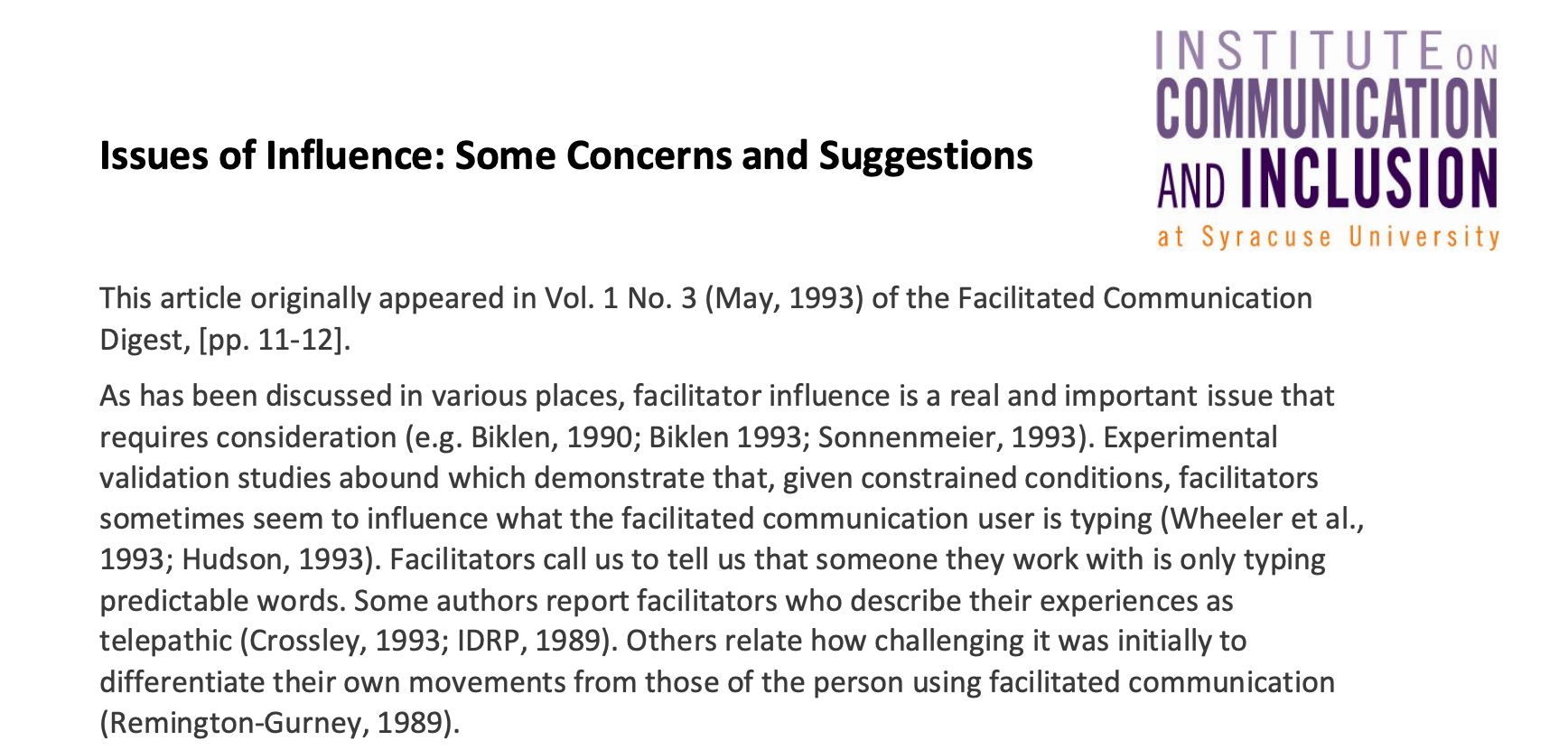
Screenshot from an ICI Newsletter
I’ve always wondered when the FC leadership became aware that their technique was fatally flawed.
Based on the content of the May 1993 Facilitated Communication Digest newsletter (pictured above), it’s safe to say that the leaders of the FC movement were aware at that time that facilitator cueing (even among their own trained facilitators) was a problem.
But, in researching FC’s history further (e.g., following the trail provided by the ICI in the citations they included in their newsletter), I can now report that Douglas Biklen (founder of the Facilitated Communication Institute), was, in 1989, given a report by Australia’s Intellectual Disabilities Review Panel (IDRP) that specifically identified facilitator influence over letter selection as a problem and cited several authorship tests to back up their claims. (See Cummins and Prior 1992).
Before delving deeper into the IDRP’s report, here’s a brief review of my last blog post where I noted
That, in 1993, the ICI was aware of what they called “experimental studies,” but downplayed the results by telling their readers that “it seemed” like the facilitators “sometimes” and “under constrained conditions” influenced the FC-generated output.
That they failed to let their readers know the two authorship studies cited in the newsletter (Wheeler et al, 1993 and Hudson, 1993) showed that none of the facilitated responses were correct when the facilitators were blinded from test stimuli (e.g., common pictures, objects).
That there were many other such studies—studies they chose not to cite.
That the two authorship studies the ICI cited (plus two additional studies I outlined in my last blog post) involved Syracuse-trained facilitators or facilitators trained by Rosemary Crossley (who’s often credited with inventing FC). These, presumably, were not “poorly trained” facilitators.
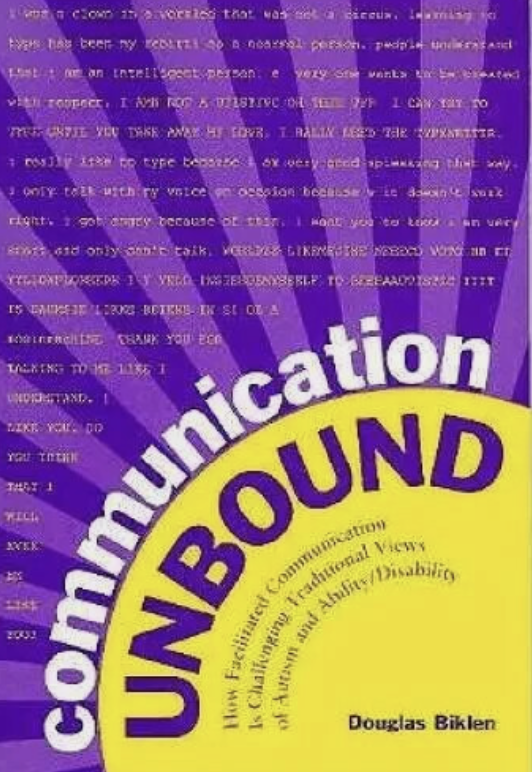
Book cover for Communication Unbound (1993)
The ICI oversold FC’s success at producing independent communication. They claimed, as was written in the newsletter, that “the evidence of individuals typing information that could not be known by their facilitators and/or typing independently, has been documented in numerous research and autobiographical reports.”
To back up this claim, they cited Biklen’s 1993 book Communication Unbound, a 1993 paper Crossley presented at an annual conference of the Australian Association of Special Education in Canberra, an article Crossley wrote in 1990 (which they left off their reference list), a report by the Intellectual Disability Review Panel (IDRP) from 1989, and a pro-FC book call Silent words: the story of David Eastham, written by his mother, Margaret, and published in 1992. But “independence” to proponents doesn’t mean “without physical, visual, or auditory cueing.”
A review of Biklen’s article and his book of the same name (e.g., Communication Unbound) indicates that neither document contained any empirical evidence or scientifically rigorous authorship testing to support his claims regarding FC and communication independence. (See Rationalizations Abound: Stopping Just Shy of Knowing)
From reading Rosemary Crossley’s 1994 Facilitated Communication Training book, it’s clear to me that she did not believe in authorship testing either (except when it came to telepathy, which I’ll talk about later). (See Do FCed Individuals have Telepathic Superpowers?)
As for the Eastham book, it appears to be one of the earliest (anecdotal) examples of FC in the United States. Margaret Eastham “invented” what she called an “independent reading technique” that worked with her son only when someone held onto his wrist, elbow or shoulder. She started the technique around 1982 and was encouraged to continue its use when Biklen published his 1990 article “Communication Unbound” in the Harvard Educational Review. Upon learning about Biklen and FC, Eastham seemed proud of herself for what she perceived as being part of the “vanguard.”
Note: I’m reminded of an article by magician and skeptic James Randi discussing his experiences with Haskew and Donnellan at the University of Wisconsin-Madison where facilitators there thought their clients had telepathic abilities. In her book, Eastham discusses teaching her “independent reading technique” to speech/language pathologists at the same university. I wonder if Eastham or the facilitators she’d taught were part of the FC/Telepathy project. (See Haskew and Donnellan’s bizarre take on FC and A Magician Can’t Dispute FC…Or Can He?)
I know from reading a 1992 article by Cummins and Prior titled “Autism and Assisted Communication: A Response to Biklen” (referring to Biklen’s mention of the IDRP in his article Communication Unbound) that Biklen’s interpretation of the report was that the IDRP supported FC use.
I will write in more detail about the Cummins and Prior article in my next blog post. Their viewpoint is especially important because they seemed to have an inside perspective on the evolution and popularization of FC in Australia and its subsequent promotion in the United States. But for today’s purposes, I’ll focus on the IDRP’s summary and recommendations considering Biklen’s and the ICI’s positive interpretation of the panel’s findings.
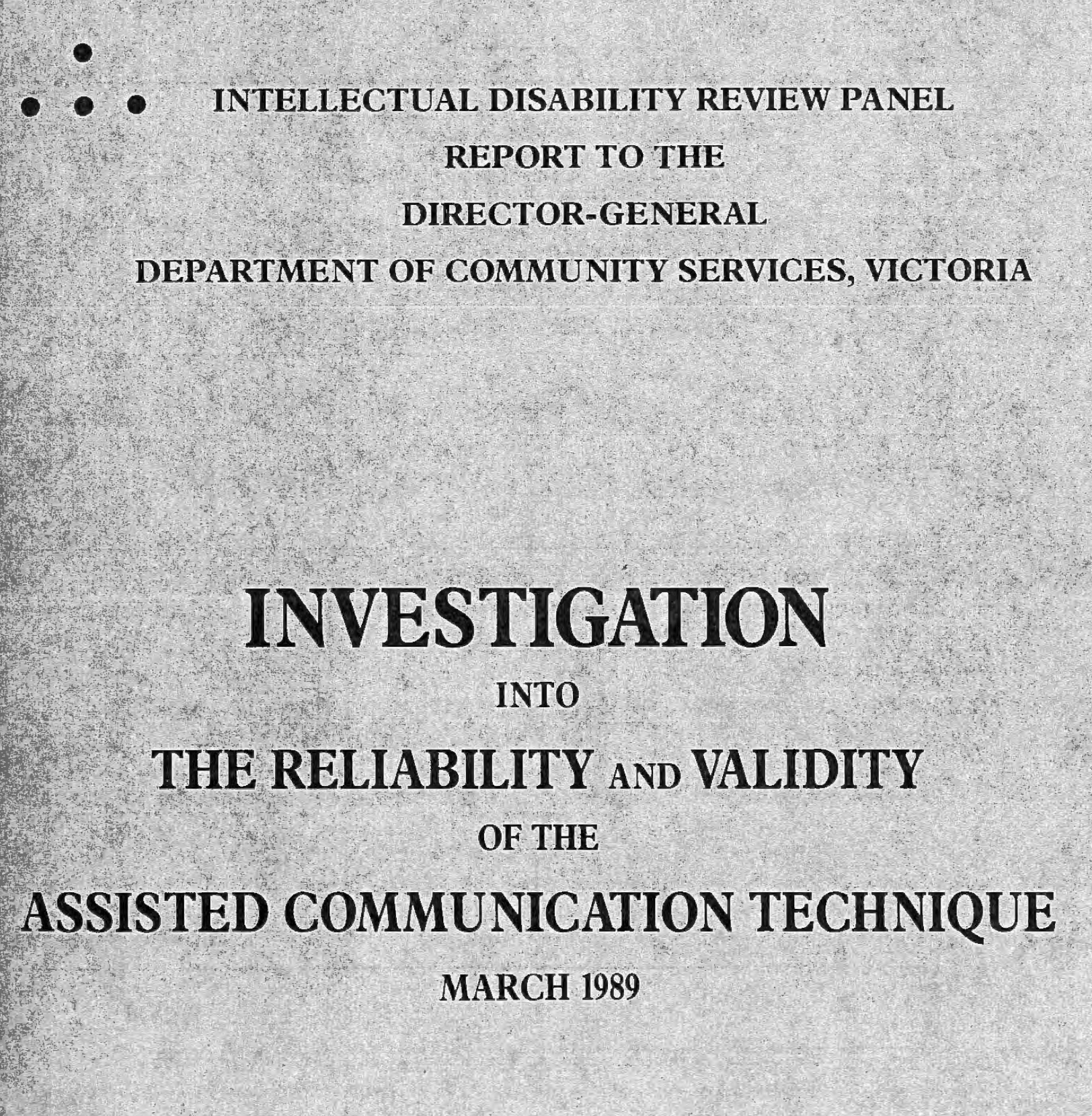
Cover page to the Australian IDRP’s 1989 Investigation into Facilitated Communication
The official title of the IDRP report was this: Intellectual Disability Review Panel report to the Director-General Department of Community Services, Victoria: Investigation into the Reliability and Validity of the Assisted Communication Technique March 1989. The “assisted communication technique” (dubbed “facilitated communication”) was being “widely used and promoted” by Crossley’s DEAL Communication Centre.
The Director-General sought the advice of the Review Panel on four terms:
To report on the method and its use as a communication aid for people with intellectual disability
To determine a way to validate the technique and its reliability as a form of communication
To recommend appropriate actions arising from (1) and (2)
To recommend any appropriate procedures or practices for funding agencies resulting from the investigation
In the report, the panel commented on the seriousness of the undertaking. They were aware of the “debate and conflict” surrounding FC and why the technique was being investigated. (I suspect the investigation was sparked, in part, because of the “Carla” false allegation of abuse case involving Crossley and several of her facilitators that I mentioned in my first blog post of this series—see References and Recommended Reading below). The panel also made clear in their report that their investigation was not a trial and that any information presented to the panel was not considered evidence for legal purposes (hinting that perhaps some of the parties who were targets of the investigation were not happy with the panel’s inquiries).
The Panel identified determining the legitimacy of the physical assistance provided by facilitators as one of its most significant issues, including the independence, complexity, and generalizability of the communication training. And, while they “developed, trialed and applied methods to determine the reliability and validity” of FC, the investigation did not conclusively resolve the dispute. By their account, some of the assisted communication was not influenced by the assistant (facilitator) and some of it was.
In their report, the panel outlined the following recommendations:
That there be ethical guiding principles for testing (e.g., resolving disputes regarding authorship) and a clear set of protocols to follow
That the Panel develop “Protocols for Dispute Resolution” and a “Code of Conduct”
That a “communication training program plan” be developed for each client
That clients eligible under the I.D.P.S. Act (1986) have the communication training program plan formally included in their General Service Plans with details to be outlined in their Individual Program Plans.
That an organization, body, or individual be appointed to resolve authorship disputes (using objective methodology)
That clients be identified and evaluated by service providers and that the information gathered during the assessments regarding their communication needs be used for determining the appropriate services for these individuals
That a booklet be published containing information about the range and type of communication services and that the booklet be made widely available in appropriate community languages. The booklet’s purpose was to outline the availability of services and options, explain communication training methods, and detail procedures for dispute resolution
That funding and service agreements be established (contingent on service providers adopting the Protocols for Dispute Resolution and Code of Conduct)
That funding and services agreements be established and funding be contingent on service providers developing and reviewing communication training program plans for each client (in accordance with the General Service Plan and Individual Program Plan for clients eligible under the I.D.P.S. Act, 1986)
Note: I think I.D.P.S. refers to the International Development Program to support education in Australia but couldn’t confirm that. If any of our readers know, please leave a comment below. Also, I believe Crossley’s DEAL Centre eventually lost government funding for her project, in part because of the IDRP investigation. Again, if anyone has information regarding the DEAL Centre’s funding (or loss of funding) at the government level, please let me know (include appropriate citations when commenting).
In my next blog post, I’ll cover the Cummins and Prior article and their reaction to Biklen’s interpretation of the IDRP. It’s a bit of a rabbit hole, I realize, but still relevant to the overly rosy spin the ICI newsletter seemed to take on the IDRP report.
Blog posts in this series:
When did the FC leadership know about the fatal flaws with their technique (Part 1)
References and Recommended Reading:
Cummins, R. and Prior, M. (1992, Summer). Autism and Assisted Communication: A Response to Biklen. Harvard Educational Review. Vol. 62 (2), 228-241.
Eastham, M. (1990). Silent Words: The Story of David Eatham. Oliver-Pate.
Heinrichs, Paul. (1992, May 31). ‘Carla’ case prompts overhaul of system. Sunday Age.
Institute on Community and Inclusion. (1993, May). Issues of Influence: Some Concerns and Suggestions. Facilitated Communication Digest. Vol. 1 (3), pp. 11-12.
Intellectual Disability Review Panel (IDRP). (1989). Investigation into the reliability and validity of the facilitated communication technique. Melbourne: Department of Communication Services, Victoria
Randi, James. (2017, July-August). A Magician in the Lab: The Farce Known as ‘FC’. Skeptical Inquirer. Volume 41 (4).
Information on the “Carla” False Allegation of Abuse Case involving Rosemary Crossley and eight of her trained facilitators
Heinrichs, P. (1991, March 10). Experts slam disabled ‘charade', Sunday Age (Melbourne, Australia), Late Edition, pp. 1
Heinrichs, P. (1992, February 16). Suffering at the Hands of the Protectors. The Sunday Morning Herald.
Heinrichs, P. (1992, February 16). State 'tortured' family – 'tragic'. Sunday Age (Melbourne, Australia) Late Edition, pp. 1
Heinrichs, P. (1992, February 23). 'Tortured' family may call for probe on facilitated evidence. Sunday Age, Melbourne, Australia, Late Edition, pp. 8
Heinrichs, P. (1992, February 23). More families take on CSV 'zealots'. Sunday Age, Melbourne, Australia, Late Edition, pp. 7
Heinrichs, P. (1992, April 12). Taxpayers will foot bill for 'Carla' case. Sunday Age, Melbourne, Australia, Late Edition, pp. 11
Heinrichs, P. (1992, May 17). US courts to rule on disability method. Sunday Age, Melbourne, Australia, Late Edition, pp. 9
Heinrichs, P. (1992, May 31). 'Carla' case prompts overhaul of system. Sunday Age, Melbourne, Australia, Late Edition, pp. 10