Warnings From a Former Believer
I had a boring 9-to-5 desk job and always wondered whether there are miracles out there in the universe. Naturally, the viral podcast The Telepathy Tapes grabbed my attention—so much so that I wanted to vet its claims for myself and advocate for spelling. Even if just 1% of what the No. 1 podcast in the U.S. presented was true, it was worth exploring.

Ky Dickens discussing The Telepathy Tapes on the podcast The Joe Rogan Experience
Wanting firsthand experience, I reached out to volunteer and was invited to spell with someone well regarded in the community who had been spelling for six years. In preparation, as recommended by parents and SLPs, I watched Spellers The Movie, read The Spellers Guidebook, and—most importantly—embraced the principle of “presume competence.” The consensus among parents was that their child’s mind is intact, their body dysregulates when cognitive demands arise, and a spelling partner helps carry the cognitive load. If the speller was experienced enough, anyone could start spelling with them and learn through practice without expensive training. In fact, some parents couldn’t afford the training and just learned through tutorial videos online and practice at home all for free. I knew nothing about nonverbal profound autism but trusted that the parents knew best.

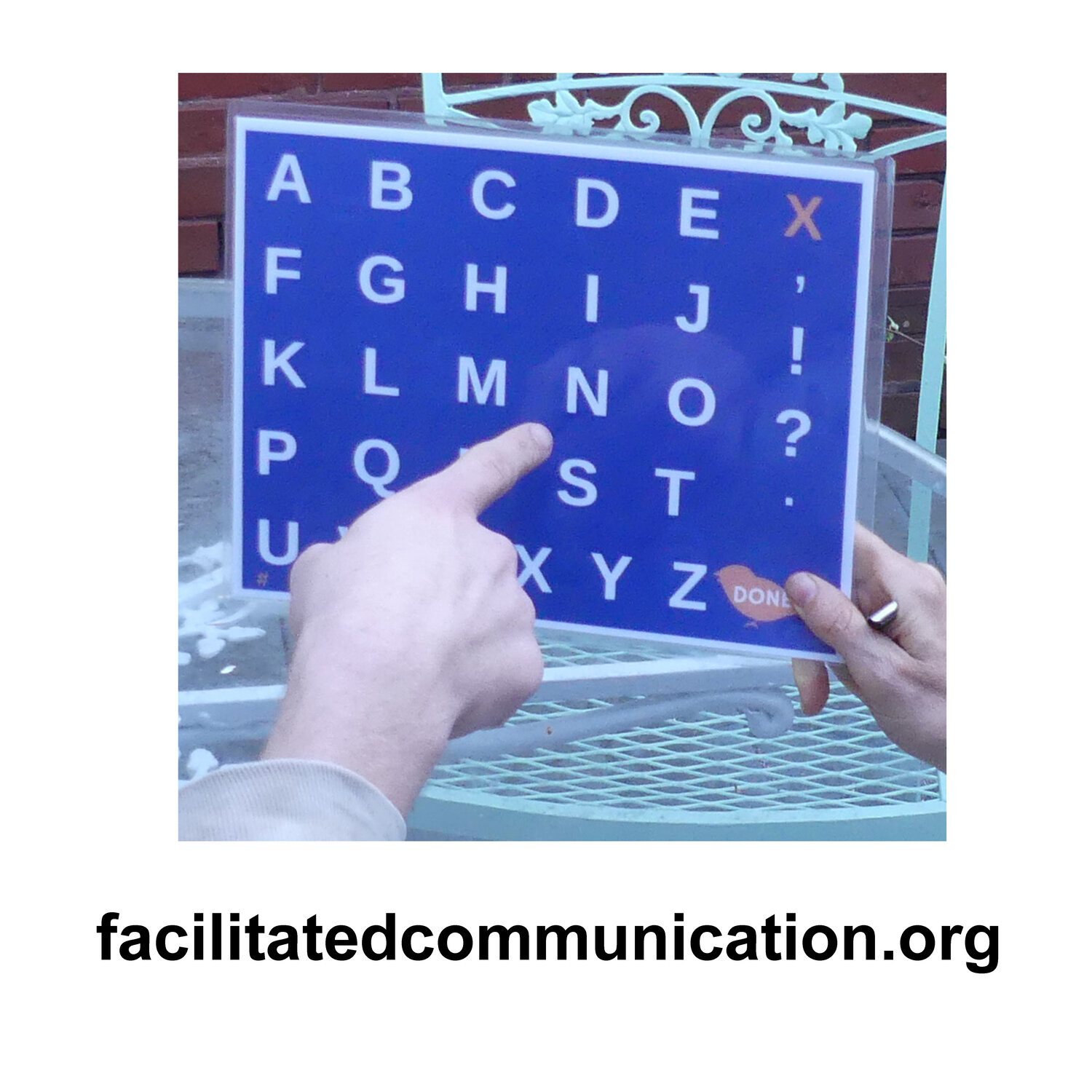
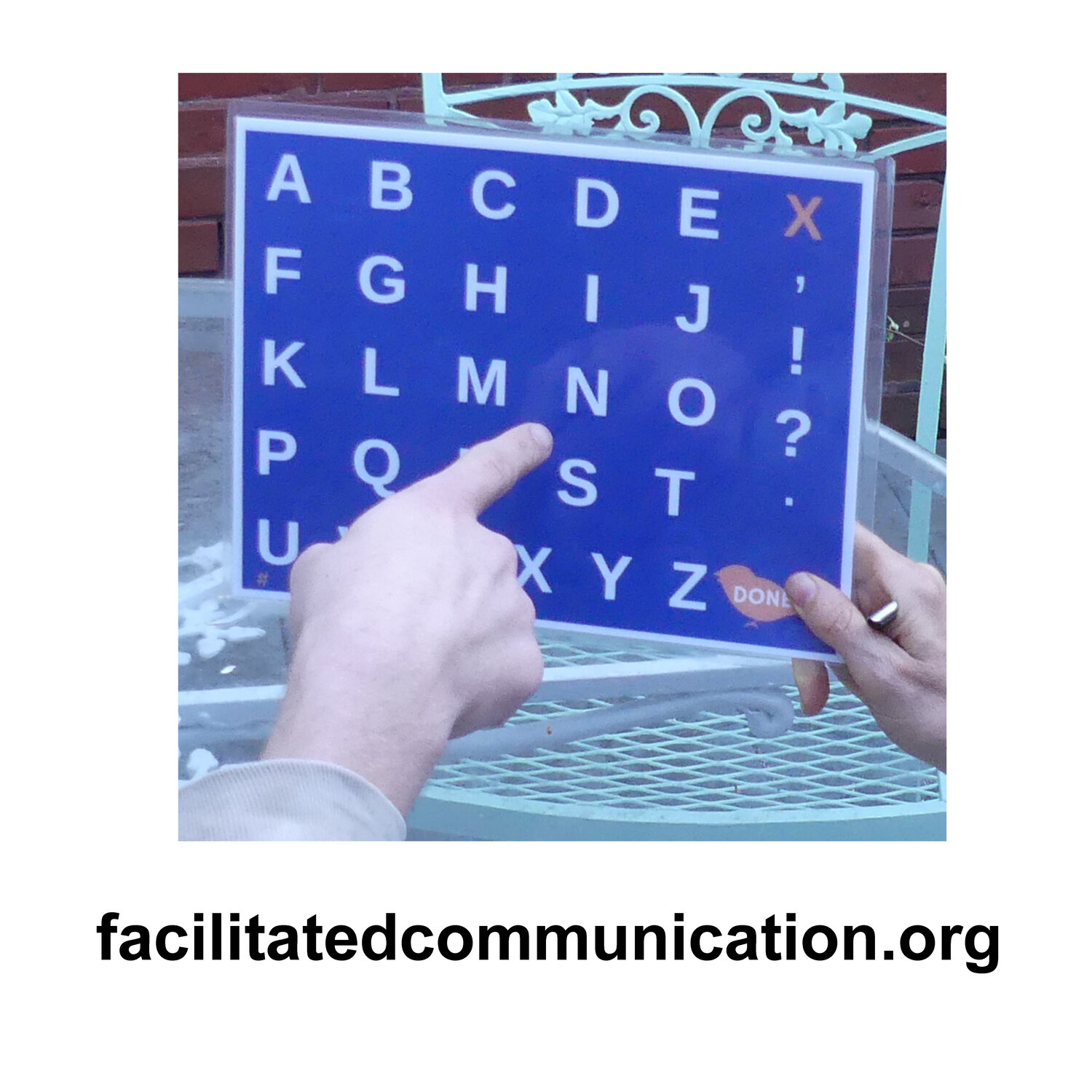
The individual being facilitated is not looking at the board during the “spelling” process while the facilitator holds the board in the air. (Spellers, 2023)
For our first hour‑long session, under the supervision of a parent trained in Spellers Method, the speller and I jumped right in. We reviewed science lessons, spelled highlighted words, and answered multiple‑choice questions. My role was simply to hold a wireless keyboard in midair, focus on the letter the speller was aiming for, and subtly shift that letter key closer to their finger. Within about 30 minutes of practice, we could answer any of the questions with ease. The process felt effortless because the speller was already at an expert level. At times, their finger would hover over the wrong key, so I would reset the keyboard’s position and angle the correct key closer. For example, if the answer was “HAT,” and their finger stalled on “G,” then I would raise and lower the keyboard so “H” was directly in their line of sight. Other times, their finger would touch a key without pressing firmly enough for it to register, and I would gently press the keyboard into their finger to complete the keystroke. I understood these actions as helping with the speller’s apraxia and didn’t see how I could influence anything.
By our third session, I noticed that whenever I held the keyboard still, looked away, or stopped thinking about what was being typed, the speller would make mistakes or stop typing. I was also strangely sensing I could get the speller to spell whatever I wanted, but I never tested it out because that felt unethical to me. The strangest thing was that every 15 minutes or so, the speller would grab a nearby laptop and mouse, click open YouTube, autonomously type a particular cartoon episode title in the search bar, open the video, and scroll to the exact second of a particular scene. According to The Spellers Guidebook, spellers can use their fine motor skills to type low cognitive outputs such as their favorite familiar phrases into YouTube but require motor coaching to type high cognitive outputs such as open conversations.
During our fourth session, the speller unexpectedly answered a multiple‑choice question with “THIS IS EASY.” I was elated—we were finally having an open conversation. I asked, “Is this too easy for you? Is that what you want to tell me?” The speller typed, “FINALLY A REAL FRIEND.” I was shocked. Thinking back to a month earlier, I remembered meeting another speller and their parent featured on The Telepathy Tapes at a fun get-together, who had greeted me with the exact same message: “FINALLY A REAL FRIEND.” The two spellers met me under different circumstances and didn’t know each other, so how did they tell me the same thing?
Before entertaining telepathy as an explanation, spelling on a held-up letter board, which is the vehicle for expressing telepathy as reported on the Telepathy Tapes, must be validated (i.e., it must be verified that the speller is the one controlling the messages). Yet parents kept saying schools didn’t believe in or accept spelling, which motivated me to research and prove the skeptics wrong. The first informational website I came across was facilitatedcommunication.org, but parents had warned me already the site was biased, unreliable, or allegedly in cahoots with the American Speech/Language Association (ASHA) to acquire their ill-gotten gains by suppressing spelling. (See Opposition Statements) So, I searched for “facilitated communication” on YouTube and watched the 1993 documentary Prisoners of Silence.
I was stunned. The failed message‑passing tests demonstrated that the facilitator—not the client—was always the true author of the messages, and the mystery of “FINALLY A REAL FRIEND” was explained. In my effort to erase all doubts to the point of misleading myself, I had subconsciously engaged in ideomotor movements and automatic writing. The moment I realized I was having an open conversation with myself, not the client, the entire framework collapsed: presume competence, apraxia, spelling partner, independent typing, eye-tracking evidence, anecdotal evidence, vision and memory issues, the Cardinal/Sheehan/Weiss studies (poorly controlled studies cited by proponents on social media) , etc. — all of it.
Now that I know some parents are unwittingly forcing their children into FC and its variants S2C/RPM/Spellers Method—often misconstruing the child’s resistance as “apraxia”—I warn those parents:
1. Your kid does not want to spell and has tried telling you so by shouting, crying, kicking, hitting, running away, throwing the board, hiding it, avoiding it, refusing to look at it, poking at random letters, or showing no interest. Your kid has verbally said:
“No.”
“Stop.”
“Hurt.”
“No more.”
“All done.”
“Go home.”
“I don’t want to.”
“No spelling.”
“I hate spelling.”
“This is stupid.”
2. People tell you to ignore their apraxic body and persist with the session.
3. What if your kid is right, and the people insisting on “apraxia” are wrong? Listen to your kid.
Thank you facilitatedcommunication.org.
Today’s guest blog post was by Steven Li, a former facilitator from Philadelphia, Pennsylvania
Note from the editors: Our website has no affiliation with the American Speech/Language/Hearing Association (ASHA). We support evidence-based Augmentative and Alternative Communication (AAC) techniques and methods that lead to independent communication for individuals with disabilities.
To date, FC/S2C/RPM and their variants are not proven to be legitimate forms of AAC. Rather the words generated via facilitator-dependent techniques represent the words of the facilitators, not those being subjected to facilitation. (See Systematic Reviews)
We are happy to review any reliably controlled testing (pro or con) that addresses concerns about facilitator authorship due to cueing and control during letter selection, as well as prompt dependency and abdication patterns in individuals being subjected to these techniques.
References and Recommended Reading
Beals, Katharine (2021, May 12). A Recent Eye-Tracking Study Fails to Reveal Agency in Assisted Autistic Communication. Evidence-Based Communication Assessment and Intervention, DOI: 10.1080/17489539.2021.1918890
Boynton, J. (2012). Facilitated Communication—what harm it can do: Confessions of a former facilitator. Evidence-Based Communication Assessment and Intervention, 6:1, 3-13. DOI: 10.1080/17489539.2012.674680
Blog Posts
Do Critics of FC “Presume Lack of Competence?” Part I: Calculator and Singer
Do Critics of FC “Presume Lack of Competence?” Part II: Green & Shane
Do Critics of FC “Presume Lack of Competence?” Part III: Jacobson, Mulick & Schwartz
Do Critics of FC “Presume Lack of Competence?” Part IV: Wheeler, Jacobson, Paglieri, and Schwartz
Do Critics of FC “Presume Lack of Competence?” Part V: Review of Broderick and Kasa-Hendrickson
Do Critics of FC “Presume Lack of Competence?” Part VI: In Sum, No.