When did the FC leadership know about the fatal flaws with their technique? (Part 1)
The other day, I was listening to a podcast featuring two Speech/Language Pathologists (SLPs) discussing their concerns about the Telepathy Tapes and Spelling to Communicate (S2C). I enjoyed their discussion and their refreshing willingness to question the claims being made by FC/S2C proponents. At one point in their discussion, they pointed out that studies older than 10-15 years often contain outdated information. Their suggestion was that people should look for more current studies on which to base their (professional) opinions. In general, I don’t disagree. However, when it comes to facilitator-dependent techniques like FC/S2C/RPM and their variants, I can think of at least three reasons why we should look at those “old” studies. For the sake of ease, I’ll use FC as an umbrella term for all forms of facilitator-dependent techniques.

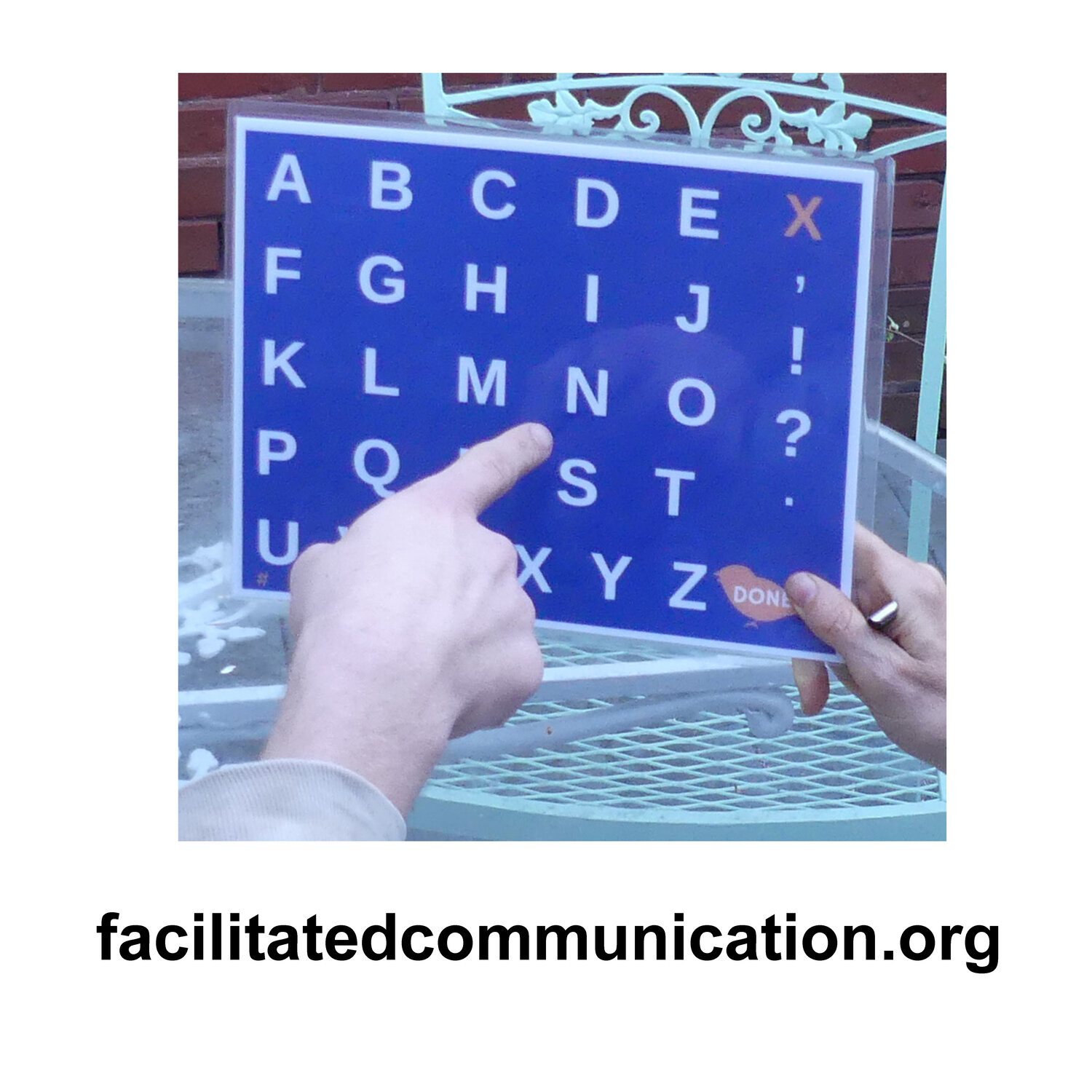
Image by Amandine Bataille
First, the mechanics of FC hasn’t changed all that much over the years, even though proponents of the technique have convinced themselves that it has. By the time FC made its way to the United States circa 1990 (thanks in large part to the marketing prowess of Douglas Biklen of Syracuse University), Australia had already studied—and thoroughly discredited the technique. (See The Unusual and Excessive Hype of FC).
And, let me be absolutely clear, the problem with FC wasn’t the individuals being subjected to the technique. It was the technique itself. It was not the low- or high-tech equipment that was the problem. It was, I’ll repeat, the technique itself and how well-meaning facilitators were (wittingly or unwittingly) taught in workshops to control letter selection through physical, visual and auditory cueing. And, it was the leaders of the FC movement who kept selling the idea of FC—a fatally flawed technique—to unsuspecting parents, caregivers and educators despite all the existing evidence that showed not only how FC can’t work, but also how it doesn’t work as an independent form of communication.

Examples of physical cues used by facilitators from the 1990s to well into the 2000s, despite claims of communication “independence” (e.g., FC doesn’t work without facilitator cueing of some sort)
And, while variants of FC have developed over the years into so-called “modern spelling methods” (See Katharine’s blog post Barry Prizant and David Kaufer take on the “naysayers” and “haters” of “modern spelling methods”), the fatal flaws in the technique were well-documented by 1992-1993—so much so that major organizations in the United States started publicly opposing its use by 1995. These opposition statements remain in place today because proponents of FC, to date, have failed to produce reliably controlled evidence to back up their claims that the use of facilitator-dependent techniques leads to communication independence (see Opposition Statements).
Note: A new systematic review of S2C/RPM and their variants was just published this week: Schlosser, R. W., Shane, H., Bryant, L., Beals, K., Todd, J., Lang, R., Skinner, S., & Hemsley, B. (2026, accepted 4th May). Systematic Review of Authorship in Rapid Prompting Method, Spelling to Communicate, and Variants: Outcomes, Significance and Clinical Implications. Review Journal of Autism and Developmental Disorders. (Accepted unformatted version, open Repository the University of Newcastle).
Second, current day proponents refuse to participate in reliably controlled tests designed to separate out facilitator behaviors (e.g., physical, visual, and auditory cueing). It’s difficult to explain how and why FC and its variants are fatally flawed without referencing the body of existing work that details how reliably controlled studies are designed and the replicable outcomes that occur when researchers control for facilitator behaviors that can and do influence and control the FC-generated “spelled” output. Facilitators exhibit behaviors that physically, visually, or verbally/auditorily cue their clients and teach them, through behavior modification and positive reinforcement, how to select keys on a keyboard (or letters on a letter board) often without taking into account the person’s language and literacy skills (or lack thereof). The “old” studies demonstrated that individuals being subjected to FC can learn to select letters without comprehending what is being spelled on their behalf. (See Systematic Reviews)
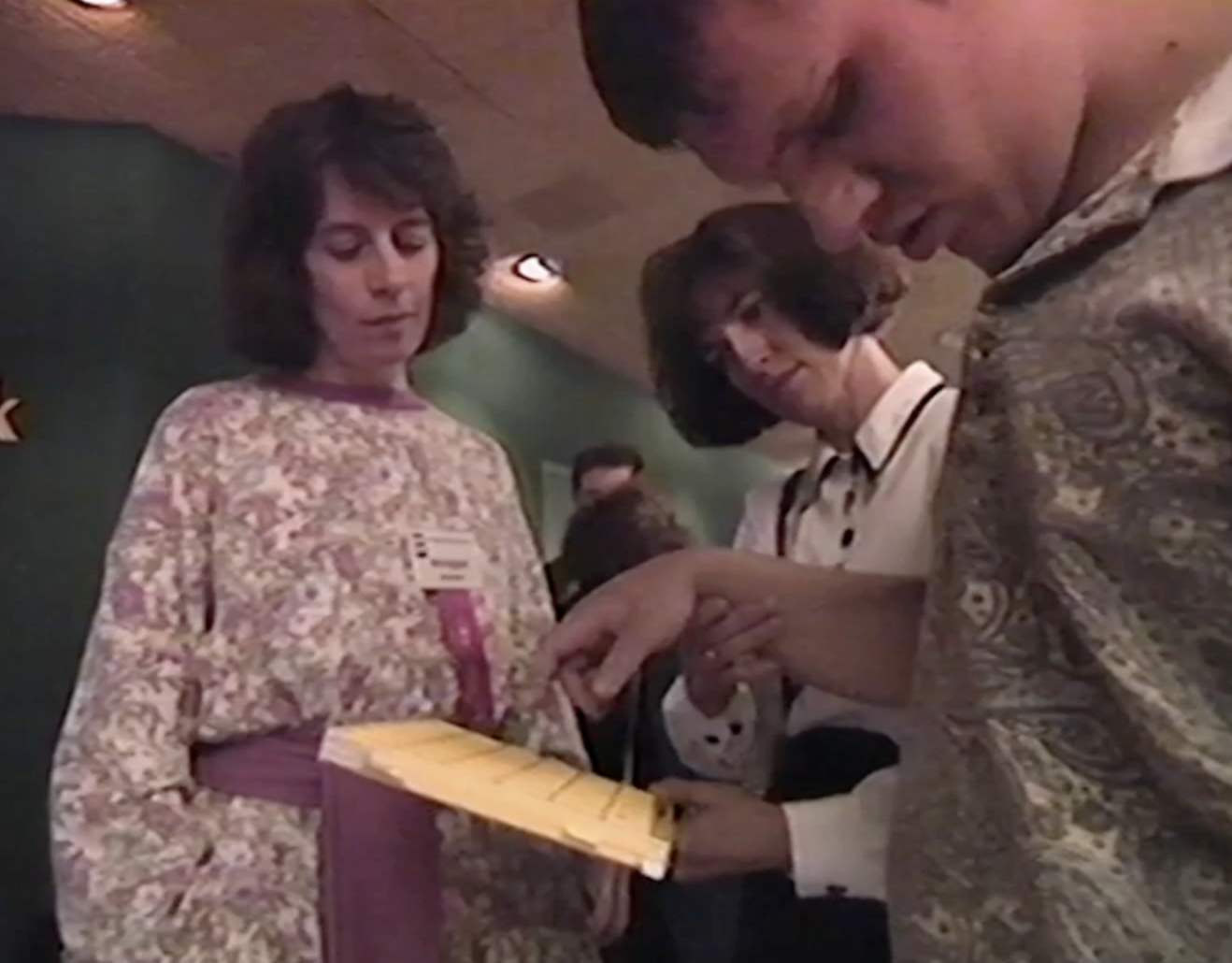
Syracuse “master trainer” Annegret Schubert observes an FC session while the facilitator holds the letter board in the air (S2C/RPM-style) and the individual being facilitated has his eyes closed. (Prisoners of Silence, 1993)
Note: Not all facilitator cueing can be attributed to the ideomotor response (or the Clever Hans effect), but that’s where critics of FC started in the early days. Had early adopters of FC done their due diligence, they would have learned that the ideomotor response (e.g., small non-conscious muscle movements that occur when a facilitator cues their client physically or holds a letter board in the air) started appearing in medical/scientific literature by the late 1800s. (See Spitz, 1997)
Third, the anti-testing, anti-science sentiment has always been an integral part of the facilitator mindset. (See Jacobson, et al., 1995). From its inception, FC guidelines discouraged testing, claiming that any questioning of the FC-generated output would somehow break the trust-bond between facilitator and client. That broken trust, in turn, would halt the individual’s ability to spell using FC.
I remember personally struggling with the idea of participating in controlled testing (in 1993), since the FC leaders in the workshop I took strongly advised against it. At the time, it felt more like peer pressure than anything else (expressing doubts about FC was strongly discouraged), but today’s facilitators are explicitly taught that testing for authorship is unethical, even though there is no evidence in the reports of these controlled tests to back up this claim. (See Katharine’s blog post Spelling to Communicate Goes on Trial - Part IV).
Proponents also strongly market the idea in their literature that the “old” testing itself was unethical. It’s not what I experienced and, as far as I can tell in the studies I’ve reread so far, (See my YouTube channel for video reviews of these studies). it’s also not what the facilitators of the time experienced either. The facilitators and the participants in the early authorship tests were willing participants. Just because the results weren’t what proponents expected, wanted or believed would happen doesn’t mean the tests were unethical.

Researchers at the O.D. Heck Center in New York preparing for authorship testing (Prisoners of Silence, 1993)
Rather, from what I can tell from the reports, early facilitators felt an ethical duty to know for sure whether they were (inadvertently) controlling letter selection. Most authorship tests were not the results of (false) allegations of abuse (another myth perpetuated by proponents), but rather by conscientious researchers who wanted to be sure the facilitated communications represented the clients’ words, not the facilitators’ words. Their expectation in doing the testing was to demonstrate and document that FC-generated messages were valid and they understood how high the stakes were for proving its efficacy. (See Controlled Studies)
I’ve always wondered just when proponents knew about the flaws in their technique. It didn’t bother me so much that they initially fell for what seemed like a promising technique. Lots of people—including me—fell (and keep falling) for the illusion. But what has mattered to me most over the years is the behavior people exhibit after learning about the flaws of the technique. Do they ask questions or do they dismiss critics’ concerns off-handedly? Do they read the research or downplay its existence? Do they test the technique under reliably controlled conditions, or do they resist authorship testing? Do they try to find out and address critic concerns or do they respond with ad hominem attacks? Whose interests do they put first, those of their clients or their own? (See Katharine’s blog post Back and Forth with Barry Prizant)
One of the documents I’ve had long buried in my files is a newsletter from Syracuse University’s Institute on Community Inclusion (ICI). The article originally appeared in Vol. 1 No. 3 (May, 1993) of the Facilitated Communication Digest, pp. 11-12 and is titled “Issues of Influence: Some Concerns and Suggestions.”
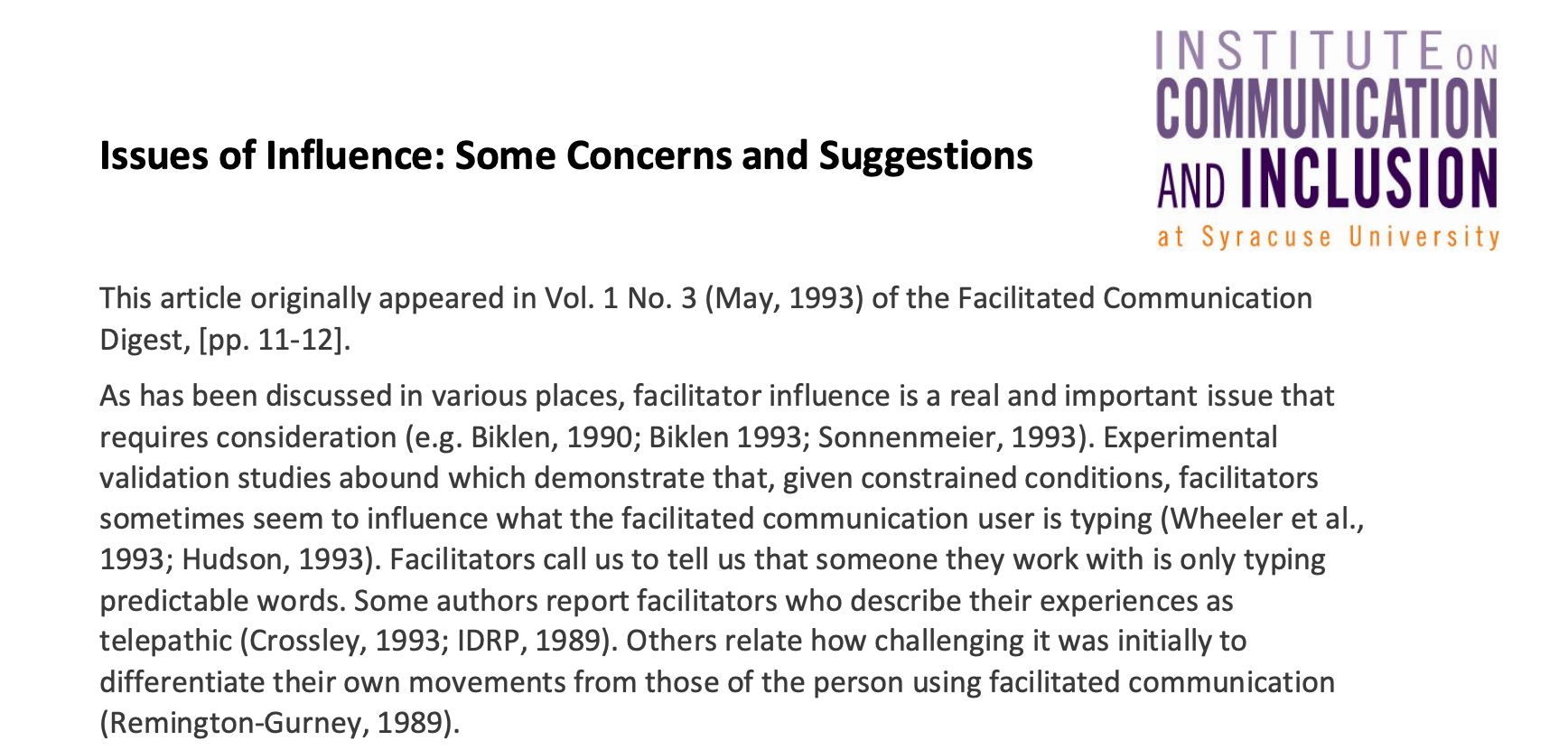
Screenshot of part of the ICI Newsletter (Syracuse University)
In 1993, the ICI was called the Facilitated Communication Institute, but the FCI was rebranded circa 2010. As I’ve pointed out in past blog posts, here’s a quote from a 10/25/15 New York Times article called “The Strange Case of Anna Stubblefield” that explains the decision:
“Meanwhile, because of past scandals, facilitated communication has been quietly rebranded. In 2010, the Facilitated Communication Institute in Syracuse changed its name to the Institute on Communication and Inclusion. “We need to do more on FC, but we can’t call it that,” said John Hussman, a major donor to the institute who runs a $6 billion mutual fund and whose son uses the technique. He had just given a talk on the neuroscience of what is now often termed ‘supported typing’. “We have to come up with some other name to fly under the radar and maintain credibility.” he said. (emphasis mine)
I’m not sure when (circa 2020?), the ICI was rebranded once again. It is now part of the Center on Disability and Inclusion at Syracuse University and is known as “Inclusion and Communication Initiatives.” I understand from sources at the university that the FC program has been discontinued, but I, personally, find that hard to believe given that Douglas Biklen’s disciple, Christine Ashby replaced him when he retired. I’d love to believe the ICI has discontinued promoting FC, but then again, they have a known history of “flying under the radar.”
In the “Issues and Influence” document, the main discussion point is facilitator influence over letter selection. So, it’s safe to say that by May of 1993, the FC leadership definitely knew about and understood that there were problems with their technique. In fact, they admitted that “experimental validation studies abound,” (their word, my emphasis), indicating not just one study of the kind, but many. And these studies, the ICI newsletter states, “demonstrate that, given constrained conditions, facilitators sometimes seem to influence what the facilitated communication user is typing.” The article cites two sources to back up the statement: Wheeler et al., 1993 and Hudson, 1993.
But the phrasing in the newsletter—that facilitators “sometimes seem to influence what the communication user is typing”—grossly underrepresents the findings of the two studies they cite (not to mention the other authorship studies of the time that the ICI chose not to include in their newsletter) (emphasis mine).
Wheeler et al., for example found that:
“For these pairs, composed entirely of participants who were almost a stereotype (in literary description) of the most appropriate treatment population, and paraprofessionals and professionals who are both skilled and experienced in working with people who have autism and highly motivated to serving them effectively, there is very clear, uncontestable proof of what we can only call facilitator control.” (emphasis mine)
The ICI newsletter also failed to mention that three of the facilitators in the Wheeler study were trained at Syracuse University’s Facilitated Communication Institute (and thus, presumably, were not “poorly trained”).
Readers would not have known from reading the ICI newsletter that the Hudson 1993 study referenced was initiated because of FC-generated allegations of abuse brought against the family of one of founder Rosemary Crossley’s clients at the DEAL Centre (ground zero for FC in Australia). (See Paul Heinrich’s 1992 series about the court case in the False Allegations of Abuse section of our website). Eight of Crossley’s trained facilitators were also part of the court case. Again, presumably the facilitators were not “poorly trained.”
This case, known as the “Carla” case in the press, was notable partly because the judge called the situation “tragic” and admonished Crossley and the facilitators for not doing their due diligence. The judge ruled in favor of the family after learning that the testing demonstrated “quite clearly that the subject was not able to communicate using the facilitated communication technique.”
Hudson, an expert witness in the “Carla” case, was also involved with two other studies in 1993 (which were not mentioned in the ICI newsletter):
Moore, Donovan, and Hudson. (1993). Brief Report: Evaluation of Eight Case Studies of Facilitated Communication. Journal of Autism and Developmental Disorders. Vol. 23(3); pp. 531-539.
In this report, we learn of the authors’ deep concern about facilitator control over letter selection. They wrote: “The general failure of all subjects in this study to demonstrate an ability to communicate using the FC technique, when considered with similar results from other studies (Intellectual Disability Review Panel 1989; Hudson et al. 1993), suggests that the technique and its uses must come under scrutiny.”
Moore, Donovan, and Hudson. (1993). Brief Report: Facilitator-Suggested Conversational Evaluation of Facilitated Communication. Journal of Autism and Developmental Disorders. Vol. 23 (3); pp. 541-552.
Again, the authors report on the technique’s flaws:: “The alternative methodology of using conversational responses failed to produce evidence of the ability of any of the 5 subjects to validly communicate using FC.”
Note: This study was a follow-up to the first study by these authors in response to facilitator complaints that the methodology (in the first study) was flawed. The authors designed the second study based on facilitator suggestions that the methodology be more “conversational” in nature. And, yet the results of the testing were the same. When facilitators were blinded from test stimuli (e.g., objects shown to the participants and/or topics of conversation presented to them by their primary caregivers), the participants were unable to respond correctly via FC-generated messages, though in both tests, some of the participants responded to the test stimuli correctly verbally and seemed to prefer spoken language to FC.
In my experience and in the FC literature, proponents’ reaction to anyone expressing concerns about facilitator cueing produces an emotional reaction rather than a considered, academic response. Rather than producing reliably controlled evidence to back up their claims of communication independence, proponents fall back on ad hominem attacks, labeling critics of the technique of FC as ableist, materialists, and against people with disabilities. This (tiresome) bullying tactic has, over the years, served to silence some critics of FC (especially facilitators and/or parents who’ve tried the technique but abandoned it for ethical reasons). But, it won’t stop the people supporting this website from speaking out and educating people about the harms of these techniques. Ad hominem attacks are not evidence.
If the so-called “modern spelling methods” are FC, then proponents should look to the controlled studies that have already been done and acknowledge the flaws in the technique. If these methods aren’t FC, then proponents need to provide reliably controlled evidence that their techniques work. Either way, it’s up to proponents of FC/S2C/RPM and their variants to prove their rather extraordinary claims that facilitator-dependent techniques lead to independence for those being subjected to them.
In my next blog post, I’ll continue discussing this 1993 artifact from the ICI. Interestingly, the topic of telepathy comes up in the newsletter. I’d always been under the impression that the idea of telepathy and FC cropped up first in the United States, but it appears that some of Crossley’s facilitators had the idea first. More on that topic to come.
Note: For those thinking that the “modern spelling methods” aren’t FC, please check out my reviews of Portia Iversen’s book “Strange Son.. Soma Mukhopadhyay, credited for the first so-called “no touch forms of FC” used FC first, then failed a simple message passing test that her husband set up. Instead of turning to legitimate forms of Augmentative and Alternative Communication (AAC), she “invented” RPM because she was aware a so-called “no touch” style of FC would at least give the illusion of independence. She also failed a simple message passing test a few years later using RPM. To date, no FC/S2C/RPM practitioner—including those in leadership—has successfully proven their claims of communication independence under reliably controlled conditions.
Truth Will Out: Review of Portia Iversen’s “Strange Son”
Strange Science in Iversen’s book “Strange Son
Blog Posts in This Series
When did the FC leadership know about the fatal flaws with their technique (Part 2 - IDRP)
When did the FC leadership know about the fatal flaws with their technique (Part 3 - Cummins and Prior)
References and Recommended Reading
Heinrichs, P. (1992, February 16). Suffering at the Hands of the Protectors. The Sunday Morning Herald.
Heinrichs, P. (1992, February 16). State 'tortured' family – 'tragic'. Sunday Age (Melbourne, Australia) Late Edition, pp. 1
Hudson, Melita, Arnold. (1993). Brief Report: A case study assessing the validity of facilitated communication. Journal of Autism and Developmental Disorders. Vol. 23 (1), 165-173
Iversen, Portia (2006). Strange Son: Two Mothers, Two Sons, and the Quest to Unlock the Hidden World of Autism. Riverhead Books.
Jacobson, J.W., Mulick, J.A., and Schwartz, A.A. (1995, September). A history of facilitated communication: Science, pseudoscience, and antiscience. Science Working Group on Facilitated Communication. American Psychologist. 50 (9), 750-765.
Spitz, H. (1997). Nonconscious Movements: From Mystical Messages to Facilitated Communication. Routledge. ISBN 978-0805825633
Wheeler, D.L., Jacobson, J.W., Paglieri, R.A., and Schwartz, A.A. (1993, February). An Experimental Assessment of Facilitated Communication. Mental Retardation. Vol. 31 (1); 49-60.