Barry Prizant and David Kaufer take on the “Naysayers” and “Haters” of “modern spelling methods”
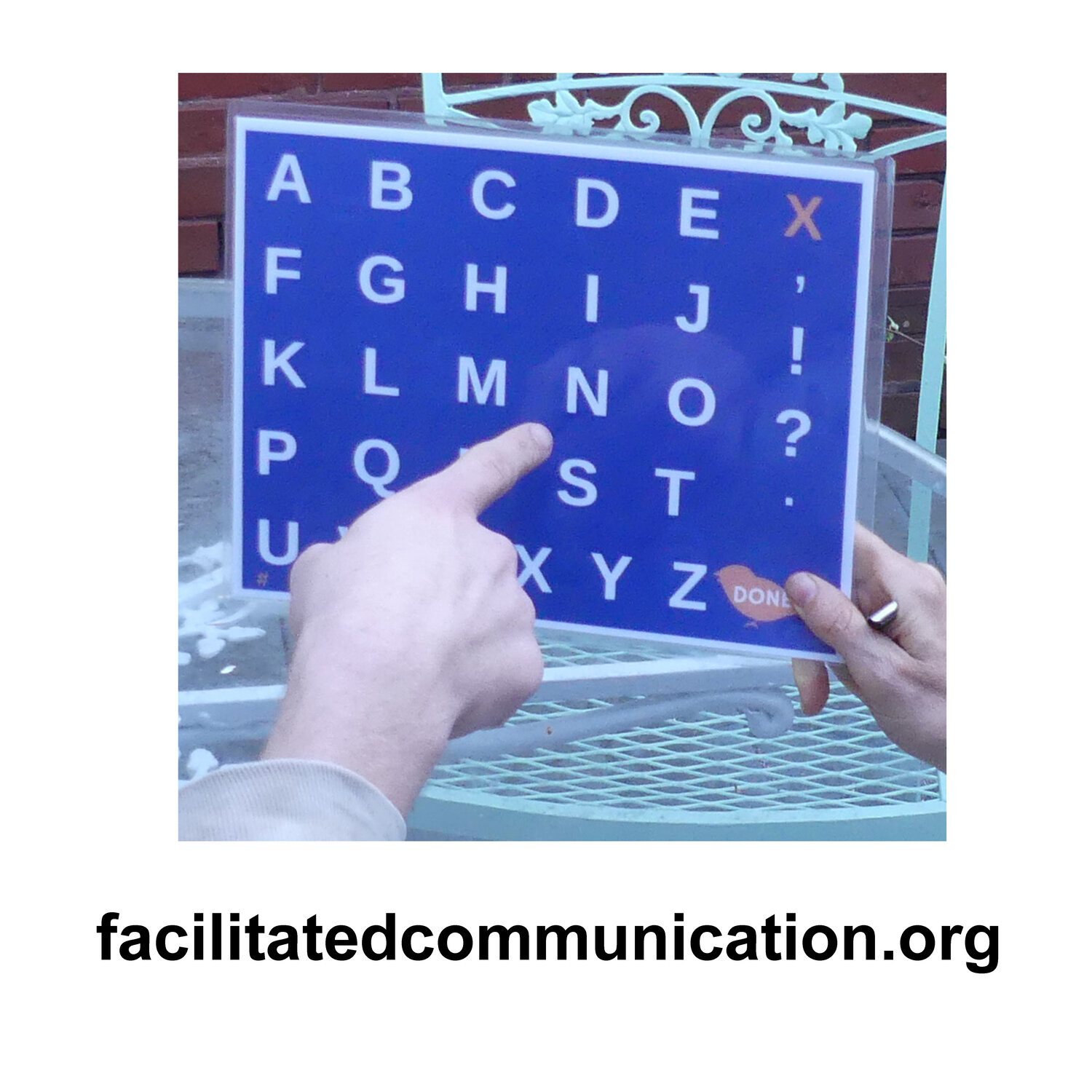
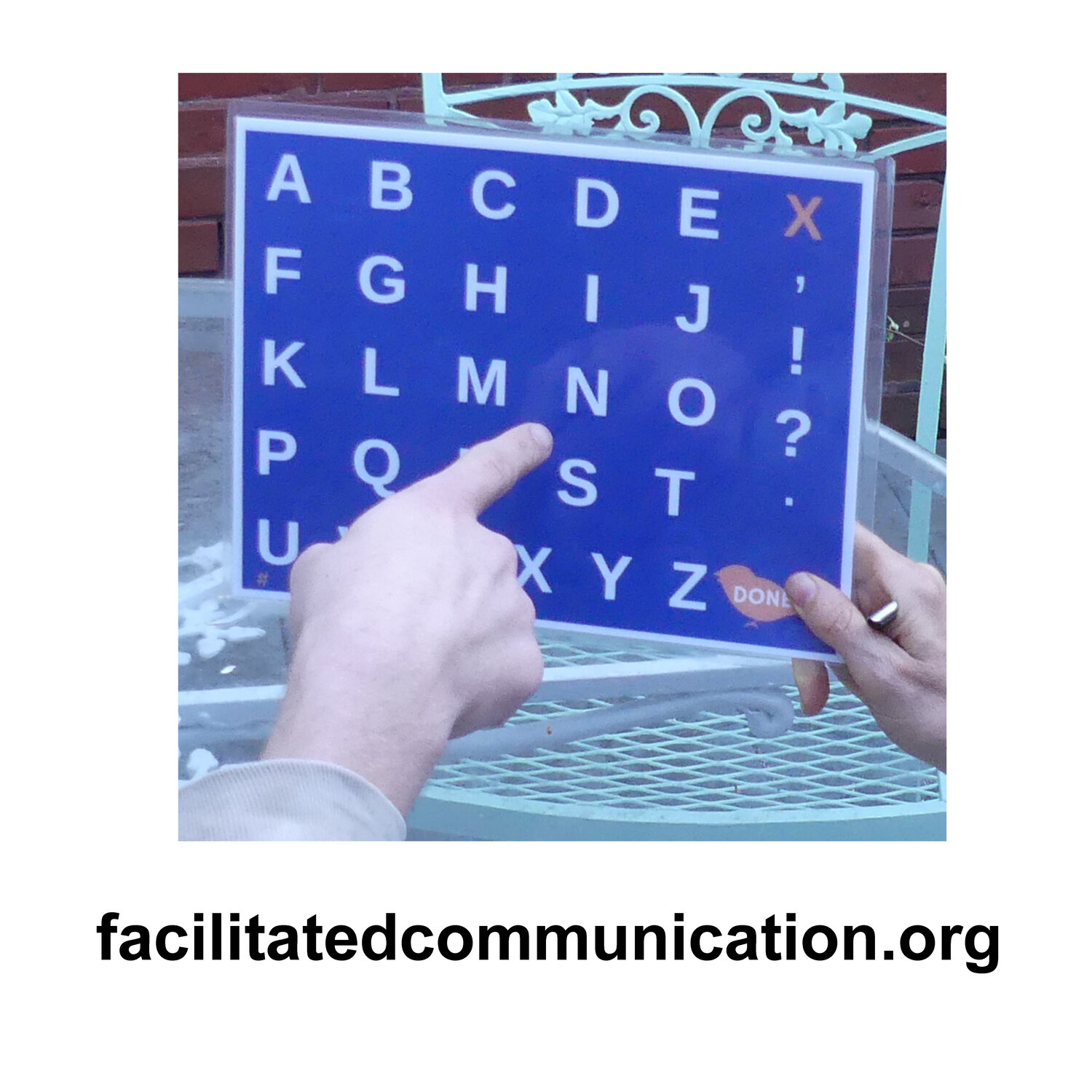
In a recent episode of his Uniquely Human Podcast, pro-FC convert Barry Prizant hosted David Kaufer, the parent of a non-speaking son and an advocate of what he calls “modern spelling methods.” For those who can’t guess what “modern spelling methods” means in the context of this website, it doesn’t mean using morphology and etymology to help students learn to spell words like “two,” “sign,” and “pleasant.” Instead, in the weird, Orwellian world of FC, “spelling” has come to mean pointing to letters with a single extended index finger while a facilitator holds up a letterboard, moves it around, decides which letters were selected, and/or hovers nearby and prompts. In other words, “spelling” is a cover term for FC and its variants, and “modern spelling methods” is a cover term for the most recent of these: e.g., Rapid Prompting Method (RPM), Spelling to Communicate (S2C), Spellers Method, and Typing for Communication (T4C).
Curiously, the minimally speaking autistic individuals who “spell” aren’t ever taught how to spell, at least in any systematic way: no weekly spelling words or morphological and etymological analyses for them. Instead, they’re assumed not only to already know how to spell most words, but also to already know the meanings of the sophisticated words they spell, despite what all the available evidence tells us about the limited receptive language skills of minimal speakers with autism (see also Bal et al., 2016). When FC/”modern spelling” advocates talk about the laborious training that “spellers” are put through, and about their ongoing struggles to “spell,” they’re not talking about challenges like whether a word is spelled “ee” or “ea” (something I still struggle with to this day), or whether it’s “principle” or “principal.” Instead, they’re talking about the laborious training, and the ongoing struggle, to control and regulate bodies that are purportedly so afflicted with “global body apraxia” and/or minds that are so emotionally dysregulated that:
They’re unable to reliably perform actions on command, including movements like pointing at particular targets, and
None of their physical behaviors reliably reflects their actual intentions.
I say “purportedly” because none of the many people who have made this claim have ever cited a single empirical study that has found any evidence that minimal speakers with autism have “global body apraxia,” or motor-based problems with pointing, or minds so dysregulated that they can’t communicate anything without constant facilitator involvement. Some of these folks cite studies that they claim provide such evidence (Bhat, 2020; Fournier et al., 2010; Mostofky & Ewen 2016; and Torres, 2013 are favorites) but none of these studies actually provide such evidence.
Returning to the Uniquely Human Podcast, Barry Prizant has been pushing FC /”modern spelling methods” for years now. Indeed, his professed views very much resonate with the Neurodiversity Movement’s take on autism as first and foremost a unique way of being human—as opposed to the potentially profound socio-cognitive disorder that eight decades of clinical observation, diagnostic criteria, and rigorous research have shown it to be. But rather than defending his take on autism, Prizant, egged on by Kaufer, laments the purported lack of scientific rigor, lack of openness and curiosity, lack of support for communication rights, ableism, and cultish tendencies of those they call “nay-sayers” or “haters.”
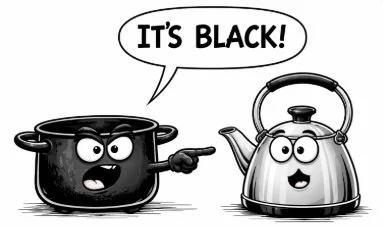
image by ChatGPT
Prizant and Kaufer also accuse the other side of failing to presume competence, apparently oblivious to the likelihood that presuming that someone has so little control over their body that all their behaviors (except those elicited by their facilitators) are essentially meaningless... is the most extreme presumption of incompetence that’s ever been made. Indeed, not just the most extreme, but the most dangerous, for many of those purportedly meaningless behaviors include behaviors that commonly communicate wants, needs, aversions, and emotional distress.
What makes the presumption of incompetence by Prizant, Kaufer, and all the other FC/”modern spelling” proponents even more extreme is the fact that they make the presumption without any evidence to back it up.
This brings me to a quick side note about one of Prizant’s terms. “Nay-sayer” is an odd epithet to bestow on one’s opponents: after all, there are many things to which it’s totally appropriate to say no. But for Prizant, “nay-sayer” appears to mean “person who disagrees with me.” As for the alleged ableism and hating (“hater” is Kaufer’s preferred term), some of the most remarkable things about proponents of FC/”modern spelling” are:
Their zealous attempts to erase intellectual disability and
Their zealous celebrations of revelations that a new “speller” has, purportedly, spectacularly defied the terribly disappointing low IQ scores that traditional cognitive testing had assigned to them.
Besides calling us “ableist,” etc., one of the main criticisms that Prizant and Kaufer level at the “nay-sayers”/”haters” concerns our insistence that message-passing tests are the only valid way to determine who is authoring a message, and our discriminatory calls for such tests to be inflicted specifically on autistic non-speakers. I say “our” here because in this podcast Prizant “names names”—just as he promised he would when he first publicized it and two other related podcasts. In this podcast, the second in the series, the honor of being named by Barry Prizant is shared by me and Howard Shane.
The basis for Prizant’s claim that message-passing tests are invalid is that they don’t appear in the Mental Measurements Yearbook. This is a new argument I hadn’t heard until recently. (Had the Lower Merion Court Case gone to trial, I apparently would have heard Prizant making that argument last year). Nor had I heard of the Mental Measurements Yearbook, which reviews psychological, neuropsychological, educational, and vocational tests. But message-passing tests are none of these. They are neither psychological, nor neuropsychological, nor educational, nor vocational.
Message-passing tests are simply one of an indefinite number of actual and theoretically possible commonsense tests where you control for one variable in order to establish the influence of another variable. A well-known example is the broken flashlight test that’s often used to demonstrate the scientific method to elementary school students. To see if the battery is the reason the flashlight won’t turn on, keep everything else the same and change the battery. To see if the light bulb is the reason, keep everything the same and change the light bulb. In a message-passing test, the possibility for facilitator influence is what’s changed (i.e., eliminated) by blinding the facilitator to either the letterboard or the stimulus (picture, object, word) that the facilitated person is asked about while keeping everything else the same. Message-passing tests don’t appear in the Mental Measurements Yearbook. Neither do the flashlight tests. To call such commonsense, variable-controlling tests invalid for not appearing in the Mental Measurements Yearbook is to invalidate much of what human beings do when we problem-solve our way through the mechanical, technological, and social aspects of daily life.
Message-passing tests are a kind of authorship test. In everyday life, the need to test authorship comes up routinely, particularly if you’re a teacher, and especially in the age of AI. Authorship tests include cutting and pasting a paragraph from a student essay into a search window to see if it shows up as someone else’s writing, or asking the student to provide a detailed, oral explanation of something they purportedly wrote. I’m pretty sure that neither of these methods appears in the Mental Measurements Yearbook.
Nor are authorship tests discriminatory against certain groups of people. They’re not done because someone belongs to a particular group, but because a methodology or a message looks suspicious. Only some student work looks like it might have been written by a professional writer or ChatGPT; only some types of communication partner behaviors look like they could be controlling the other person’s messages.
In the Podcast, Barry Prizant reminds us of just how convincing he found S2C-based facilitation when he visited the clinic of S2C “inventor” Elizabeth Vosseller in 2018 and watched her Tribe of autistic minimal speakers point to letters on held-up letterboards. Prizant claims these individuals were highly engaged in spelling out messages and made appropriate eye contact with their interlocutors; he claims that he knew from all his decades of clinical experience that they were communicating intentionally. But in the videos I’ve seen of members of the “Tribe,” for example this one, what’s evident isn’t engagement and eye contact, but disengagement and distress.
In his letter to the American Speech Language Hearing Association objecting to its position statement against Rapid Prompting Method and describing his experience with Vosseller’s Tribe, Prizant made similar remarks about engagement and eye contact, and also said:
[I]n no, and I mean NO instances where they physically or gesturally directed to specific letter targets.”
This has me wondering what Prizant makes of all the S2C-mediated telepathy out there, for example, what starts unfolding at the 30:25 minute mark of this video of the “Contact in the Desert.” The S2C-ed girl is blindfolded, her mother is shown various pictures, and when her mother un-blindfolds her and holds up a letterboard, the girl somehow types out what the mother saw. There are no obvious signs of cueing, and yet if the mother isn’t controlling the messages, the only other “obvious” explanation is telepathy. Does Prizant want to go there? So far, he hasn’t, at least in public. Kaufer has hinted that he’s open to the idea that minimal speakers with autism are telepathic... but doesn’t want to embrace it publicly.
Even if Prizant and Kaufer are certain that the proliferating reports of S2C-mediated telepathy aren’t red flags for facilitator control—i.e., for the ability of facilitators to totally control S2C-generated messages with cues too subtle for outsiders to detect—surely, if they thought this through judiciously, they would at least understand:
Why reasonable people might view the numerous reports of telepathy as signs that S2C facilitators can (however unwittingly) control S2C-generated messages
Why these people might therefore be concerned that S2C is violating the communication rights of minimal speakers with autism
Why these people think that message-passing tests are essential for ruling in or out facilitator control over messages.
Interestingly, Kaufer tells us (starting at around the 16:30 minute mark) that, as part of a due process lawsuit against his son’s public high school for refusing to allow an S2C communication partner to provide “letterboard” support, the school put his son through a standardized assessment that included a message-passing test. His son, Kaufer tells us, failed the message-passing test and then “spelled” out that he failed it on purpose. Apparently he now no longer wanted to attend that school. (Kaufer cites deliberate failures of message-passing tests by those who feel insulted about being subjected to them as another reason why message-passing tests are invalid.)
Side note: Kaufer also reported that his son spelled out that the school was “a toxic environment.” The word “toxic” caught my ear: it’s a sophisticated word, and when used in this context, it’s metaphorical. Not only is “toxic environment” well out of the comprehension range of most minimal speakers with autism; it’s also out of the comprehension range of many less profoundly autistic individuals who can express all their thoughts in spoken words. I checked in with a moderately autistic family member who is considerably older than Kaufer’s son (he’s several years out of college now) and who communicates readily through speech. I asked him what “toxic environment” meant, and the only examples he could cite were environments of literal toxicity, for example, “near a nuclear power plant.” He had no idea what a “toxic environment” might mean metaphorically, say in the context of high school.
Speaking of family members, another argument that Prizant and Kaufer level at the “nay-sayers”/”haters,” besides ableism, etc., is that we’re ignoring the lived experience of families who use S2C. Lived experience, of course, is important. But it tends to be full of subjective experiences, and subjective experiences tend to be... subjective. If we’re going to listen to such experiences, we should make sure we listen to all of them. In the context of FC and “modern spelling methods,” there are a host of lived experiences that FC proponents routinely ignore or dismiss. They include those of:
Parents who were falsely accused, via FC/RPM/S2C-generated messages, of child abuse/child sexual abuse, and end up spending months in solitary confinement.
Families that were broken up by such abuse accusations.
Parents whose children were subjected to S2C at school or in residential facilities without their consent.
Parents who risk losing some of their disability benefits, or all of their guardianship rights, because S2C-using speech-language pathologists have produced evaluations that claim that their child isn’t intellectually disabled.
Parents who come to believe that the “spelling method” that their spouses are using on their children is invalid after observing what seem like definitive instances of facilitator control.
The parent whose ex-spouse said their child spelled out that he no longer wants to be on certain medications that the parent deems critical to preventing self-injurious behaviors.
The parent whose ex-spouse agrees that S2C is susceptible to facilitator control but is weaponizing it in order to generate messages that justify a more favorable divorce settlement.
The siblings who, after the death of their parents, will have to share guardianship with a facilitator because the parents believe in FC/RPM/S2C and suspect, correctly, that the siblings do not.
The parent who believes that the child’s academic work was generated through FC/RPM/S2C by the other parent and has repeatedly tried to tell each of the child’s schools about the need to do authorship checks, only to be completely ignored.
The parent who knows that the words attributed to the child are coming from the other parent and watches helplessly after the child is showcased as a miracle by one major news broadcaster after another, invited to speak at one public venue after another, and/or appointed to one high-profile advocacy position after another.
All the parents, siblings, aunts, uncles, and grandparents who have grown skeptical but are afraid to speak out because they know that the next thing that generally happens are reputation-destroying, financially ruinous, FC/RPM/S2C-generated accusations of child abuse/child sexual abuse that lead to months, or years, of solitary confinement.
Since many of these people have good reason not to speak out, many have shared their lived experiences only privately or anonymously. We who care about such people can only hope that they will somehow find one another and secure safety in numbers.
Meanwhile, Prizant and Kaufer could at least acknowledge, from reports like this one and this one, that such people exist.
And while they’re at it, they could also include the lived experiences of parents like me who have first-hand experience addressing the comprehension challenges across the autism spectrum, and of clinicians like Howard Shane, who has many first-hand experiences helping minimal speakers with autism to communicate authentically and independently through evidence-based tools.
So I’ll end with an overture. Barry Prizant, invite me and Howard Shane onto your show. We promise to say “nay” only to that which we can critique with actual substance, and we promise do so with respect and collegiality.
REFERENCES
Bal, V. H., Katz, T., Bishop, S. L., & Krasileva, K. (2016). Understanding definitions of minimally verbal across instruments: evidence for subgroups within minimally verbal children and adolescents with autism spectrum disorder. Journal of child psychology and psychiatry, and allied disciplines, 57(12), 1424–1433. https://doi.org/10.1111/jcpp.12609
Bhat, A. N. 2020. “Is Motor Impairment in Autism Spectrum Disorder Distinct From Developmental Coordination Disorder? A Report From the SPARK Study.” Physical Therapy, 100, no. 4: 633–644.
Fournier, K. A., C. J. Hass, S. K. Naik, N. Lodha, and J. H. Cauraugh. 2010. “Motor Coordination in Autism Spectrum Disorders: A Synthesis and Meta-Analysis.” Journal of Autism and Developmental Disorders, 40, no. 10: 1227–1240. https://doi.org/10.1007/s10803-010-0981-3.
Mostofsky, S. H., & Ewen, J. B. (2011). Altered connectivity and action model formation in autism is autism. The Neuroscientist : a review journal bringing neurobiology, neurology and psychiatry, 17(4), 437–448. https://doi.org/10.1177/1073858410392381
Torres, E. B., M. Brincker, R. W. Isenhower, et al. 2013. “Autism: The Micro-Movement Perspective.” Frontiers in Integrative Neuroscience7: 32. https://doi.org/10.3389/fnint.2013.00032.
