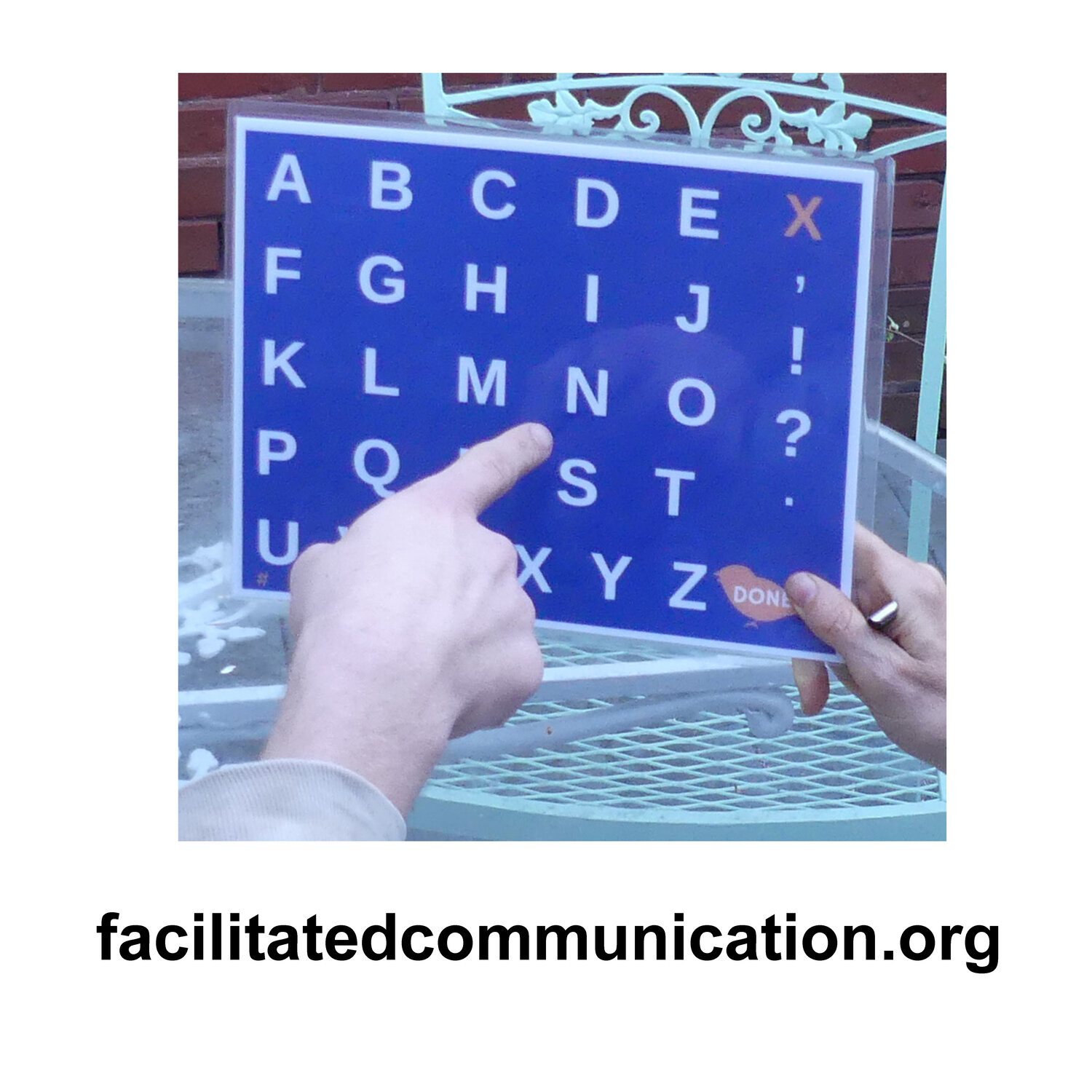
What’s wrong with thinking that FC works for some people?
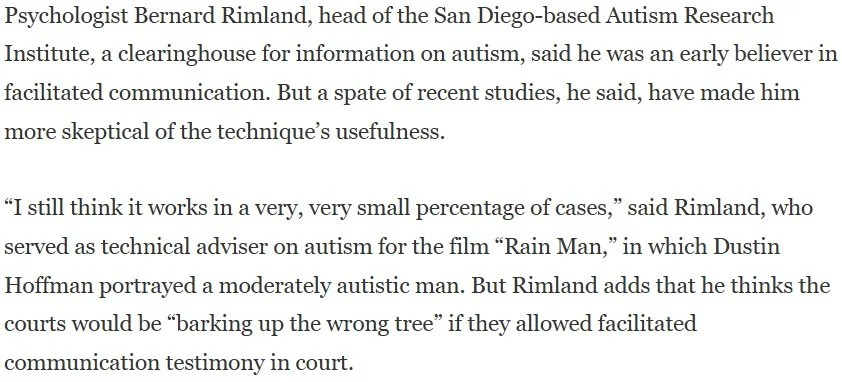
From a 1993 story in the LA Times.
It works for some people. Bernard Rimland may have been the first autism expert to say this, but he wasn’t the last. And while it might seem like a big improvement over “It works for everyone” (what the quacks say), “It works for some people” is still bad news for those subjected to facilitated communication (FC) and its variants (Rapid Prompting Method/RPM; Spelling to Communicate/S2C; Spellers Method; “spelling”).
“Some people” generally refers to people who:
aren’t being obviously touched, and who
either type on held-up letterboards or keyboards that don’t appear to be moving around enough to influence letter selections
or type on stationary keyboards with their helper merely sitting or standing next to them.
The first of the “some people” whom I came across was Sue Rubin. I saw her typing on a held-up keyboard in a trailer for the 2005 documentary Autism is a World. And, for some reason, I didn’t leap to the conclusion that what I was seeing must be independent typing. The only possibilities I entertained were:
1. Maybe Sue Rubin isn’t what she was claimed to be—i.e., a non-speaking person with autism. Maybe she instead has an oral motor disability that prevents her from speaking. And maybe the letterboard doesn’t have to be held up all the time, but just happened to be held up in the short clips in the trailer.
OR:
2. Maybe, somehow, even though I couldn’t see enough board movements or any other cues that would explain how this could be happening, Sue Rubin’s letter selections were being controlled by the person holding up the keyboard.
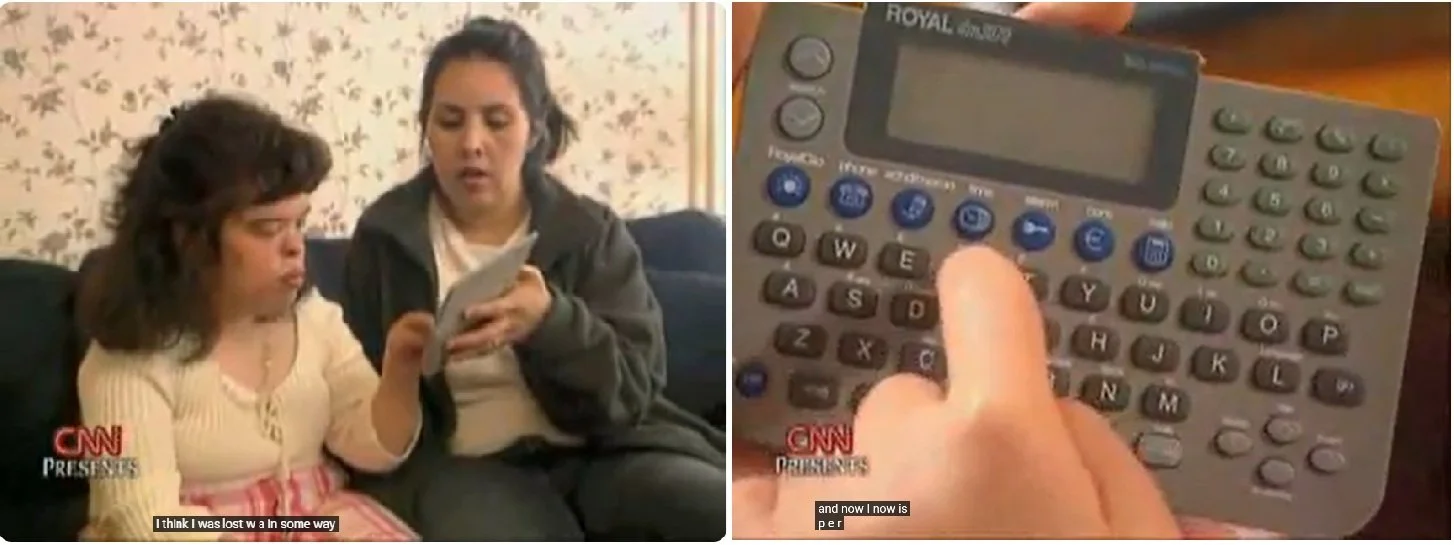
Still images from the trailer for Autism is a World of Sue Rubin pointing to letters. The caption below the first image suggests that Rubin is typing “I think I was lost in some way.”
By the early 2000s when this trailer appeared, I’d been immersed in “autism linguistics” for some half-dozen years. I’d seen how my son, moderate (Level 2) on the spectrum, had had to have every word and word meaning deliberately demonstrated or explained to him. I knew that phrases like “I think I was lost in some way” were (at that time) completely beyond him. Moreover, the reasons for his challenges were obvious to me: he was mostly tuning out the language around him—both speech and sign language. You can’t learn language if you tune it out.
If my lived experience wasn’t sufficient, the empirical research clinched it. Here’s what it finds, condensed into a syllogism:
Autism, as defined by eight decades of clinical observation, diagnostic criteria, and screening tools, and contrary to the claims of FC proponents, is a social disability, not a motor disability.
In those with profound autism, who are non- or minimally-speaking, the social disability is especially profound.
The social disability causes autistic individuals to attend much less to social stimuli like faces, gestures, voices, and what other people are looking at when they communicate.
Ergo, those with profound autism aren’t just minimally speaking; they’ve also had minimal opportunities to learn the meanings of phrases like “I think I was lost in some way.”
That’s why, if Sue Rubin, a non-speaker, was independently typing these words, her diagnosis couldn’t be autism. And yet, in the trailer, she looked pretty autistic: she made almost no eye contact with the people she was purportedly communicating with—before, during, and after she typed. And she didn’t seem to have an oral motor problem that accounted for her minimal speech: in fact, in the two-and-a-half-minute trailer, she spoke two words (“alright” and “yeah”) intelligibly enough for me to readily identify them. When I sought to corroborate my impressions by looking her up, I learned Sue Rubin has 2q37 deletion syndrome, a condition that causes autism-like symptoms and intellectual disability.
All this was enough for me to conclude that Rubin’s letter selections were being cued by her facilitator, even if I couldn’t see how.
But not all autism specialists concur. In Autism is a World, autism neurologist Margaret Bauman suggested that Rubin is the one communicating. Indeed, in a flawed case study she co-authored back in 1996 (see here for critiques), Bauman had already concluded that FC works for some people (Weiss et al., 1996).
Several decades on, the number of “some people” who “it works for” has surged. One of them, Grant Blasko, who initially typed through classical FC but now types through the FC variant known as Rapid Prompting Method, was presented as an independent typer by two autism experts, Connie Kasari and Helen Tager-Flusberg, at a virtual workshop hosted in 2023 by the National Institute on Deafness and Other Communication Disorders (NIDCD).
As I wrote in a blog post back then:
On several occasions during the conference, both Dr. Kasari, an expert in interventions in young children with autism, and Dr. Tager-Flusberg, an expert in language acquisition in autism, remarked on the amazing heterogeneity of non-speaking autism. Their implication, presumably, was that only a small fraction of non-speakers with autism are capable of the linguistic output produced by the two (“)non-speaking(“) participants. If most autistic non-speakers have somehow mastered this much language, that would be much more academically problematic: it would overturn decades of research into autism and language acquisition, including much of their own research. [1]
Interestingly, a 2013 paper that included Kasari and Tager-Flusberg as co-authors (Kasari et al, 2013) is one of just a few academic publications I’m aware of to offer a specific, FC-friendly speculation: namely, that difficulties with “pointing skills” might make autistic non-speakers appear to have lower cognition and comprehension skills than they actually do:
Standard methods for assessing even foundational cognitive or receptive language skills depend on a range of behaviors that may not part [sic] of the repertoire of the minimally verbal child. These include the ability to develop rapport with the examiner, the motivation to comply with task demands, capacity to understand the pragmatics of the testing situation, attention or interest in the testing materials, interference from challenging behaviors, anxiety or frustration, and basic responses such as pointing skills. [Boldface added]
Curiously, one of the few other academic publications to claim that autistic individuals have trouble pointing, Belmonte et al. (2013), was published the same year and was lead-authored by another invitee to the virtual NIDCD workshop who, like Tager-Flusberg and Kasari, suggested during the workshop that FC works for some people: Matthew Belmonte. Here’s what Belmonte et al. (2013) wrote about pointing:
Our data suggest that autistic motor difficulties could range from more basic skills such as pointing to more refined skills such as articulation.
Even more curiously, this article was one of just a few listed in the “participant-suggested” readings on the website of the virtual workshop—along with Jaswal et al.’s infamous eye-tracking study (critiqued here) and two works attributed to Grant Blasko.
But Belmonte et al.’s claims about pointing are flimsy. As I noted in an earlier post:
besides saying that pointing is one of the skills taught at their clinic, Belmonte et al. provide no evidence that any of their clients actually struggle to point.
(The only empirical evidence for pointing difficulties in autism implicates the communicative aspects of pointing, as opposed to the motoric aspects of pointing. This, of course, is consistent with the fact that autism is first and foremost a social disorder. It’s also consistent with the complete absence of empirical evidence that motor challenges prevent autistic individuals from pointing.)
But let’s return to the “some people” for whom FC “works.” Fast forward to a month ago, and Tager-Flusberg has once again publicly raised this possibility. The occasion was an interaction with another researcher whom she and Kasari had invited to the NIDCD virtual workshop: Vikram Jaswal. At the workshop Jaswal had moderated a panel consisting of Grant Blasko (who types through the Rapid Prompting Method) and Jordyn Zimmerman (see the end note below). More recently, Jaswal had been invited to publish a commentary in the journal Autism Research by then-editor David Amaral: a commentary that called for more open-mindedness about, and more research on, what Jaswal calls “assisted methods” that involve typing. But this research, as Jaswal and his co-authors make clear, should not include message-passing tests (Jaswal et al., 2026).
In response to that commentary, a bunch of us wrote letters. You can find them here. Among them is one by Helen-Tager Flusberg; it opens with:
I have met several nonspeaking autistic people who type independently and communicate effectively. Thus, I agree wholeheartedly with the authors of this commentary: nonspeaking autistic individuals should be evaluated for their suitability for training in typing.
In her closing remarks she writes:
The authors admit there is no information on the percentage of students that achieve genuine independence, or how long it takes them to get there.
While it’s conceivable that Tager Flusberg isn’t referring to people like Grant Blasko, two circumstances suggest otherwise. First, she had previously defended him as an independent speaker (along with the other “non-speaker”—see the end note below).
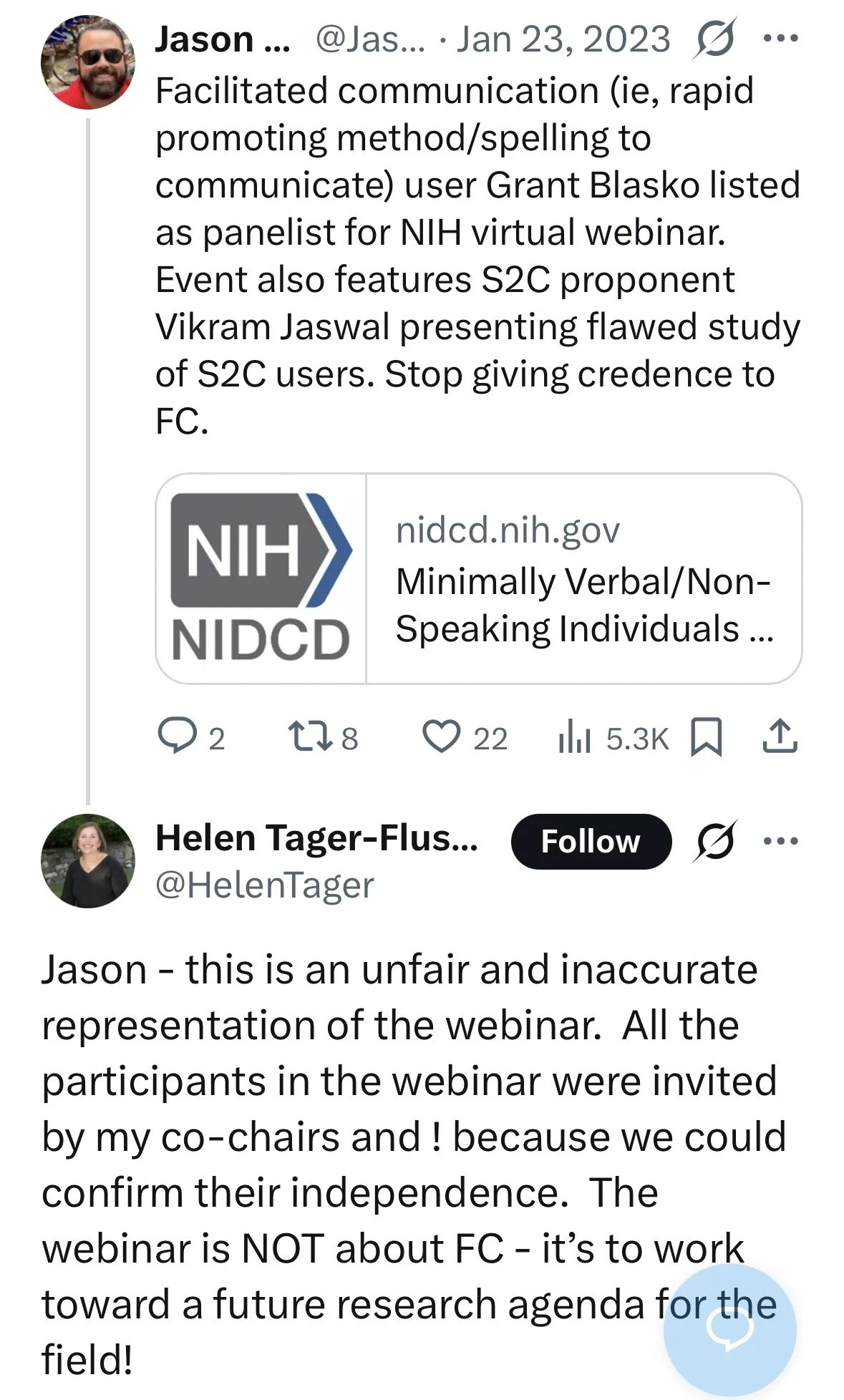
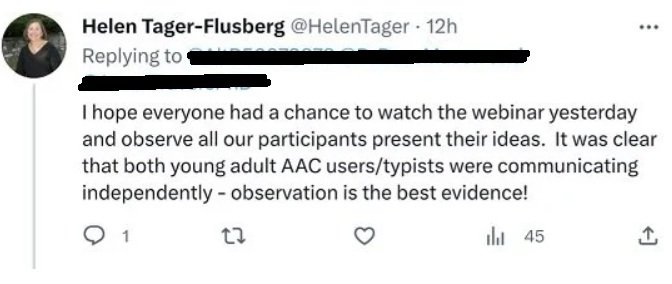
Tager-Flusberg responding to skeptics on X, including Jason Travers, who faulted the workshop organizers for platforming Grant Blasko, who types through Rapid Prompting Method.
Second, given that she was responding to (and critiquing) Jaswal’s commentary, one would have thought that, if what she meant by “nonspeaking autistic people who type independently” were people other than those whom Jaswal et al. call “nonspeaking autistic people who type independently” (i.e., S2C users), she would have said so. Third, her characterization of genuine independence as something that has to be “achieved” over an indefinite period of time sounds primarily applicable to those who are subjected to S2C, as opposed to those who are taught to use standard, evidence-based AAC, where cues and prompts are faded right away rather than persisting for years, even if communication remains limited.
Accordingly, in their response to the letters critiquing their commentary, Jaswal et al. readily interpret Tager-Flusberg’s “several people” who “type independently” their way—i.e., as including some of the non-speakers they’ve encountered in professional activities (nearly all of them S2C users), as well as the non-speakers who have served in government agencies, or, in one case, was accepted to MIT (also users of S2C/”spelling”):
Nonspeaking autistic people who type independently (without anyone touching them or the keyboard) exist. In our labs, clinics, and community partnerships, we have gotten to know several. In her letter, Tager-Flusberg writes that she also has “met several nonspeaking autistic people who type independently and communicate effectively.” They have served on the US President's Committee for People with Intellectual Disabilities.. and the US Interagency Autism Coordinating Committee... One independent typer was recently accepted to MIT.
Jaswal et al. go on to take Tager-Flusberg’s apparent admission that there are independent typers who learned to type through FC/S2C and to milk it for all it’s worth:
As Tager-Flusberg noted, we do not even know how many independent typers there are or how long it took them to become independent. A descriptive approach is thus a logical starting point that will inform subsequent experimental research.
A descriptive approach, that is, instead of controlled testing:
It is not clear why one would conduct an RCT [randomized controlled test] on an assisted teaching method without first incorporating insights from people who now type independently... An important outcome of our approach would be a manualized method–one that draws on both lived experience and scientific advancements–that should then be tested in an RCT.
The purported existence of independent typers justifies not only an indefinite delay in controlled testing, but also, potentially, an outright prohibition: individuals “have the right to decline participation and choose the research in which they engage.”
Finally, Jaswal et al. invoke the purported existence of independent typers to argue that there’s no real point in doing one specific sort of controlled test—namely, the message-passing test:
Several letter writers objected to our decision not to prioritize message passing studies. But if someone does not find the existence of independent typers a compelling reason to study the methods by which they learned, it is unlikely that results from a message passing study would change their mind.
Beyond this, Jaswal et al. (and others) may think there’s another reason not to subject independent typers to message-passing tests: they’re purportedly independent, so what’s there to test? In any case, however, Jaswal et al. don’t seem to have noticed that only one of the four critical letters appears to agree with their claim that independent typers exist (namely, Tager-Flusberg’s).
The one letter supportive of Jaswal et al. is from the person who invited the original commentary: David Amaral. In it, Amaral outs himself as yet another believer that FC works for “some people”:
During the summer of 2025, I attended a conference in Stamford CT that featured adult autistic individuals who used letterboards, iPads, or keyboards as their primary means of communication. My goal was to determine whether I thought that these individuals were being manipulated by their facilitators or conversely whether they were communicating their own thoughts. My general impression was that there was little or no manipulation and that individuals who could not express themselves verbally had found an alternative method to do so. Of course, I am not an expert in this area, and my impression is only anecdotal.
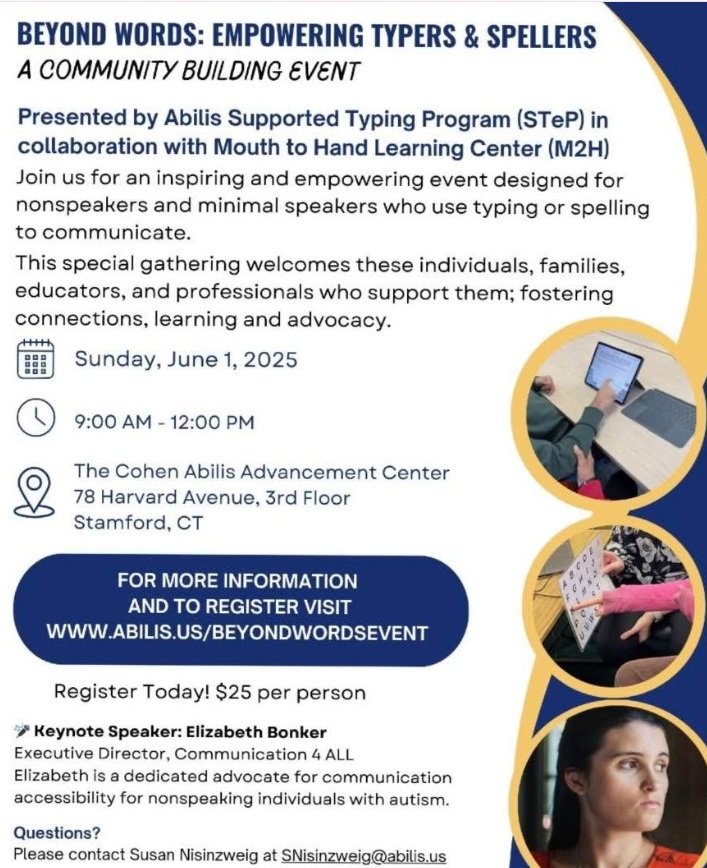
Amaral’s admitted lack of expertise doesn’t stop him from declaring a few weeks later in an interview with The Transmitter that:
A subset of autistic people may benefit from facilitated communication... particularly those who go on to become independent spellers.
Unlike Jaswal et al., however, Amaral thinks that message-passing tests are useful, if only to help identify these independent spellers that he appears certain must exist (an a priori certainty that he telegraphs, below, by saying “see that” rather than “see whether”):
“Message passing is a very reasonable strategy for trying to validate the independence of communication by a nonverbal person,” he says. “It has to be done with a large enough population of participants that you can begin to see that it works for some people and doesn’t work for others.”
Rimland, Bauman, Tager-Flusberg, Kasari, Belmonte, and Amaral aren’t the only autism experts who’ve publicly stated that FC works for some people (setting aside all those, who, like Jaswal et al., think it works for most). Also in this category was AAC expert Pat Mirenda, until she had the courage to publicly change her mind (Mirenda, 2015). Less well-known is Matt Lerner, a recent faculty hire at Drexel University. In an April article in the Atlantic by veteran FC reporter Dan Engber on the Woody Brown affair, Lerner is quoted as saying that “it might be unusual” for a non-speaking autistic person like Woody Brown to write a novel, “but it’s surely possible.” Lerner added that, while research shows that “FC and FC-derived methods of communication can be suspect... in some cases, they clearly work.”
The one other autism expert who appears in Engber’s article, but who is paraphrased rather than quoted, also appears to think that some non-speakers type independently:
Beals conceded that it can be hard in some cases to say whether such communication is real—but not in this one.
Yes, that Beals.
As soon as I read this sentence, I emailed Engber the following request:
Can you change "Beals conceded that it can be hard in some cases to say whether such communication is real" to "Beals said that it can be hard in some cases for observers to see how the facilitator could be influencing the letter selection."?
In the course of a lengthy reply, Engber reminded me of what exactly I’d said during our over-hour-long recorded interview:
You’d explained to me that some video clips of spellers may seem very convincing in isolation, because any source of influence is very subtle. You also indicated that the videos of Woody Brown are decidedly not in this category, because the facilitator influence is so blatant.
While defending his original wording, Engber also acknowledged that his paraphrase could be taken the wrong way and said he’d “put in a request” to have it changed.
Unsure of what change he had in mind, I replied:
May I suggest that the most succinct way to convey what I said would be to phrase it as "Beals said/conceded that some video clips of spellers may seem very convincing"? I firmly believe—and this is a very fundamental belief of mine based on many years in the thick of this—that no reliable conclusions about authorship (whether communication is real) can be made simply by watching an S2C video. Nothing better illustrates that than the convincing videos of S2C-mediated telepathy. So the issue I have is partly with the phrase "whether the communication is real." Replacing "is real" with "seem convincing" would eliminate the issue.”
I received no reply, and when I checked the article later, I saw that Engber’s request had gone through. “In some cases” had been replaced with “on the basis of a video”:
Beals conceded that it may be hard to say, on the basis of a video, whether such communication is real.
Why the Atlantic opted to stick with “whether such communication was real,” along with its implication that Beals is suggesting that some FC-ed communication is real, is anyone’s guess.
But even if the Atlantic had countenanced clarifying that Beals isn’t one of those autism experts who think that FC works for “some people,” there remain all those other experts who do. And as we’ve seen, even just a few statements by one prominent person provide enough material for FC supporters like Jaswal to concoct excuses for postponing or avoiding the kinds of controlled testing that might liberate autistic non-speakers from procedures that, as all the available evidence indicates, suppress rather than enable their authentic communications.
END NOTE:
1. The other “non-speaker” at the conference was Jordyn Zimmerman, who didn’t learn to type through facilitated communication, who clearly types independently, and who is not actually a non-speaker as the term is defined (see here).
REFERENCES:
Amaral, D.G. (2026), Why I Invited a Commentary on “Why We Need to Study Assisted Methods to Teach Typing to Nonspeaking Autistic People”. Autism Research, 19: e70259. https://doi.org/10.1002/aur.70259
Beals, K., B. Hemsley, R. Lang, and H. Shane. 2026. “Inaccurate Claims in a Recent Commentary Supporting Facilitated Communication.” Autism Research19, no. 5: e70258. https://doi.org/10.1002/aur.70258.
Belmonte, M. K., Saxena-Chandhok, T., Cherian, R., Muneer, R., George, L., & Karanth, P. (2013). Oral motor deficits in speech-impaired children with autism. Frontiers in Integrative Neuroscience, 7, Article 47. https://doi.org/10.3389/fnint.2013.00047
Borrell, B. (2026, May 21). Still no proof for facilitated spelling methods. The Transmitter: Neuroscience News and Perspectives. https://doi.org/10.53053/ZNUP4548
Engber, D. (2026, April 15). The publishing mystery that no one wants to talk about. The Atlantic. https://www.theatlantic.com/books/archive/2026/04/who-really-wrote-autistic-author-woody-brown-novel/686814/
Jaswal, V. K., Prizant, B. M., Barense, M. D., Patten, K., & Stobbe, G. (2026). Why we need to study assisted methods to teach typing to nonspeaking autistic people. Autism Research, 19(5), e70176. https://doi.org/10.1002/aur.70176
Kasari, C., Brady, N., Lord, C., & Tager-Flusberg, H. (2013). Assessing the minimally verbal school-aged child with autism spectrum disorder. Autism research : official journal of the International Society for Autism Research, 6(6), 479–493. https://doi.org/10.1002/aur.1334
Lutz, A., J. Escher, A. Halladay, and A. Singer. 2026. “Empirical Validation Must Be a Precondition to Future Research in Facilitated Communication.” Autism Research19, no. 5: e70262. https://doi.org/10.1002/aur.70262.
Mirenda, P. (2015). Comments and a personal reflection on the persistence of facilitated communication. Evidence-Based Communication Assessment and Intervention, 8(2), 102–110. https://doi.org/10.1080/17489539.2014.997427
National Institute on Deafness and Other Communication Disorders. (2023, April 7). Minimally verbal/non-speaking individuals with autism: Research directions for interventions to promote language and communication—Participants. U.S. Department of Health and Human Services, National Institutes of Health. https://www.nidcd.nih.gov/workshops/2023/participant-list
Tager-Flusberg, H.2026. “Assisted Communication Cannot Bypass Objective Research Investigation.” Autism Research19, no. 5: e70257. https://doi.org/10.1002/aur.70257.
Weiss, M. J., Wagner, S. H., & Bauman, M. L. (1996). A validated case study of facilitated communication. Mental Retardation, 34(4), 220–230. https://pubmed.ncbi.nlm.nih.gov/8828341/
