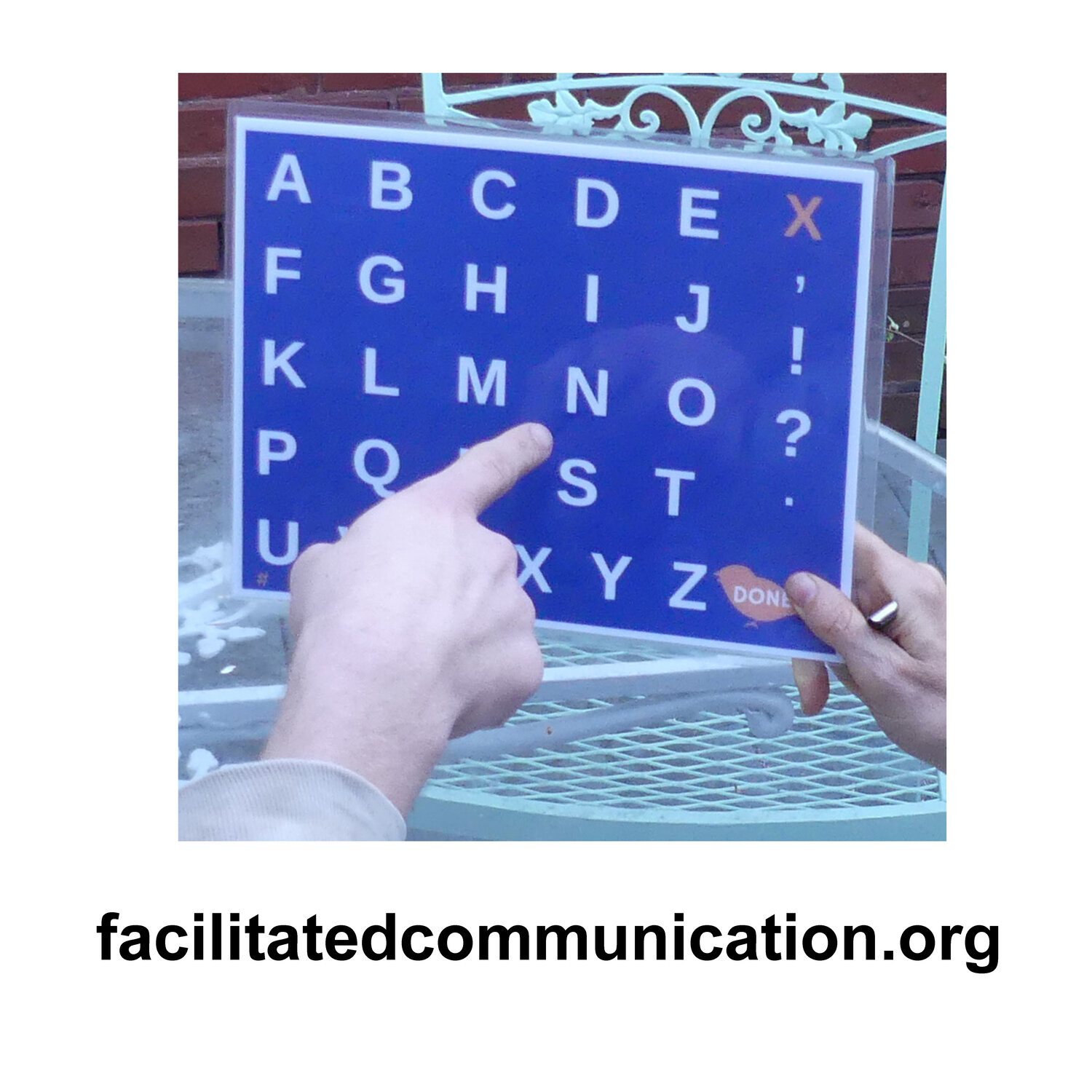
In my last post, in which I discussed the latest issue of Autism Spectrum News and its 27 pro-FC articles, I cited Barry Prizant’s statement about what led up to this publication:
We just approached the editor-in-chief [sic], David Minot, and just said, “Is this a topic that you think your readers would be interested in?” And he said, yes. And he took it from there, you know? So we basically made this suggestion, gave a little bit of feedback about the range of topics, but then stepped back and we submitted our articles just like anybody else submitted articles to the issue.
Prizant makes this statement on the latest episode of his Uniquely Human podcast; this episode, a conversation between Prizant, his co-host (Dave Finch), his collaborator (Amy Laurent), and a parent of a non-speaking autistic who is subjected to a form of FC known as Spelling to Communicate or S2C for whom Prizant served as an expert witness (Jen Le Pape), contains enough additional material of interest to warrant a blog post of its own.
Prizant introduces Laurent as “a PhD in developmental psychology and an occupational therapist”; “the co-director of Autism Level Up, a neurodivergent partnership dedicated to the provision of education, accessible resources, and practical strategies focused on increasing active engagement”; and “a co-author [with Prizant] of the SCERTS model.” (SCERTS stands for “Social Communication, Emotional Regulation, and Transactional Support”).
Prizant introduces Le Pape as “co-plaintiff in Le Pape versus Lower Merian School District in Pennsylvania, a case that centered on the ADA's effective communication clause.” He doesn’t elaborate, however, on how the question of “effective communication” played out in court: How the communication method in question was S2C; how the School District argued that whether S2C is “effective communication” should be decided via message-passing tests (tests that ask the facilitated person about something the facilitator can’t see), and how, when the judge refused the plaintiffs’ request to block message-passing tests at trial, the plaintiffs terminated their six-year legal battle by settling with the School District.
The conversation begins with a discussion of the meaning of one of the most common FC-friendly exhortations: to “presume competence” on the part of autistic non-speakers who are subjected to FC. As often happens in these discussions, the term proves quite slippery.
Presuming competence
Le Pape goes first: “I think this is widely misunderstood. I think it has been distorted to mean every autistic or disabled person is a hidden genius.”
Interestingly, the best-known source of such claims is another S2C parent, J.B. Handley, who has called autistic non-speakers both “brilliant” and “higher-order beings.”
Le Pape proceeds to present “presume competence” as a series of mostly unobjectionable assumptions:
It means that every person is an expert in their own life and that they deserve being spoken to directly and not through a caregiver. They deserve even if they can't communicate hearing things in age appropriate language. They deserve to fully participate in the measure they can in all the decisions that have their life regardless of whether they're a genius, average or intellectually disabled, right? It's that presume that they have a role to play and agency in their own.
Prizant adds:
When we talk about presuming competence, we're talking about presuming the ability to learn, right? ... It's not that they know everything, right? It's that if we get our support right, they can learn. And as you said, not everyone's going to learn everything, right? And somebody might be learning quantum physics and somebody else is going to be learning how to make the decision of what they want for dinner.
If this is what “presume competence” means, one has to wonder why anyone would think that anyone would object to it.
But then Prizant adds this:
And that [presuming competence] was actually one of the themes that came out in... this issue [Autism Spectrum News’s pro-FC issue]. So many [articles]—I think 17 of them—were authored or co-authored by non-speakers and so many of them said I was able to learn but I was not being taught in a way that I could learn.
Given that all the non-speakers in this issue communicate through FC, Prizant is letting “presume competence” extend beyond from presuming the capacity to learn to presuming that non-speakers are the authors of the messages that are facilitated out of them.
The conversation moves on to the purported motor issues in non-speaking autism.
Motor issues and “global bodily apraxia”
Laurent goes first:
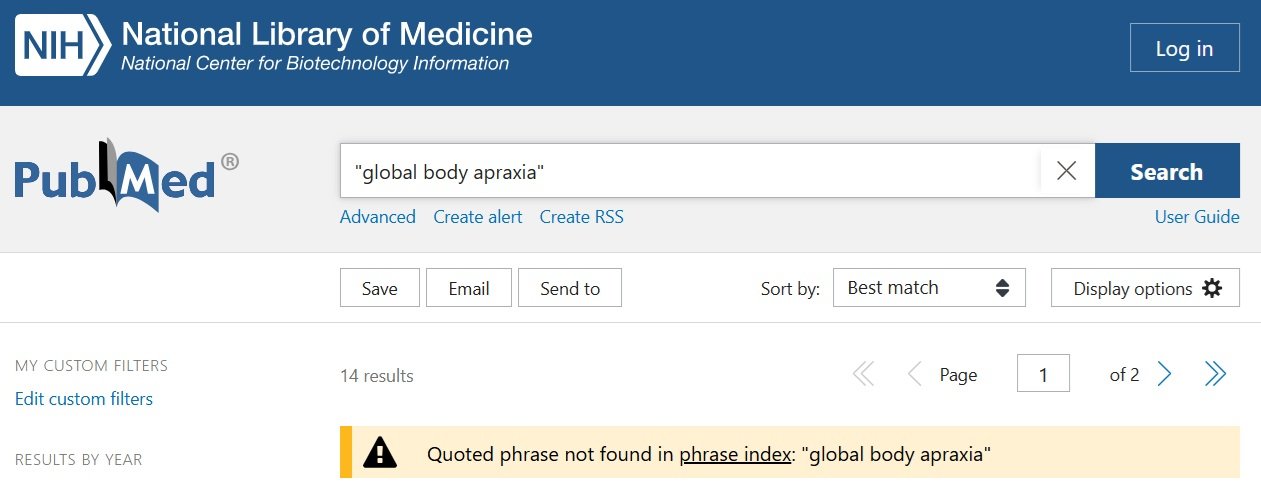
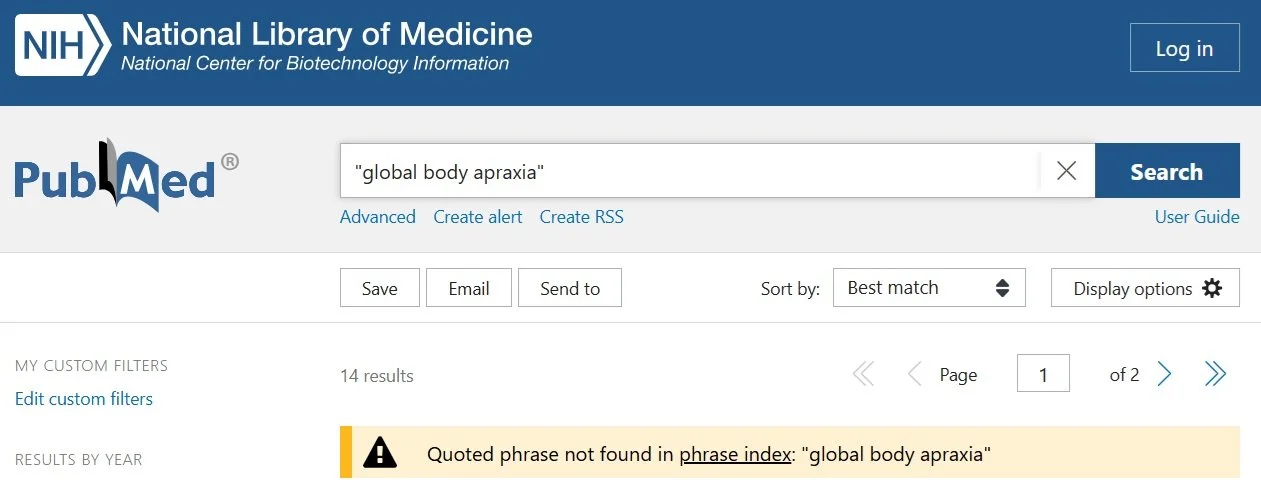
They say upwards of 30% of autistic individuals will not develop reliable spoken language. And one of those factors that we look at is motor ability and practice... And for a long time, people focused on oral motor practice... But now people are kind of like taking a step back and understanding these issues of practice are actually global issues for individuals which impact kind of all aspects of interacting with the environment... [including] being able to reliably get their body to move in ways that they're thinking that they want to move their body is impacted. And there's a large body of research that's been emerging.”
Actually, there isn’t.
Laurent, continuing:
I mean, I would say gosh, you know, even 25-ish years ago, people were looking at neuromotor differences in infants and is that a way we could reliably detect a child who was likely to be identified as autistic in their future and based on how they rolled. And there was good evidence that we could look at babies and look at motor differences.
She’s almost certainly talking about Teitelbaum et al. (2004), whose results failed to replicate in later studies (see Ozonoff et al., 2008).
Laurent:
And now that's really extending into kind of more global aspects of understanding like motor experiences throughout the world and how it really influences so many different things and people like Elizabeth Torres are doing amazing research looking at just really fine detailed differences in motor and consistently demonstrating statistically significant differences in autistic profiles and not autistic profiles.
“Fine, detailed motor differences,” of course, do not entail an inability “to reliably get their body to move in ways that they're thinking that they want to move their body,” let alone what growing numbers of FC supporters are calling “global body apraxia.”
Le Pape goes next, citing data on motor issues in non-speakers that purportedly comes from the lived experiences of non-speakers themselves:
They talk frequently about this disconnect between what they what they want to do and... how that message gets translated to their bodies. But it presents differently in different individuals. Some individuals have difficulty initiating an action, right? Even if they're hungry to get up and get something or cold to get a blanket. I think Ido Kedar talks about this in one of his books, right? Other people get stuck in loops where they do the same action repetitively and it's the stopping that's hard.
Since all these testimonials are generated through FC, all the available evidence indicates that they do not actually represent the lived experiences of autistic non-speakers.
Le Pape continues:
And then other times it's just having the energy to really force the concentration that's required for spelling and typing because these unruly bodies require a lot more effort than I think a lot of the neurotypical bodies. And so it's fascinating to me because it is both a very common theme, but the specific presentations vary significantly from individual to individual.
It’s not surprising that this is a common theme. It takes a lot of effort and concentration to comply with one’s facilitator and sit or stand still, stare at a held-up letterboard, and poke repeatedly at different points on the board, in compliance with the facilitator’s expectations, when the entire process has so little meaning—and much less appeal than alternative activities like watching YouTube videos or playing electronic games.
Facilitator influence
Prizant next brings up the question of facilitator influence:
We know that a major argument of some of the critics is that wait a second, this is not authentic communication. They're being 100% influenced by people who are with them... and they present people who are supporting different kinds of approaches through spelling and typing as if we're ignoring the factor of influence. Is that the case?
Le Pape’s response does what many responses to this question do: it conflates facilitator influence with conversational influence:
I have to say in my training... the issue of influence was always present. I can remember doing a two-hour seminar once I was a more open... partner for Alex just about influence about how to ask questions, how to phrase them and... all the different ways you can influence someone. So for me, this has always been present. It's a real risk, but it's also one that I think it is quite addressable with thoughtful practice.
There is, of course, a huge difference between asking leading questions and finishing people’s sentences for them, on one hand, and, on the other hand, moving letterboards around and otherwise cueing non-speakers in ways that affect which letters their outstretched index fingers point to—a difference that even “Spellers Method” inventor Dawnmarie Gaivin appears to recognize. From Le Pape’s description, it doesn’t sound as if her training addressed the latter type of influence: the influence that is FC-specific and of far greater concern. In Gaivin’s words, “when influence flows from CP to speller during open communication, it doesn’t color the message – it replaces it.”
Laurent extends the conflation of facilitator influence and conversational influence to include instructional influence (the initial modeling and prompting that is quickly and completely faded in evidence-based communication interventions and evidence-based instruction):
I want to take a bigger picture step back again and say all communication is relational. [In] all communication your partner influences the message that you're sending because you're responding to the other person in interaction. And when we're talking about supporting non-speakers, some of them are going to be spellers and typers... But some of them will be using other assisted technology devices. Some of them might be using sign language. And if we think about how we teach those methodologies, there is always a partner helping to teach somebody how to use whatever methodology they're using to communicate... So there... is no communication method that is learned outside of an interaction with another person. And if there's an interaction with another person there's always going to be an opportunity for influence I suppose.
Interaction trivially involves influence. What most interaction doesn’t involve is “replacing communication,” as when a facilitator controls which letters a non-speaking autistic person selects and which messages are thereby spelled out and attributed to the non-speaker.
Next to pipe in is Dave Finch, who conflates facilitator influence with autocorrect and word prediction. The difference, of course, is that we routinely override our phones and computers when they put the wrong words in our mouths.
But Finch is certain that non-speakers would, similarly, override any spelled-out messages that don’t reflect what they want to say:
Wouldn't there have been at some point ever the... the non-speaker figuring out some way to say to basically express that “Hey this person's manipulating that's not what I intended to say; they're misrepresenting... what I'm saying...” It's come up maybe to my knowledge maybe zero times like you be some would think that there would signal or there would be some evidence that uh these people are not autonomously communicating or that their communicative intent is not being respected by their support person and it's just not true.
It sounds like Finch has never watched videos like this one and this one. Indeed, none of the podcast’s participants seem to be aware of the many videos (here’s another) in which the facilitated person is clearly agitated about being forced to remain in front of a letterboard and point to letters.
Instead, Le Pape states:
I have never seen a speller that has required ABA type rewards to continue spelling, even for long sessions, even for two-hour book clubs. There is no reward other than the intrinsic reward of learning and communicating and the social interaction.
And Prizant remarks on how focused one parent reports that her son was during his initial spelling lessons with Dawnmarie Gaivin (it sounds like he hasn’t seen the initial spelling lesson in this video).
Sudden skills
The conversation then turns to claims concerning the sudden emergence of literacy skills when non-speakers are subjected to FC. As Prizant puts it:
This is a miracle, you know, all of a sudden these miracles are happening overnight. Uh, is it just a miracle where you snap your fingers and all of a sudden a person is a fluent speller or typer?”
Buried within his mocking tone and straw-man characterizations is yet another conflation. What most FC-skeptics find implausibly sudden is the emergence of fluent, grammatical language, sophisticated vocabulary, and worldly knowledge; not the emergence of fluent spelling or typing. As a matter of fact, very few facilitated individuals spell or type fluently, as we see in videos even of those who have are considered “advanced typers.” Those who might appear to be typing quickly are jabbing repetitively at the letterboard rather than spelling words and phrases (see here and here).
In her response to the question of sudden skills, Le Pape mentions “open communication”: a purported S2C milestone that occurs when the facilitated person is able to type out longer, more open-ended responses on a single letterboard. The S2C literature equivocates on whether “open communication” is more of a motor-based or more of a communication-based milestone; Le Pape’s discussion is no exception, though she ends by talking about body regulation challenges rather than language, vocabulary, and worldly knowledge.
I know in our case, it probably took Alex three or four months of working with trained professionals for an hour twice a week and then doing smaller bits of practice at home to become an open communicator. And... then it probably took an additional 3 months for me to learn how to support him, for him to be open at home. He was open with the professionals before... I had built my own skill set. Um in my experience it generally takes... three to four months [or] a year or more for people to sort of learn the motor skills to learn how to regulate their bodies.
None of this, of course, addresses where the language, literacy, vocabulary, and worldly knowledge have come from, or even knowledge of complex spelling rules like “through”, “rough”, “cough.”
Laurent, oddly, does make a comparison to language learning, but then evades the question of how it occurs in S2C users:
It’s no different than any other communication method, right? If we're using a picture-based communication method, it's going to take time for someone to know how to use that. Especially if you're moving from single words to make a request into multi-word, multi-picture utterances to share a sentence or an idea... It's just like in typical development of any language skill, spoken language, children start with vocal approximations, move into single words, then we get to word combinations which will eventually lead into sentences, right? So language development takes time. It isn't like put this thing in front of somebody and it's a miracle, right?
Le Pape’s response picks up on this, acknowledging a language challenge in non-speaking autism, but then reducing it to motor difficulties:
And then I think on top of that there's a language component and there's what you're talking about earlier about for people with apraxia just mastering the motor skills even if they might have more advanced mental language skills right but how to get that to output, you know, is an additional challenge for a lot of this population.
A curious side note about Le Pape’s son: Le Pape tells us that “he has some words, basic requests and things, but he is much more expansive and eloquent when he spells.”
How non-speakers acquire advanced language skills remains unaddressed. Finch, instead, takes us back to global bodily apraxia:
Knowing exactly what you want to do, exactly what you want to say, and your body shuts it down. It's just oh, it's in my head and I can't get it out. I just I can't even imagine.
Then Prizant raises the question of sudden, unexpected knowledge:
For those individuals who begin to spell or type and people are surprised at how much they either knew about something or what they observed about something. And many of the critics say, well, they've never been explicitly taught to read. You know, they don't look like they're learning.... How could they have this information in their minds, in their brains, if they never formally went through school like other kids or participated in those kinds of learning activities? So, what do we say about that? I guess it brings up the issue of everyday incidental learning that happens in human beings, right?
Finch concurs, adding “When were schools invented? I guarantee it wasn't when mankind first crawled out of the swamps.”
For my part, I guarantee that Finch, if he has children, will send them to school, however much he thinks they might learn outside their classrooms.
Le Pape concurs as well:
I think it is a great point. Like, schools are a relatively recent invention in human history. I think that, you know, we're hardwired to learn and to observe and absorb... from our environment. I would also say, have these people never heard of Children's Television Workshop?
She then talks about how much her son learned from Sesame Street Starfall.com:
I think he found a self-paced way to sort of access some of that learning that he wasn't getting in autistic support classrooms.
Passive TV watching, of course, only goes so far—even when one is actively paying attention.
At this point, Prizant reminds us that “non-speaking does not mean non-thinking”—a refrain as common among modern-day FC-advocates as it is bleedingly obvious to most modern-day humans.
Laurent takes this back to “presuming competence,” extending it to presuming that autistic non-speakers can pick things up by osmosis:
It goes back to that presumption of competence that you asked us about earlier too, Barry. And you know, I think about like I think about what kids learn in school, and school's absolutely, there's value there, and curriculum's important and whatever, but some of the brightest minds are learning outside of school. Like where they're really absorbing and applying is not like on the spelling test and the times tables. It's like that integration, hands-on, exploratory type of learning that doesn't happen necessarily in a traditional classroom.
Consistent though this may be with child-centered intervention models like Prizant & Laurent’s SCERTS model (see also Floortime), extending this notion to academics entails a largely pseudoscientific presumption that students can acquire academic skills without systematic instruction and become literate through print-rich environments (see Christodoulou, 2013). Even as these presumptions have faded in cognitive science and education departments, they endure among FC proponents.
That’s not to say there isn’t a lot you can learn about the world without systematic instruction and systematic practice: Prizant, quite reasonably, cites deaf people who “take in a ton of information about the world.” But the skills and knowledge that you can pick up informally on your own do not include phonics, expository writing, chemistry, or calculus.
Prizant continues:
I just had a discussion with a New York Times writer who's doing an article on Jason Arday. Jason Arday is a man from the UK, autistic, diagnosed when he was young, and he did not begin speaking till he was 11. He did not become literate until he was 18.
To the extent that Prizant is an autism expert, this should have raised red flags. Autistic children who go on to become fluent speakers are generally speaking by four years of age; in autistic individuals who go on to become highly literate, literacy generally starts emerging in elementary school if not earlier. As two other autism experts, Howard Shane and Stephen Camarata, noted in an August 15th piece in the New York Times, Dr. Arday’s assertion that he learned to speak at 11 and read at 18 strains credulity.
Prizant’s account of Jason Arday continues: “Now he is a full distinguished professor at Cambridge University in England.”
Not anymore. Arday resigned from Cambridge on August 5th, five days after this podcast was released, and on August 14th, tragically, was found dead in his apartment.
Prizant: “And he's a fluent speaker. Um, and you could see him on some interviews that are on YouTube. I never heard about him…. And this uh this person who I spoke with um her name is Susan whatever and she uh is coming out with an article about him in the New York Times in August.”
Prizant’s name does not appear in the August 16th article, even though one of its contributors is named Susan. There was, however, another article in the New York Times that came out on August 3rd, shortly after Prizant’s podcast. This article was entitled “Questions Mount Over a Star Scholar’s Life and Career” and subtitled “A knife-wielding masked man. A pig’s head outside his parents’ door. Running 30 marathons in 35 days. The Cambridge professor Jason Arday, accused of plagiarism, says he’s been through it all. Not everyone believes him.” Neither of the contributors to this article are named Susan, however, nor does Prizant’s name appear anywhere here either.
Prizant:
And so there are individual examples of people not only just taking in so much of the world and learning and then learning to express that knowledge that they have, but there are extreme examples like that. And what Jason says was his mom in particular was always very good at pointing things about the world out to him and speaking with him about everything and narrating and describing. And he said “I was just absorbing it like a sponge. I just couldn't speak.” Uh, fascinating.
Indeed.
The Autism Spectrum News issue
The conversation then turns to the latest issue of Autism Spectrum News—the one with those 27 FC-promoting articles. Everyone is enthusiastic. Le Pape and Laurent are impressed by the new brain imaging research (which I critique in my last post). Le Pape is impressed by the number of articles co-authored by both neurotypicals and non-speakers; Laurent is impressed with the holistic take on the lives and non-speakers and how best to support them; Prizant is impressed with the range of articles (“everything from the arts to legal issues written by lawyers”) and the “rich sense of the lives of non-speakers and what they have to say”; Finch is impressed with how the arguments of FC critics, whom he characterizes as “intellectually lazy,” are hurt by “the nuance and lived experience aspect of all of this.”
The problem, of course, is that the “range of articles” (1) included no criticisms of FC, and (2) assumed, without exception, that the lived experiences recounted through FC represent actual lived experiences recounted by non-speaking autistic individuals—despite the fact that all the available evidence strongly suggests that these accounts are authored, instead, by speaking, non-autistic facilitators.
The least dangerous assumption and balancing risks
Claiming that “we're just well past the yeah, it's real, no, it's fake arguments,” Prizant makes a “shameless plug” for the Autism Research article he co-authored with Vikram Jaswal back in January, which advocates for moving away from message-passing tests and instead figuring out who FC works for (my critique of these notions is here). Le Pape brings up the “least dangerous assumption” and the need to balance “the risk of influence” and “the risk of silence” while waiting for all the wonderful new research to unfold.”
Of course, there’s no tension between the risk of influence and the risk of silence. They are two ways of formulating the same fundamental question: are the facilitated messages coming from the non-speaker; is the non-speaker being silenced by facilitator control?
Nor need we await new research to address these risks: we’ve always had a simple, common-sense tool for that. Asking the non-speaker to describe something their facilitator can’t see may not be in the Mental Measurements Yearbook, but it can nonetheless tell you who’s influencing or silencing.
While it’s not clear what exactly Le Pape means by the least dangerous assumption, here’s what I propose:
The least dangerous assumption is twofold: (1) that the person is able to control their body and express their needs, wants, and aversions through body language, independently of other people; and (2) that it is possible to assess their capabilities by examining what they are able to do, independently of others.
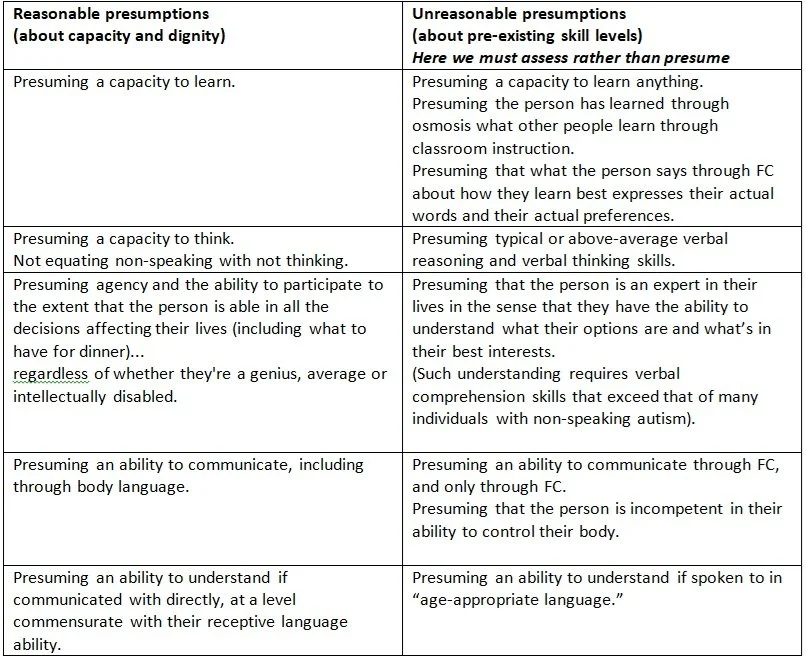
In the context of disability, the “least dangerous assumption” harks back to FC proponent Anne Donnellan (1994) and basically means to “presume competence.” But the latter term, as we’ve seen, has become hopelessly slippery, by turns reasonable and unreasonable, so here’s a side-by-side comparison that I hope captures most of the many meanings we see in this podcast and elsewhere.
REFERENCES:
Christodoulou, Daisy. (2013). Seven Myths about Education. Abingdon, UK: Routledge.
Donnellan, A. M. (1984), “The Criterion of the Least Dangerous Assumption,” Behavioral Disorders, 9(2), 141–150.
Ozonoff, S., Young, G. S., Goldring, S., Greiss-Hess, L., Herrera, A. M., Steele, J., Macari, S., Hepburn, S., & Rogers, S. J. (2008). Gross motor development, movement abnormalities, and early identification of autism. Journal of autism and developmental disorders, 38(4), 644–656. https://doi.org/10.1007/s10803-007-0430-0
Teitelbaum, O., Benton, T., Shah, P. K., et al. (2004). “Eshkol–Wachman movement notation in diagnosis: The early detection of Asperger's syndrome.” PNAS, 101, 11909–11914;
