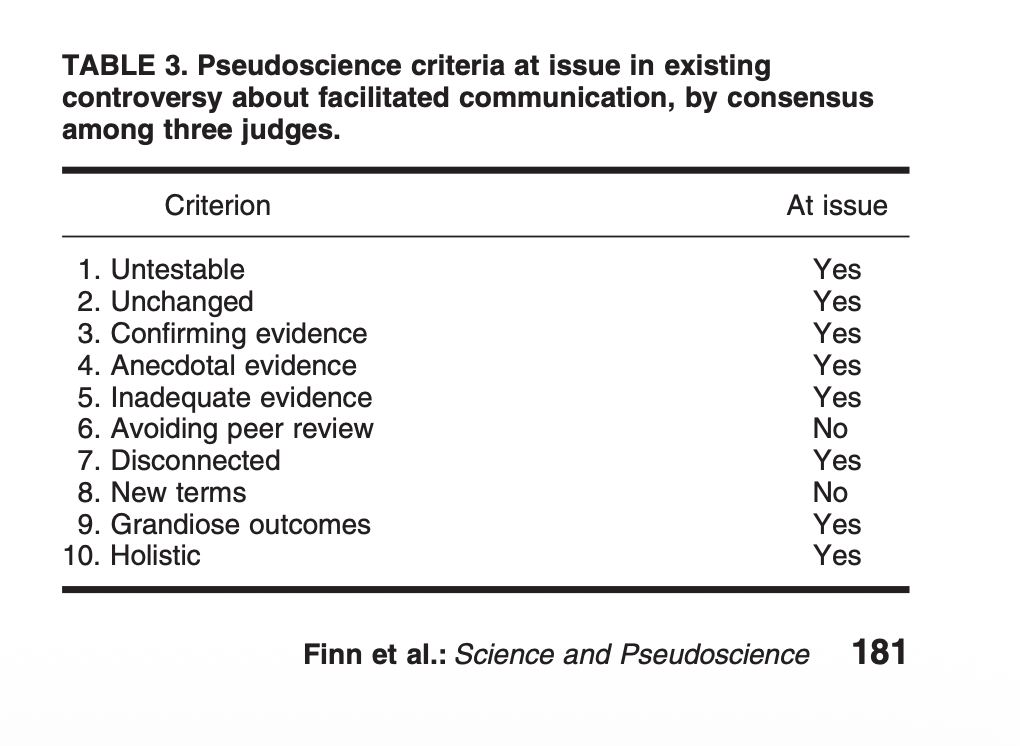
In today’s blog post, I’ll analyze FC/S2C/RPM using the criteria from a 2005 article titled “Science and pseudoscience in communication disorders: criteria and applications” written by Patrick Finn, Anne K. Bothe, and Robin E. Bramlett.
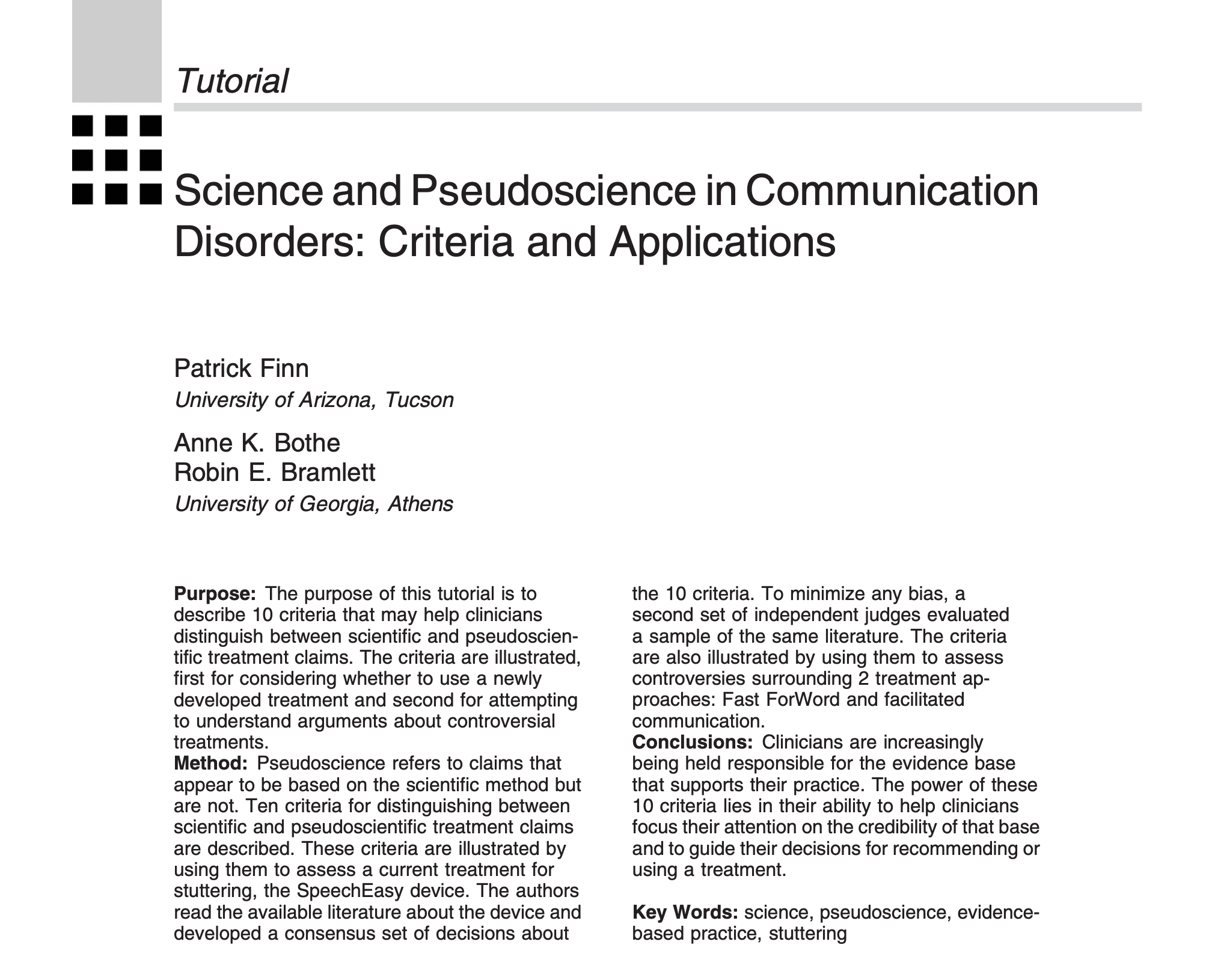
Science and Pseudoscience in Communication Disorders: Criteria and Applications (Finn et al., 2005)
The tutorial was written with the intention to help Speech/Language Pathologists distinguish between scientific and pseudoscientific treatment claims.
I’ve read the article in full, considered the 10 criteria, and applied them to current-day FC/S2C/RPM practices. I invite you to do the same and then let me know what you think in the comment section below. Were your answers the same or different than mine or Finn’s?
Remember, not all criteria have to be met for a treatment to be considered pseudoscientific. What does the weight of your answers reveal about whether FC falls within the realm of scientific or pseudoscientific practices?
#1 Untestable: Is the Treatment Unable to Be Tested or Disproved?
My understanding and experience are that FC/S2C/RPM facilitators are told by workshop leaders to presume competence and not test their clients. Facilitators are also being told that authorship testing completed in the 1990s was inaccurate and somehow unethical and, therefore, should be ignored.
As I’ve written in previous blog posts, researchers have shown that FC/S2C/RPM authorship is testable under reliably controlled conditions and that when facilitator behaviors are controlled—that is, when facilitators are prevented access to test stimuli—the FC generated responses are 1) unintelligible (the clients can’t spell); 2) spelled correctly, but irrelevant to the questions asked (e.g., facilitator guesses), and/or 3) correctly spelled and based on facilitator responses (e.g., facilitator controlled).
Instead of accepting the evidence and correcting the problem of facilitator cueing and control that is built into the techniques, proponents are taught that the tests are wrong and that FC/S2C/RPM “works” despite the evidence against them.
For those reasons, my score for #1: Do proponents believe FC/S2C/RPM are untestable? Yes. (Finn et al.’s response: Yes)
#2 Unchanged: Does the Treatment Approach Remain Unchanged Even in the Face of Contradictory Evidence?
This is a tricky one. I think that proponents believe FC has evolved from touch-based forms in the 1980s-early 2000s where facilitators held onto their clients’ wrists, elbows, or shoulders to no-touch forms of FC (e.g., Spelling to Communicate, Rapid Prompting Method) where, instead of holding onto their clients, the facilitators hold letter boards in the air.
Many proponents of FC/S2C/RPM today believe that if the facilitator isn’t touching their client, they can’t cue them, but they still haven’t solved the problem of facilitator cueing and control. S2C/RPM practitioners have simply substituted visual and auditory cues for touch-based, physical cues. (See An FC Primer).
The problem is still facilitator cueing. I can also think of examples where the facilitators claiming to use “FC” (rather than S2C/RPM) are holding a letter board in the air. It seems to me that the basic tenets of FC/S2C/RPM haven’t changed much, if any, over the past 30+ years.
For that reason, I’m going to say that my score for #2: Has the treatment approach changed in response to contradictory evidence? is No. Not in any significant way that solves the problem of facilitator dependence with these techniques. (Finn et al’s response: Yes)
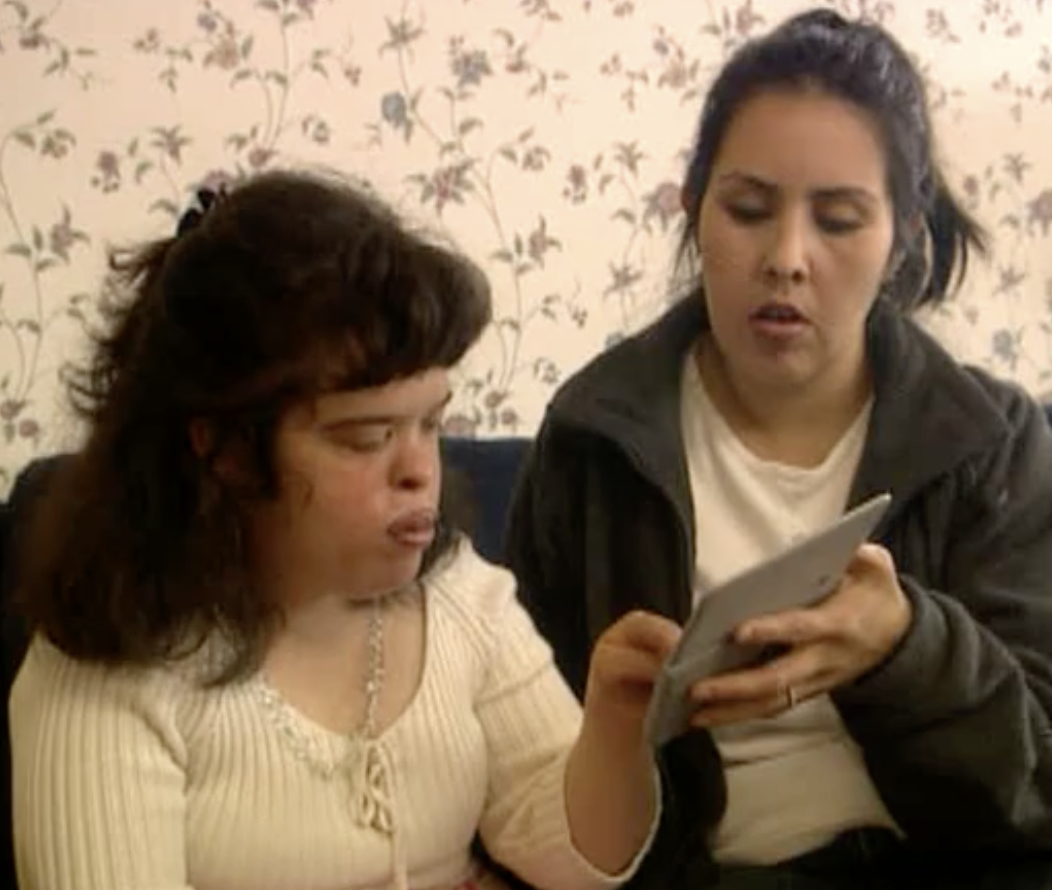
Sue Rubin’s facilitator in the pro-FC film “Autism is a World” holds the letter board in the air, mimicking RPM and S2C, in that physical touch is minimized while visual and/or verbal cues are emphasized (as facilitators maintain eye contact with the letter board and wittingly or unwittingly move the letter board in the air).
#3 Confirming Evidence: Is the Rationale for the Treatment Approach Based only on Confirming Evidence, With Disconfirming Evidence Ignored or Minimized?
Proponents insist that FC/S2C/RPM work because people using the techniques say it works. In other words, facilitators have seen these techniques work with their own eyes. For them, their personal experience is “evidence” enough.
But, the reliably controlled testing that does exist shows that facilitators, not their clients, are controlling letter selection. Many facilitators are unaware of the extent to which their own behaviors influence and control letter selection. Current day facilitators either downplay or ignore the existing authorship test results and/or refuse to participate in authorship testing of their own.
Based on that, my score for #3: Is the treatment approach based on only confirming evidence while disconfirming evidence is ignored or minimized? Yes. (Finn et al.’s response: Yes)
#4 Anecdotal Evidence: Does the Evidence in Support of the Treatment Rely on Personal Experience and Anecdotal Accounts?
My rationale for criteria #4 is the same as #3. For proponents, seeing is believing, but anecdotes and testimonials, though interesting, are not reliably controlled evidence.
For that reason, my score for #4: Does the evidence in support of the treatment rely on personal experience and anecdotal accounts? Yes (Finn et al.’s response: Yes)
#5 Inadequate Evidence: Are the Treatment Claims Incommensurate with the Level of Evidence Needed to Support Those Claims?
Proponents claim unexpected literacy skills in their clients, as well as the ability to spell out letters without looking at the letter board and/or the ability to spell out words that are different than the ones they are verbally saying during the spelling session. Often the clients’ verbal and nonverbal behaviors are at odds with the spelled, facilitated messages. In addition, facilitators need to be within visual and auditory range of their clients for FC/S2C/RPM to work.
For those reasons, my score for #5: Are the treatment claims incommensurate with the level of evidence needed to support those claims? Yes. (Finn et al.’s response: Yes)
#6 Avoiding Peer Review: Are Treatment Claims Unsupported by Evidence That Has Undergone Critical Scrutiny?
This one’s tricky because some proponents have managed to get their work published in peer reviewed journals. However, the reviews appear to be uncontrolled, poorly controlled or otherwise sympathetic to FC/S2C/RPM and do not include critiques of the techniques. Nor do any of the articles directly address the problem of facilitator cueing and control. A systematic review for authorship studies that used S2C/RPM-style FC was published in July 2026. The review came up empty.
For that reason, I’m going to say that for criteria #6: Avoiding Peer Review, the answer is yes, specifically when it concerns authorship testing for FC/S2C/RPM. (Finn et al.’s response: No)
#7 Disconnected: Is the Treatment Approach Disconnected from Well-Established Scientific Models or Paradigms?
Proponents contend that nonspeaking or minimally speaking individuals with autism and other developmental disabilities have an innate understanding of language and literacy and/or they learn sophisticated written language skills through osmosis. In other words, the individuals being subjected to FC/S2C/RPM do not need to be taught how to use written language. They also contend that communication difficulties in these populations are solely due to motor planning problems. In addition, some proponents of FC/S2C/RPM are claiming their clients are telepathic.
To date, none of these claims are supported by the science, so for that reason, my score for #7: Is the treatment approach disconnected from well-established scientific models or paradigms is yes. (Finn et al.’s response: Yes)
#8 New Terms: Is the Treatment Described by Terms that Appear to Be Scientific but Upon Further Examination Are Found Not to be Scientific at All?
Proponents have, from the start of FC, blurred the lines between legitimate, scientific terms and adapted or created definitions that fit their own needs. To them , for example, “independent communication” doesn’t mean “by oneself,” but rather with the support of a facilitator. Apraxia is another term facilitators use to justify the use of FC/S2C/RPM, even though apraxia isn’t a core characteristic of autism. Many facilitated individuals can successfully and independently complete fine and gross motor tasks, like painting with a paintbrush, using tools, dressing themselves (e.g. using buttons and zippers), and/or finding their favorite game or movie on an iPad, but for some reason these same people need assistance when pointing to a letter on a keyboard. In addition, the existence of apraxia does not preclude someone from communicating independently and without facilitator interference. Communication technologies exist that allow individuals to independently interact with and use the devices with minimal physical movements: eye gazing, blowing into a straw, twitching a muscle. The need for a “communications regulations partner” (e.g., someone told hold the client or hold a letter board in the air) is obsolete.
For that reason, my score for #8 is yes, the treatment is described in terms that appear scientific but are not. (Finn et al.’s response: No)
#9 Grandiose Outcomes: Is the Treatment Approach Based on Grandiose Claims or Poorly Specified Outcomes?
I don’t know about now, but for many years, FC was advertised as a treatment of last resort. In other words, desperate parents and caregivers would turn to FC when evidence-based treatments failed to meet their expectations. I’ve also seen proponents of FC/S2C/RPM guarantee 100% success rates for spelling skills (when supported by a literate facilitator) which no practitioner of evidence-based treatments would promise. In addition, people being subjected to FC/S2C/RPM for 20-30 years still require the presence of a facilitator, even though the goal for use of these techniques is independence. Evidence-based measures build in fading support from the beginning of treatment. There are no protocols that I’ve found in FC/S2C/RPM literature to systematically fade support. Instead, facilitators are encouraged to “prompt their hearts out.” They’re told to fade, fade, fade—and may even intend to do so--but with no direct instructions how to extricate themselves from the letter selection process, this rarely, if ever happens
For these reasons, my score for #9 –is the treatment approach based on grandiose claims or poorly specified outcomes—is yes. (Finn et al.’s response: Yes)
#10 Holistic: Is the Treatment Claimed to Make Sense Only Within a Vaguely Described Holistic Framework?
FC/S2C/RPM build dependence on the facilitator, not independence for the individuals being subjected to these techniques. In addition, the "holistic" aspects of FC/S2C/RPM include proponents’ invocation of everything from motor control problems to regulation problems to the need for emotional support that only work in alignment with a unique “trust/relationship bond” between the facilitator and nonspeaking individual.
Evidence-based communication techniques serve specific purposes and are not a panacea for every condition or difficulty a non-speaking individual encounters. And, though a good working relationship is beneficial, the techniques are still reliable even when there isn’t a strong “trust bond” established among the participants and their communication partners. In fact, evidence-based communication techniques “work” (that is, the individual can interact with the letter board or device and independently communicate his or her thoughts) even when the facilitator is out of visual and auditory range.
To the extent that FC-generated messages obscure the underlying communication difficulties with nonspeaking and minimally speaking individuals and prevent access to legitimate, evidence-based treatments, my score for #10 is yes.
(Finn et al.’s response: Yes)
Results of the analysis of FC and the criteria in Finn et al. 2005
Discussion
My responses differed from the Finn et al. study on three of the 10 criteria. This was, I think, mostly because when Finn et al. published their study in 2005, S2C/RPM were just starting to become popularized. I view S2C/RPM as extensions of FC and the changes to FC from touch-based to no-touch forms marks a response to critiques from the scientific community, but in ways that still do not address facilitator cueing and control. In addition, proponents have doubled down on their insistence that communication difficulties in autism are primarily due to motor planning problems or apraxia. Until FC/S2C/RPM proponents prove their claims through reliably controlled testing, then, I have no choice but to see these techniques as pseudoscientific. The onus is on proponents to prove their claims that facilitator-dependent techniques lead to communication independence.
To me, FC/S2C/RPM are clearly pseudoscientific practices. Despite what proponents claim, FC hasn’t really changed all that much over the years. But the IACC just passed an autism plan that opens the door for these techniques to be used in the public schools while rejecting the body of evidence that shows facilitators are authoring the messages generated using these techniques. It’s difficult to watch policy makers push strategies that have already been proven to be detrimental to the communication rights of nonspeaking or minimally speaking individuals with profound autism, cerebral palsy, or other developmental disabilities. When will it stop?
References and Recommended Reading
Finn P, Bothe AK, Bramlett RE. (2005, August). Science and pseudoscience in communication disorders: criteria and applications. American Journal of Speech Language Patholology. Volume 14(3), ppl. 172-86. Doi: 10.1044/1058-0360(2005/018). PMID: 16229669.
Hemsely, Bronwyn, Beals, Katharine, Lang, Russell, Schlossers, Ralf W., Shane, Howard, Simmons, William, Skinner, Sharon, and Todd, James. (2025, October 1): Safeguarding the communication rights of minimally- or non-speaking people who are vulnerable to Facilitated Communication, Rapid Prompting (Spellers Method) and variants, Research and Practice in Intellectual and Developmental Disabilities. Research and Practice in Intellectual and Developmental Disabilities. DOI: 10.1080/23297018.2025.2544116
Schlosser, R.W., Howard, S., Bryant, L. et al. Systematic Review of Authorship in Rapid Prompting Method, Spelling to Communicate, and Variants: Outcomes, Significance and Clinical Implications. Review Journal of Autism Development and Disorders (2026). https://doi.org/10.1007/s40489-026-00569-7
New takes on apraxia, miracles, presuming competence et al. from S2C proponents