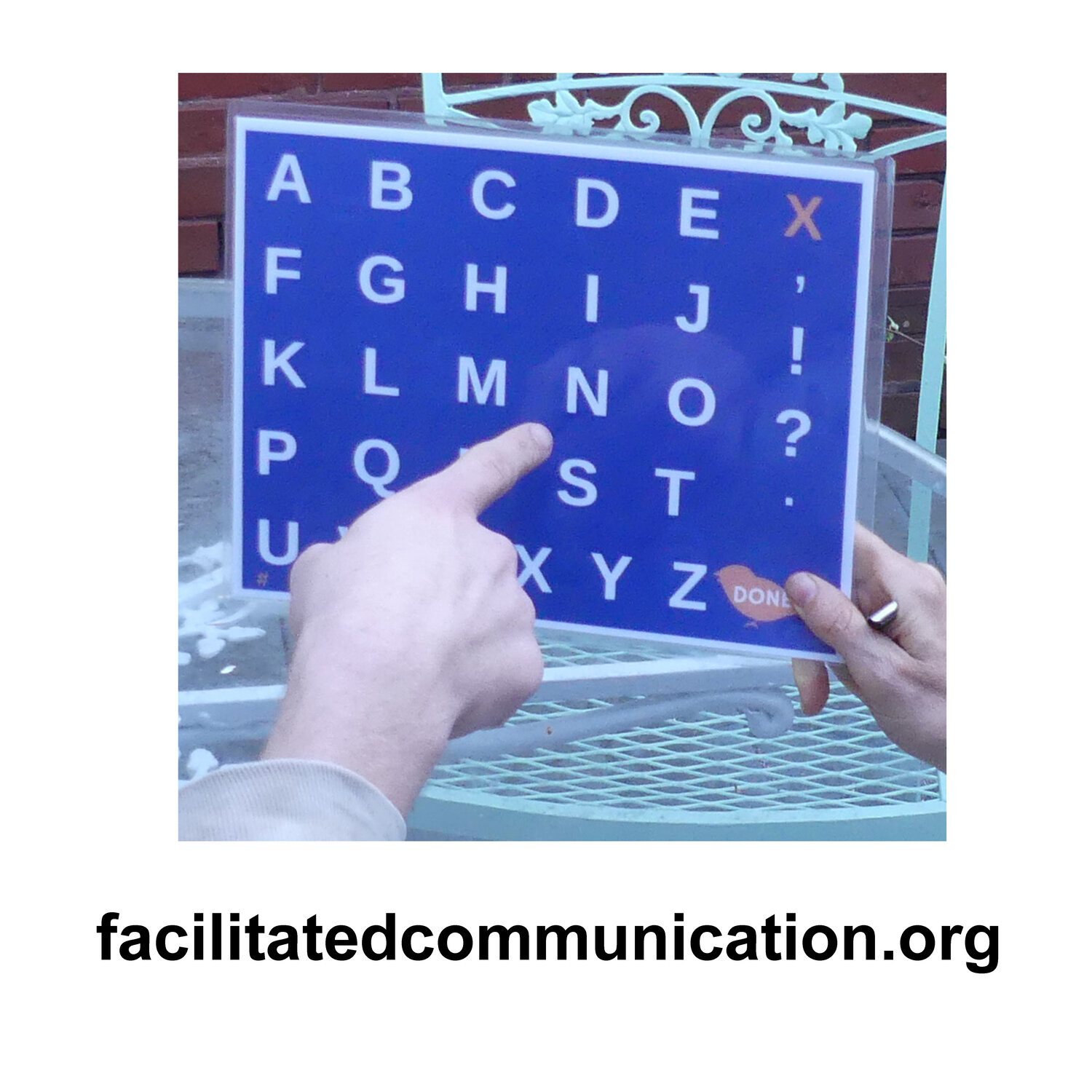
FC-friendly gatekeeping of FC critical publications
In my most recent news roundup, I noted that several news articles referenced a certain updated systematic review that showed that the lack of evidence for recent variants of FC continues unabated. In that post, I promised that I would say more about the systematic review in a later post. This is that post.
The article in question, Schlosser, R.W., Shane, H., Bryant, L., Beals, K., Todd, J., & Hemsley, B. Systematic Review of Authorship in Rapid Prompting Method, Spelling to Communicate, and Variants: Outcomes, Significance and Clinical Implications. Rev J Autism Dev Disord, 2026, followed, in its journey from submission to publication, a somewhat unusual trajectory.
The manuscript was submitted on September 21st, 2025; received peer review at the beginning of April, 2026, over six months later; went through a few rounds of revision with extensive peer reviewer comments; was accepted May 3rd; was released in keeping with the Springer ‘open science’ policy (see here) the next day as a preprint by Dr. Hemsley on the University of Newcastle open repository website (where Dr. Hemsley is Head of the School of Health Sciences and Professor of Speech Pathology); and was published some eleven weeks later, on July 17th, by the same journal that accepted it back in May. Given the long interval between submission and peer review, the systematic review’s search for evidence, initially completed on April 2nd, 2025 had to be repeated: it was completed a second time on April 7th, 2026. As for the eleven week interval between the journal’s acceptance of the article and the journal’s eventual publication of the article, it involved dozens of email messages (mostly by Dr. Hemsley to the journal), an hour-long meeting between four of the paper’s authors and the editor, and a point-by-point rebuttal by those authors of the reasons put forward by some readers of the open repository version as to why the empty systematic review shouldn’t be published.
Many of the hurdles to publication were due to attempts at gatekeeping, or outright censorship, by FC-proponents and/or FC-friendly agents.
Peer Review
The FC-friendly gatekeeping began back in April with a reviewer who requested significant revisions in two areas:
revisions that would ground our findings in the lived experiences of the people we were focusing on (autistic non-speakers and their caregivers)
revisions that discussed the challenges of apraxia and dyspraxia that the reviewer claimed are common in autism.
No matter that a systematic review isn’t about lived experience; no matter that apraxia and dyspraxia are mainly invoked by FC/RPM/S2C proponents as purported explanations for (1) the purported need for FC and (2) the purported unlocking through FC/RPM/S2C of levels of linguistic and cognitive ability not typically found in non-speaking autism.
In response to this reviewer, however, we added the following lines about lived experience:
[A]ccounts presented as the lived experiences of autistic individuals are frequently taken at face value as representing their independent voices, despite the absence of validation of authorship. Best-selling memoirs attributed in part to autistic individuals [Here we cite JB Handley’s Underestimated] as wall as award-winning documentaries [Here we cite The Reason I Jump, Spellers, and the PBS documentary Understanding Autism, which platforms Elizabeth Bonker], exemplify this pattern, particularly in the way they are framed in public discourse and disseminated to broad audiences... Anecdotal reports of lived experiences of RPM/S2C are often assumed to faithfully reflect the voices of the autistic individual. In the absence of independent authorship testing, it remains unclear whose lived experiences are being described in these accounts.
And we added the following lines about apraxia/dyspraxia:
The rationale for both FC and RPM is that autism, rather than being the socio-cognitive disorder that its diagnostic criteria, informed by decades of clinical observation and empirical research, have defined it to be, is instead some sort of motor disorder or body apraxia that impedes both speech and fine motor skills and may be compounded by additional problems with sensory and emotional regulation. This rationale, which dates back to Biklen (1990) and is found, most recently, in Jaswal et al. (2026), purportedly accounts for the poor performance by those with profound autism on language tests; for their inability to demonstrate comprehension by following directions; and for their need for facilitators to help steady their arms, bypass their fine motor difficulties, and/or provide emotional, sensory, or attentional support through vocalizations and board movements (see also I-ASC.org, n.d.). While no research actually supports this, some studies and commentaries have found, or posit the existence of, coordination difficulties and sensory sensitivities in autism (e.g., Belmonte et al., 2013; Bhat, 2020, 2021; Chenausky et al., 2019; Donnellan & Leary, 1995; Fournier et al., 2010; Gernsbacher et al., 2008; Kapp, 2025 ; Mostofsky & Ewen, 2011; Prizant, 1984, 1996; Shoener et al., 2008; Tierney et al., 2015; Torres et al., 2013), and proponents now routinely misconstrue these studies as validating the alleged motor and regulation challenges that provide the theoretical and practical basis for FC and its variants RPM/S2C.
This apparently satisfied the editor, as we learned a month later that the paper had been accepted. Dr. Hemsley released the preprint of the accepted version, and within the next couple of months the review was cited in four news articles:
May 21st, in The Transmitter, a journal focused on autism news: Still no proof for facilitated spelling methods.
June 12th, the Wall Street Journal: Is The Rapid Prompting Method A Miracle or A Mirage?
June 28th, The Australian: Too Much is At Stake to Take This at Face Value (Weekend Magazine)
July 6th, The New York Times: An Autism Breakthrough, or an Illusion? The Fight Over Assisted Spelling
(See my recent news roundup for further discussion).
Mob Review
Meanwhile, suddenly we weren’t hearing anything back from the editor about when we’d be receiving the proofs so that the review could proceed to publication. After Dr. Hemsley, the corresponding author, sent some half-dozen emails, the editor wrote back that the journal had received three letters complaining about the review and saying it shouldn’t be published. Upon Dr. Hemsley’s request, she forwarded those emails (with names redacted).
All three came from parents of non-speakers who use one or another variant of FC, two of whom also identified themselves as professional practitioners of FC variants. The emails overlap quite a bit in their content (suggesting a common source); I’ve extracted some general themes and some representative quotations, and added my own comments in italics:
The usual false claims about apraxia/mind-body disconnects
“Many nonspeaking people live with minds that are far more capable than their bodies reliably allow them to express.”
“We in this field observe that nonspeakers can be taught to overcome their profound motor challenges, to fully communicate...
The poor performance by those with profound autism on language tests and their inability to demonstrate comprehension by following directions isn’t supported by what the motor research on autism actually says (see the second excerpt, above, from the review).
An a priori assumption that RPM, S2C, and “related spelling methods” work:
“When access to communication methods is restricted or removed, nonspeaking people become far more vulnerable than necessary because their ability to express themselves, advocate for themselves, report abuse, participate in decisions affecting their lives, and demonstrate competence is diminished. Families and nonspeaking people will once again find themselves fighting systems already inclined to underestimate them.”
“For many people, these methods have not caused harm; they have profoundly improved lives. They have opened pathways to learning, relationships, self-expression, participation, and dignity that previously seemed unreachable.”
“Suddenly, people once presumed incapable began spelling, typing, learning, expressing preferences, building relationships, and in some cases graduating from college.”
As the systematic review discusses, there are many reasons to believe that these methods are highly susceptible to complete facilitator control, such that their use actually increases the vulnerability of non-speakers, reduces their ability to communicate important messages, and decreases their quality of life, learning opportunities, authentic relationships, self-expression, participation, and dignity.
The real-world harms that the review will do to clinical practice, especially with its purported recommendation that S2C, RPM, and “related typing and spelling methods” be “discontinued.”
In particular, the harm of going back to underestimating these kids and erasing their current successes.
And denying them communication access, or silencing them, at least until the “science catches up”: “The words of doubters should not silence the words of people who have fought this hard to be heard.”
“Publications like this should not be used as tools to invalidate lived experience, undermine communication access, or reinforce traditional systems”
“Scientific debate should never become a vehicle for justifying discrimination, restricting access, or pushing vulnerable people backward”
The likelihood that the facilitators are the ones communicating the FC/RPM/S2C-generated messages means that the real-world harms of silencing communication, restricting access, suppressing lived experience, and pushing vulnerable people backward are more likely to result from using FC, S2C, RPM, and “related typing and spelling methods” than from not using them.
“People who gain effective communication often become more independent, more engaged, more empowered, and less reliant on systems that profit from perpetual dependence.”
This is absolutely true; however, it is FC, S2C, RPM, and “related typing and spelling methods” that result in perpetual dependence (as well as disengagement and disempowerment—see here, here, and here).
The “extraordinary implication” that these kids aren’t communicating authentically, and that all those parents, clinicians, universities, and other institutions… who honor their communication… are either mistaken or being misled” or are “complicit in an elaborate hoax.” “That is a serious accusation, one that demands extraordinary care, humility, and evidentiary restraint.”
It is indeed an extraordinary implication: one that did, indeed, require extraordinary care and careful attention on the part of the authors of the review, as to what the evidence does and does not tell us. Those interested in the details are invited to read the review, which is open access, with care and attention.
The review’s supposed illogic in acknowledging “the prevalence of motor and sensory challenges in nonspeaking people, while simultaneously dismissing methods designed to help people work through or around those very barriers.”
As the above excerpt explains, the documented motor and sensory challenges in non-speaking autism do not create barriers to communication that have to be “worked through” by letterboard-wielding communication partners.
The review’s supposed illogic in its combination of inclusion criteria and conclusions drawn therefrom:
We purportedly chose criteria “which eliminate all existing research” and then discovered that “there are no supportive papers for these methods”
Our inclusion criteria related to the study’s stated aim of reviewing authorship studies, and hence required included studies to involve “a quantitative experimental design involving (a) a priori controlled manipulation of knowledge/stimuli presented to the facilitator and the individual to (b) empirically establish who was authoring the messages produced in response to the stimuli to evaluate authorship of messages produced using RPM/S2C and its variants.” In layman’s terms, to be included, a study had to include a well-controlled experiment in which the non-speaker was asked to answer questions about pictures or other stimuli that their facilitator couldn’t see.
As it turned out, no studies met those criteria. But the criteria were chosen not in order to eliminate all studies, but because there is no other way to definitively establish who is controlling the messages. In particular, neither anticipatory eye-gaze tracking, nor linguistic analysis, can tell you what a well-controlled message-passing test—e.g., asking a non-speaker to describe a picture their facilitator can’t see—can tell you: namely, who is the author controlling the message.
True, a total absence of any published studies of RPM, S2C, or other recent variants of FC that asked non-speakers to describe pictures that their facilitators can’t see is just what we suspected we would discover. That’s because proponents of RPM and S2C have long resisted such testing, and we were pretty sure that if any published tests had occurred, they would have crossed our radar already. But the suggestion that we had simply cast about for whatever criteria would “eliminate all existing research” is as misguided as what comes next:
That the article says there’s no evidence either way and then says that the communication isn’t authentic.
That “A lack of research satisfying a particular standard is not the same as proof that something is ineffective or harmful.”
Here’s what the review actually concludes:
A lack of evidence does not necessarily indicate that these methods are invalid or ineffective (Schlosser & Sigafoos, 2009; Yaffe et al., 2012), and thus may call for (a) a neutral stance in terms of effectiveness, and (b) a cautious approach clinically. Two critical contextual factors, however, alter that interpretation: compelling evidence from a closely related intervention—Facilitated Communication—demonstrating lack of independent authorship (Hemsley et al., 2018; Schlosser et al., 2014), and the high-stakes ethical implications of misattributed communication. Together, these considerations shift the appropriate clinical stance from caution to non-adoption. Additionally, there is anecdotal evidence that these methods are susceptible to facilitator control, indicating that these concerns are not to be taken lightly.
That is, it’s important to read past the first sentence of the paragraph and attend to the “two critical contextual factors” that alter the implication that no conclusions can be drawn from the lack of evidence.
“So rather than concluding that we need more science... the paper concludes that such methods should be abandoned.”
What the paper urged was non-adoption, and there’s a subtle difference between “non-adoption” and “abandonment.” Non-adoption applies only to those who haven’t yet started using the method in question; abandonment applies to all users, actual and potential. Nor does the review rule out “more science”; in fact, it goes on to say that “In cases where warnings are not heeded, ethical and responsible practice requires beginning with a properly conducted independent message-passing test to determine authorship before considering the use of any of these methods with any specific individual.”
Claims that the science isn’t yet settled; that there are “unresolved scientific questions.”
Indeed there are, and again that’s because proponents of RPM, S2C, and “related typing and spelling methods” uniformly refuse to participate in well-controlled tests in which non-speakers are asked to describe pictures that their facilitators can’t see.
An exhortation, while waiting for the science to “catch up,” to pay more attention to the lived experience of autistic people in general (“autistic voices and lived experiences deserve representation in scientific journals”) and of non-speakers in particular, and to involve more people in the autism community in reviews like these, with allusions to:
“how profoundly disconnected this review feels from the lived reality of the tens of thousands of nonspeaking people and families actively using these methods to access communication, education, relationships, autonomy, and a fuller quality of life.”
how it contradicts “the observational evidence of thousands of qualified professionals, and parents, who see their children openly expressing themselves”
how its recommendation to discontinue these methods conflicts with “the existence of so many people who credit these approaches with giving them access to communication” and “risks dismissing the very people whose experiences should matter most in this conversation.”
how “this conversation deserves broader consideration from researchers and clinicians with expertise in communication, motor differences, neurodiversity, and evolving evidence around minimally speaking and nonspeaking populations.
The problem is that the lived reality of nonspeaking people and their families and facilitators, if based on FC-generated output that all the available evidence suggests is coming from the facilitators, may be not only highly subjective (as all lived experiences are), but profoundly detached from reality, and thus detached from the actual lived experiences of anyone, including the actual lived experiences of non-speakers.
Claims of bias and double standard:
The letters attribute hostility on our part to the typing and spelling methods; as well as “discomfort with reconsidering long-held assumptions about competence.”
I will refrain from making similar guesses as to the sentiments of parents who believe their non-speaking children have been unlocked by these techniques after years of silence, or of professionals who make money promoting and teaching these techniques to others.
The claim that similar techniques are used with other populations whose minds similarly don’t cooperate (stroke, traumatic brain injury) and that we are wrongly singling out non-speakers with autism.
The claim that other methods used with non-speakers aren’t questioned, such that we are wrongly singling out FC.
Individuals with motor difficulties that actually undermine communication methods—as opposed to individuals with autism—aren’t subjected to methodologies that allow the many opportunities for facilitator influence that are afforded by RPM, S2C, and “related typing and spelling methods” (see the review for details).
Calls for not publishing the review, or at least for an investigation, because of bad science, conflicts of interest, and potential civil rights violations:
One writer (one of the two who identifies both as a parent of a non-speaker and as an “expert in typing for communication”) accuses the journal of publishing “garbage science” that concludes that “our lived experiences—as fully qualified professionals—are HARMFUL.”
That person also calls for the journal to “review whether this publication’s framing and conclusions meet appropriate standards for transparency, proportionality, research integrity, and editorial responsibility under Springer Nature’s Research Integrity and Publishing Ethics policies, as well as the principles outlined by the Committee on Publication Ethics (COPE), given the likely impact on communication rights, educational access, disability accommodations, and the civil rights of nonspeaking people.”
Another letter writer calls for the journal “to carefully evaluate potential conflicts of interest and the broader systemic incentives surrounding this topic.”
That person adds: “When the stakes involve whether people are allowed access to communication, journals should err on the side of protecting human rights, access, and dignity, particularly for populations that are already underserved and routinely underestimated.”
On these last two points, I wholeheartedly agree.
The “Thinking Person’s Guide to Autism” weighs in
The Transmitter article may have been what called the systematic review to the attention of the three letter writers; it was definitely what called it to the attention of Emily Willingham of the Thinking Person’s Guide to Autism (TPGA).
The TGPA, back in the days of Kim Womble’s tenure here, was a refreshing source of evidence-based information and commentary. Then, in 2016, it took the extraordinary step of erasing a piece that Kim wrote in 2011 (“Questionable Autism Approaches: Facilitated Communication and Rapid Prompting Method”) and replacing it with the following announcement:
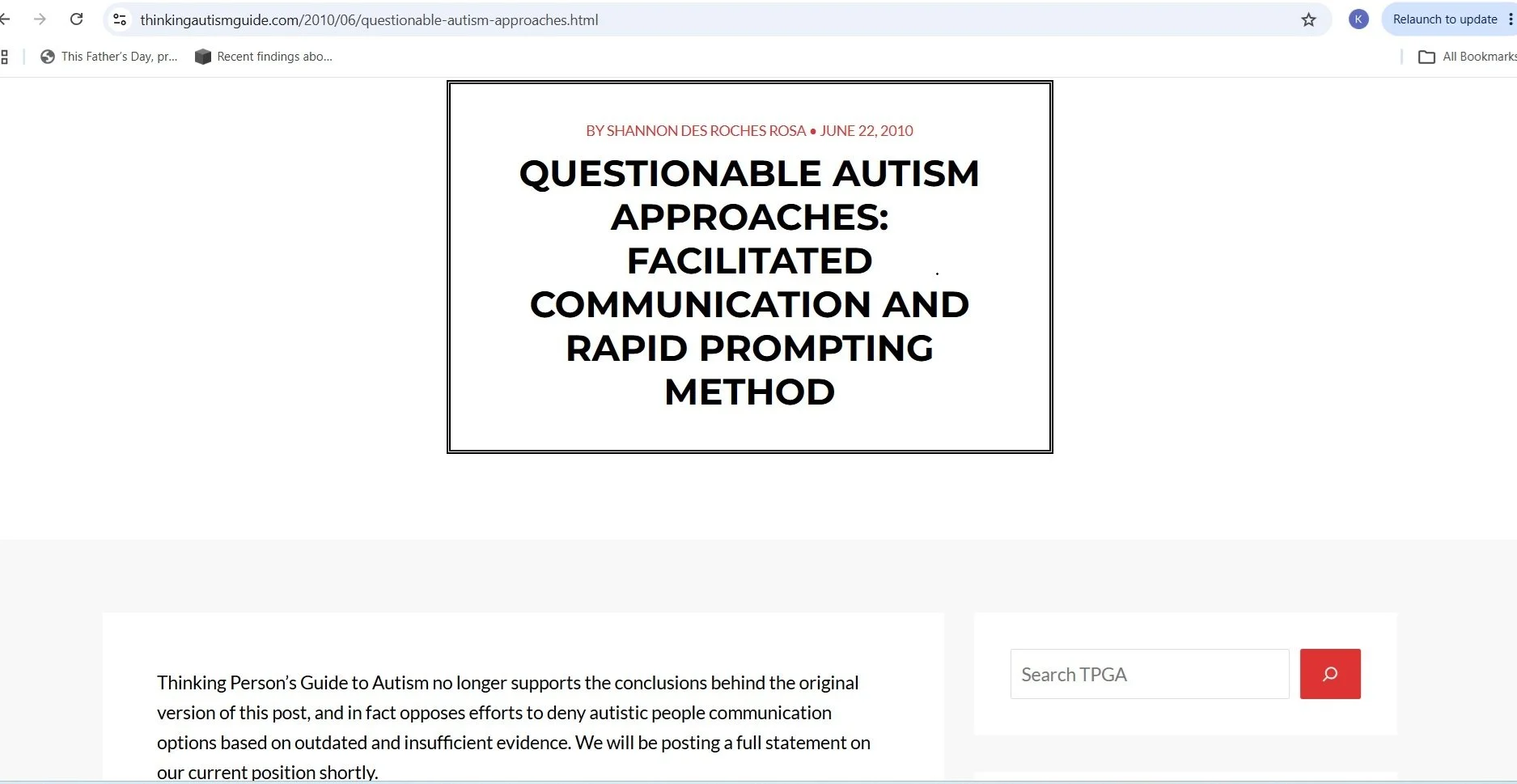
Since then, TGPA has been apologetically pro-FC. After I started critiquing its FC stance, it blocked me on Twitter and removed my name from its list of contributors, even though I contributed to the book they published in 2011.
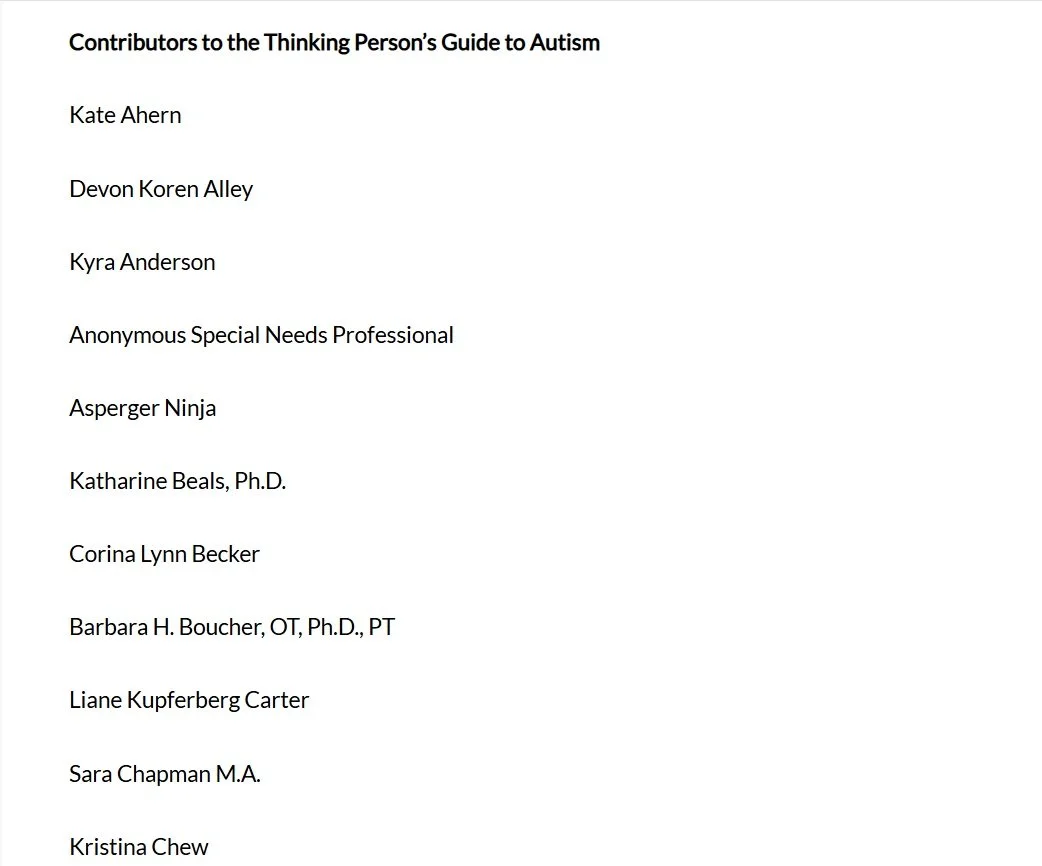
The first eleven of the alphabetically listed contributors to the Thinking Person’s Guide to Autism book.
Nonetheless, long-time TGPA contributor Emily Willingham, in the May 26th piece that critiques the systematic review (Facilitated Spelling: We Need Rigorous Research: Not Polemics), implicitly situates herself between the extremes of “infallible autism therapy that uncovers secret powers in everyone” and “only delusional people buy the shit they’re selling.” Within that middle ground, Willingham is sure, FC works for some people:
Evidence exists that at least some nonspeaking autistic people using these methods move on to communicating independently – without being guided in some way, consciously or unconsciously, by a facilitator.
Here Willingham cites Jaswal et al.’s 2026 Commentary, which provided no such evidence. She then cites the “motor-related” rationale, for which there is also no evidence, as well as those two other FC-adjacent mantras: “presuming competence” and “lived experience”:
Along with a motor-related physiological rationale that I can’t dismiss, examples like these leave me open to the possibilities of such practices, along with my closely held, gotta-take-it-from-my-cold-dead-hands ethos of presuming competence and not rejecting lived experience.
Thinking that FC might work for some people might sound like a reasonable, open-minded stance, but as I argue here, the notion not only lacks evidence; it’s detrimental.
Willingham, however, sees it differently, lobbing ad hominems and strawman arguments at those she calls “ultraskeptics”:
Yet those who cannot bear the idea that “nonverbal” does not equal “utterly incapable” refuse to accept that such people exist....
In their eyes, nonspeaking autistic people are no more capable than horses of understanding or expressing language and do so “successfully” only because of cues from facilitators.
We are people “who the public record attests are clearly obsessed with attacking these methods at sometimes a very personal level”; we’re also accused of “co-occurring with enthusiasts of the “profound autism” label and applied behavioral analysis (ABA)” and being snide, condescending, and polemicist.

Image generated by ChatGPT.
Willingham also thinks we’re illogical. Somehow—I can’t follow her logic—she finds it contradictory to simultaneously believe (1) that autistic people hit the correct letters only because of cues from their facilitators and (2) that “autistic people aren’t pointing on their letterboards where facilitators say they are.” (I’ve included Willingham’s link in this last excerpt; it’s one of Janyce’s video analyses that shows an autistic person not pointing where the facilitator says he is).
Having dispensed this preliminary wisdom, Willingham proceeds to reveal the reason why she’s writing this piece: a “weird little systematic review’” cited in the Transmitter Article…. Whereupon we’re treated to another set of misrepresentations of the systematic review, starting with:
The Transmitter piece describes the review as “an analysis,” despite the fact that it analyzed precisely nothing, which seems to have been precisely the authors’ intent.”
People who are curious about this are invited to read the review (which is open access) and decide for themselves whether we failed to analyze anything.
Among many concerns, my primary one is that this group of authors pretended to conduct a systematic review at all. They had to have been quite aware going in of what they would conclude. The only thing systematic about this “review” is that they systematically set the constraints to produce no studies to review.
See above commentary in the Mob Review section. The notion that we had simply cast about for whatever criterion would “eliminate all existing research” is as misguided as Willingham’s other accusations.
Willingham proceeds to suggest that we all had conflicts of interest. She notes that “conflicts of interest can be financial, professional, or intellectual,” and provides short descriptions of our professional activities and purported intellectual interests. People who are curious about Willingham’s claims are invited to decide whether any of these weird little biographies she’s written up reveal the kinds of conflicts of interest that should have been disclosed—or that are routinely disclosed by anyone.
Willingham does acknowledge Vikram Jaswal’s conflict of interest, calling him “the father of a user of S2C” who has “worked with I-ASC, a key organization promoting S2C, in some of his research.” But she doesn’t acknowledge that Jaswal himself never acknowledges those conflicts of interest in his own research.
Why this double standard? Might Willingham herself have a conflict of interest? Some sort of professional relationship, perhaps, with Vikram Jaswal? Along those lines, it seems to trouble her that:
Katharine Beals, writes lengthy, granular ripostes to his work, mostly on a blog, but occasionally published in journals, such as the snidely [sic] titled, Illusions of literacy in nonspeaking autistic people: a response to Jaswal, Lampi & Stockwell.”
And that:
In the empty systematic review, Schlosser, Beals, and their co-authors shift between citing work from Jaswal and colleagues and their own motley assortment of publications. The result is an opening section that reads like a debate involving two parties – except in this debate, just one party gets to speak or produce evidence.
That could just as easily describe Jaswal et al.’s 2026 Commentary, which Willingham cites approvingly throughout her piece.
Interestingly, Willingham faults the systematic review for how much of our evidence for influence in “facilitated spelling” comes from a blog post that describes a letterboard user’s personal experience, a personal memoir, two court cases, and the Telepathy Tapes podcast. Somehow it escapes her that this is one of the logical consequences of the review’s empty results. In the absence of published authorship studies, we’re stuck with lived experience: something that FC proponents love to tout—except when it turns out to be problematic for them.
Willingham goes on to complain about how narrow the review’s inclusion criteria were, faulting it for “ruling out any study that relied on linguistic analysis, analysis of eye or finger movements, and observations or interviews.” (See my above comments in the Mob Review section).
Oddly, Willingham appears to simultaneously believe (1) that there was a “vanishingly small chance that these authors, of all people, would have overlooked publication of any study relying on their pet study design” and (2) that there was a good chance we missed some relevant studies within our “constraints”:
They excluded 5,830 publications based on reading the abstract alone. We do not know what the 5,830 publications they excluded said, described, reported, or concluded. We just have to take their word that they weren’t relevant within the constraints they imposed.
The review located just 25 potentially relevant studies that related in any way to RPM/S2C and in each case reported on reasons for exclusion.
Willingham proceeds to fault The Transmitter for the “Still no proof” in its title and for, purportedly, contradicting itself:
The Transmitter headline claiming “still no proof” is belied by comments from sources in the piece such as David Amaral, distinguished professor of psychiatry and behavioral sciences at the University of California, Davis MIND Institute. Amaral is framed as viewing the entire debate as “too polarized and too dogmatic” and says that “a subset of autistic people may benefit from facilitated communication … particularly those who go on to become independent spellers.”
Unfortunately, there is no more evidence for this claim when Amaral says it than when Jaswal et al. say it.
Willingham then cites a paper co-authored by Helen Tager-Flusberg that she sees to think provides some evidence for FC’s purported unlocking of language:
Helen Tager-Flusberg, director of the Center for Autism Research Excellence at Boston University, is author on a study suggesting that a quarter of nonspeaking autistic people have receptive language capacities that outpace their expressive language ability. Is this proportion somehow not substantial enough to warrant further investigation and consideration for supports?
One has to wonder whether Willingham actually read Tager-Flusberg’s paper, which finds very low receptive language skills in all nonspeaking autistic people, even though some have receptive language abilities that are stronger than expected relative to their extremely limited expressive language abilities. Across the board, the vocabulary levels in non-speaking autism are far below the vocabulary seen in typical FCed messages.
Next, Willingham rhapsodizes about Jaswal et al.’s 2026 Commentary:
The commentary that Amaral solicited from Jaswal and colleagues is a thoughtful, measured, and evidence-based appeal for studies to sort out how and which autistic people can benefit from these approaches.
This leaves me wondering how carefully she read it, checked its references, and/or looked at the four critical letters it received.
Willingham also cites Jaswal’s claim that message-passing tests don’t show “that assisted methods to teach typing never help learners achieve the goal of typing independently”—which, of course is trivially true inasmuch as any given message-passing test only tells you about who’s controling the messages in any given facilitator-facilitatee dyad. This, of course, does not invalidate message passing tests—nor does anything else that Jaswal has claimed about these tests.
Vikram Jaswal weighs in on the systematic review
Willingham concludes by faulting The Transmitter for leaving out much of what Jaswal said when it interviewed him about the systematic review. Most fortunately, however, Jaswal has emailed Willingham everything he said, and she concludes her piece by passing his words on to us:
I was surprised that almost all of the references the authors used to motivate this empty review are to commentaries published in journals they edit, blog posts they wrote, policy statements they authored, or prior empty reviews they have written—one of which (Schlosser et al., 2014) was not even peer-reviewed. This scholarship by self-reference to non-empirical, often non-peer-reviewed material does not strike me as a form of serious academic engagement.
In an area where few people dare to publish intellectually rigorous research and commentaries and where no one is willing to participate in well-controlled studies, there are, admittedly, slim pickings. But “almost all” is patently false, as anyone who actually reads the introductory sections of the review (which, again, is open access) can see. Furthermore, anyone who wants to check our references will find (1) that we characterize them accurately and (2) that they support what we say. Unfortunately, this much cannot be said of many of the references made by Jaswal (as I discuss here and here); not to mention the fact that much of Jaswal’s data comes from FC-generated testimonials whose provenance is highly questionable (see, e.g., here).
Jaswal continues:
I was less surprised about what the authors found. The only studies they considered including involved message passing tests. Other methodologies that are standard in contemporary communication science, psycholinguistics, and neuroscience (e.g., eyetracking, movement analyses, stylistic analyses) were excluded.
See my above commentary about message-passing tests vs. eye tracking and stylistic analysis.
This would be like conducting a systematic review on object permanence, limiting eligible papers to those between 2016 and 2026 that investigated whether 6-month-old infants reach for hidden objects. There are unlikely to be any studies (positive or negative) meeting those criteria. But it would be incorrect to conclude from that empty review that 6-month-olds do not understand object permanence. Countless studies over the past 40 years using other methodologies have demonstrated that they do.
No, it would not. Instead, it would be like conducting a systematic review of object permanence that, quite reasonably, limits eligible papers to those that used well-controlled experimental designs to investigate whether infants and toddlers reach for hidden objects and that, quite reasonably, excludes studies in which researchers simply watched children explore a cluttered play space, or had parents fill out surveys about their children’s object permanence-related behaviors, or interviewed toddlers about what they do when a ball rolls behind screens, or extracted information from infants via facilitated communication.
Back to Mob Review and Peer Review
So much for Willingham and Jaswal; let’s go back to the Mob Review. The three letter writers who tried to cancel our systematic review set in motion a high-level “investigation” of our review, and perhaps of us as well: an investigation that it took the publisher, Springer, about nine weeks to complete. We have no idea what all it involved, but part of the process was them sending the letters to the peer reviewers to see if they stood by their reviews, and us writing two point-by-point rebuttals, to which we received no response. The entire thing felt Kafkaesque, and the investigation might have gone on indefinitely had Dr. Hemsley not asked Springer where letters by people who’d been harmed by FC should be sent. Springer didn’t respond to that email message, but published the review two days later.
Nor do we think any of this was just a fluke. One of our previous submissions to another journal, subsequently withdrawn and published elsewhere after peer review, also encountered FC-friendly gatekeeping. One reviewer thought it best that we focus less on FC and acknowledge that all interventions, traditional AAC included, present risks of influence or other adverse events, as well as weak evidence for efficacy. No matter that the dangers of outright communication hijacking and false attribution of messages are distinct from these other concerns, are specific to FC, and haven’t been addressed in other articles on communication rights. Like the reviewer who was critical of the systematic review, this reviewer also wanted more “lived experience.”
But the biggest obstacle posed by this reviewer was an insistence that we address whether message-passing tests had been empirically validated and what the likelihood or risk was that a message-passing test would draw erroneous conclusions about authorship. The notion that an empirical test that simply manipulates one variable (what the facilitator knows) to explore its effect (on the FC-generated message)—something akin to changing the batteries on a flashlight to see if the original batteries were responsible for the flashlight not working—was something that itself needed to be empirically validated, had us completely baffled. In a letter we wrote to the editor before withdrawing our paper from this journal and sending it elsewhere, I contributed this:
[This reviewer] seems to want us to expand our paper to include an empirical defense of basic principles of experimental design. This leaves us wondering what it would be like if such a demand were made of studies in general; not just studies of FC. Studies examining the validity of telepathy might use designs similar to those we describe for FC: blinding the targeted recipient of the telepathic message to the message contents and to any possible cueing from the “sender.” Are the results of such studies unreliable until their empirical designs have somehow been empirically validated? What would such a meta-validation even look like, and how do we avoid infinite regress?
More practically speaking, how do researchers writing papers critical of FC avoid the potentially infinite delays caused by FC-friendly gatekeeping? I suspect this will get worse before it gets better.
REFERENCES:
Belmonte, M. K., Saxena-Chandhok, T., Cherian, R., Muneer, R., George, L., & Karanth, P. (2013). Oral motor deficits in speech-impaired children with autism. Frontiers in Integrative Neuroscience, 7, 47. https://doi.org/10.3389/fnint.2013.00047
Biklen, D. (1990). Communication unbound: Autism and praxis. Harvard Educational Review, 60(3), 291–314. https://doi.org/10.17763/haer.60.3.013h5022862vu732
Bhat, A. N. (2020). Is motor impairment in autism spectrum disorder distinct from developmental coordination disorder? A report from the SPARK Study. Physical Therapy, 100(4), 633–644. https://doi.org/10.1093/ptj/pzz190
Bhat, A. N. (2021). Motor impairment increases in children with autism spectrum disorder as a function of social communication, cognitive and functional impairment, repetitive behavior severity, and comorbid diagnoses: A SPARK study report. Autism Research, 14(1), 202–219. https://doi.org/10.1002/aur.2453
Brady, N. C., Bruce, S., Goldman, A., Erickson, K., Mineo, B., Ogletree, B. T., ... & Wilkinson, K. (2016). Communication services and supports for individuals with severe disabilities: Guidance for assessment and intervention. American Journal on Intellectual and Developmental Disabilities, 121(2), 121-138
Chenausky, K., Brignell, A., Morgan, A., & Tager-Flusberg, H. (2019). Motor speech impairment predicts expressive language in minimally verbal, but not low verbal, individuals with autism spectrum disorder. Autism & Developmental Language Impairments, 4, 1–12. https://doi.org/10.1177/2396941519856333
Donnellan, A. M., & Leary, M. R. (1995). Movement differences and diversity in autism/mental retardation. DRI.
Fournier, K. A., Hass, C. J., Naik, S. K., Lodha, N., & Cauraugh, J. H. (2010). Motor coordination in autism spectrum disorders: A synthesis and meta-analysis. Journal of Autism and Developmental Disorders, 40(10), 1227–1240. https://doi.org/10.1007/s10803-010-0981-3
Gernsbacher, M. A., Sauer, E. A., Geye, H. M., Schweigert, E. K., & Goldsmith, H. H. (2008). Infant and toddler oral- and manual-motor skills predict later speech fluency in autism. Journal of Child Psychology and Psychiatry, 49(1), 43–50. https://doi.org/10.1111/j.1469-7610.2007.01820.x
Hemsley, B., Bryan, L., Schlosser, R., Shane, H., Lang, R., Paul, D., Banajee, M., & Ireland, M. (2018). Systematic review of Facilitated Communication (FC) 2014–2018 finds no new evidence that messages delivered using FC are authored by the person with disability. Autism and Developmental Language Impairments, 3, 1–8. https://doi.org/10.1177/2396941518821570
Jaswal, V. K., Prizant, B. M., Barense, M. D., Patten, K., & Stobbe, G. (2026). Why we need to study assisted methods to teach typing to nonspeaking autistic people. Autism Research, e70176. https://doi.org/10.1002/aur.70176
Kapp, S. K. (2025). Sensory–movement underpinnings of lifelong neurodivergence: Getting a grip on autism. Frontiers in Integrative Neuroscience, 19, 1–27. https://doi.org/10.3389/fnint.2025.1489322
Mostofsky, S. H., & Ewen, J. B. (2011). Altered connectivity and action model formation in autism is autism. The Neuroscientist, 17(4), 437–448. https://doi.org/10.1177/1073858410392381
Prizant, B. M. (1984). Assessment and intervention of communicative problems in children with autism. Communicative Disorders, 9(9), 127–140.
Prizant, B. M. (1996). Brief report: Communication, language, social, and emotional development. Journal of Autism and Developmental Disorders, 26(2), 173–178. https://doi.org/10.1007/BF02172007
Schlosser, R. W., & Sigafoos, J. (2009). Empty’ reviews and evidence-based practice. Evidence-Based Communication Assessment and Intervention, 3, 1–3. https://doi.org/10.1080/17489530902801067
Schlosser, R. W., Balandin, S., Hemsley, B., Iacono, T., Probst, P., & von Tetzchner, S. (2014). Facilitated communication and authorship: A systematic review. Augmentative and Alternative Communication, 30, 359–368. https://doi.org/10.3109/07434618.2014.971490
Schlosser, R.W., Shane, H., Bryant, L. et al. Systematic Review of Authorship in Rapid Prompting Method, Spelling to Communicate, and Variants: Outcomes, Significance and Clinical Implications. Rev J Autism Dev Disord (2026). https://doi.org/10.1007/s40489-026-00569-7
Shoener, R. F., Kinnealey, M., & Koenig, K. P. (2008). You can know me now if you listen: Sensory, motor, and communication issues in a nonverbal person with autism. American Journal of Occupational Therapy, 62(5), 547–553. https://doi.org/10.5014/ajot.62.5.547
Tierney, C. M., Mayes, S., Lohs, S. R., Black, A., Gisin, E., & Veglia, M. (2015). How valid is the Checklist for Autism Spectrum Disorder when a child has apraxia of speech? Journal of Developmental and Behavioral Pediatrics, 36(8), 569–574. https://doi.org/10.1097/DBP.0000000000000189
Torres, E. B., Brincker, M., Isenhower, R. W., Yanovich, P., Stigler, K. A., Nurnberger, J. I., Metaxas, D. N., & José, J. V. (2013). Autism: The micro-movement perspective. Frontiers in Integrative Neuroscience, 7, 32. https://doi.org/10.3389/fnint.2013.00032
Yaffe, J., Montgomery, M., Hopewell, S., & Shepard, L. D. (2012). Empty reviews: A description and consideration of Cochrane systematic reviews with no included studies. Plos One, 7, 5. https://doi.org/10.1371/journal.pone.0036626
