News Roundup Part II, January-July 2026: news analyses and commentaries
In my last post, I went through the various news reports that appeared since the start of the year; in this one, I focus on the various analyses and commentaries. Some of them were occasioned by RFK Jr’s appointment of facilitated non-speakers and FC-supporters to the new Inter Autism Agency Coordinating Committee, and others by some combination of the Woody Brown affair and an empty review showing continued lack of evidence for Rapid Prompting Method (RPM) and “spelling,” about which I’ll have more to say in a later post. Many of these commentaries include at least some critical analyses of FC.
The most critical, tellingly, are responses to RFK Jr’s appointment of facilitated non-speakers and FC-supporters to the new Inter Autism Agency Coordinating Committee. They are:
A January 30th article in Mother Jones entitled RFK’s Overhauled Autism Committee Is Even Worse Than It Looks
A January 31st post in Zaid Jilani’s American Saga entitled RFK Jr. Is Remaking a Key Government Autism Committee in His Image
RFK, Jr., perhaps, is a safer target than the broader world of FC: most of the commentaries on Woody Brown and the empty review are disappointingly wishy-washy.
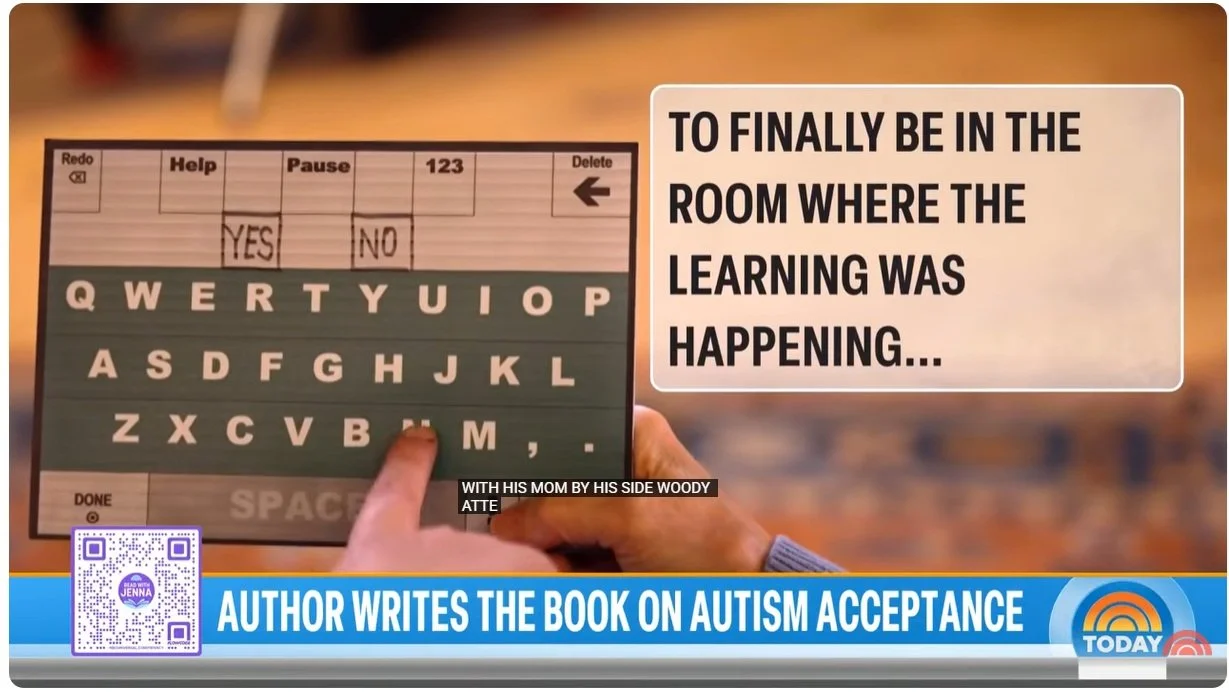
A screenshot of the Woody Brown on the Today Show episode “Author of Read With Jenna Book Club Pick Shines Light on Autism”
1. The Atlantic
The first, from April 15th, is an article in the Atlantic entitled The Publishing Mystery That No One Wants to Talk About, which I mentioned in my last post. It misquoted me as suggesting that FC sometimes works and found another autism expert affiliated with Drexel who said so explicitly. Though highly critical of FC/”spelling” in places, it ends on a note of uncertainty about whether Woody Brown wrote the book that has been attributed to him.
2. The Transmitter
The second, from May 21st, is an article in The Transmitter entitled Still no proof for facilitated spelling methods and subtitled “A systematic review into whether the “rapid prompting method” or “spelling to communicate” can help autistic people express themselves comes up empty yet again.” (Again, I’ll have more to say about that review in a later blog post).
While this article, too, is critical, it also ends by leaving open the possibility that FC is still real. It quotes John Damaio, associate professor of occupational therapy at Pace University, as questioning why Vikram Jaswal’s problematic eye-tracking study “is not seen as proving authorship.” And it quotes David Amaral, whom it characterizes as a “distinguished professor of psychiatry and behavioral sciences at the University of California, Davis MIND Institute and the journal editor who had solicited Jaswal’s [Pro-FC] commentary” (see above)” as saying that “a subset of autistic people may benefit from facilitated communication” and that message-passing studies have “to be done with a large enough population of participants that you can begin to see that it works for some people and doesn’t work for others.” Note the presumptuous, question-begging “see that” in place of the open, scientific “see whether.”
3. The Washington Post
The third article appeared in June 8th in the Washington Post. This article, entitled The latest autism debate: is spelling therapy effective or a hoax? , and for which I was interviewed but not quoted, is also largely critical while still leaving room for the possibility that FC sometimes works. Worse, it opens by attributing levels of communicative agency to FCed non-speaker Elizabeth Bonker that would only be plausible if FC actually does work:
Elizabeth Bonker is a silent woman with a loud mission. She wants government agencies to cover the costs of training people with autism in a form of communication called assisted spelling.
Given what we know about verbal comprehension skills in non-speaking autism, non-speakers are unlikely to be able to access information about abstract entities like government agencies, government funding, or training costs.
The author also recounts a meeting with a family that uses “spelling” and does not pass definitive judgment on what he observes. While meeting these families seems like a good idea, I’m wondering if it also deters today’s journalists from saying things that might hurt their feelings.
4. The Wall Street Journal
The fourth article, from June 12th, is an article in the Wall Street Journal entitled Is the Rapid Prompting Method a Miracle or Mirage? Again, while critical (it mentions the empty review showing no evidence for RPM/”spelling”), the author leaves the headline’s question unanswered. Like the Washington Post journalist, she also meets a family that uses RPM. Surprisingly, she somehow gets them to agree to something almost no families agree to: several rounds of blinded testing. The tests she conducts, however, falls short of the kind of well-designed message-passing tests that more definitively determine authorship (see Hemsley et al, 2025), and it’s unclear whether the boy’s mother and/or his RPM provider had some input. It involved showing the boy short words while the latter was out of the room and then seeing if he could spell what he saw after she returned. The boy only manages to spell one of the three words, “OLIVE,” correctly.
Given that rote memorization and rote spelling skills are common strengths in autism, profound autism included, it’s not clear that spelling a just-displayed word is something the boy couldn’t have done on his own—independently of RPM and his facilitator. A better test would have involved a question about a picture of an olive rather than the word “OLIVE.” Nonetheless, reporter Emma Camp, who doesn’t seem to have consulted with any experts on authorship testing, when considering possible extraneous confounds that might distort these results, focuses more on reasons why the boy may have failed to spell the other two words than on reasons why he might have gotten OLIVE correct and still not been authentically communicating when subjected to RPM.
5. The Australian
The fifth article, a piece by Gary Nunn, published in the Australian in June 28th and entitled “Too Much is At Stake to Take This At Face Value”, is the one non-wishy-washy piece on the Woody Brown piece in a major news outlet, beside the article in the Telegraph I mentioned in Part I of this news roundup. Much more comprehensive and better researched that its counterparts in the Atlantic, the Washington Post, and the Wall Street Journal, it recounts the evidence against FC (including the empty review); it quotes from two world-famous FC experts (Bronwyn Hemsley and Howard Shane) and two eye witnesses (Janyce and our anonymous source on telepathy in France); and gives us the bigger picture on books that have been, most likely falsely, attributed to autistic non-speakers (discussing Annie’s Coming Out, Eye Can Write, and The Reason I Jump). It ends with the most powerful statement about the Woody Brown novel that I’ve seen:
The true tragedy of this story - one that the world's most respected publishing houses and media outlets have largely failed to report - is that the real fictionally created character isn't, in fact, Walter at all. It's Woody himself.
6. The New York Times
A July 6th article in the New York Times entitled An Autism Breakthrough, or an Illusion? The Fight Over Assisted Spelling returns us to disappointingly wishy-washy reporting.
On the one hand, it notes the failed messages passing tests of 1990s FC; quotes long-time FC-evaluator Howard Shane as saying that “I never found anyone that passed”; observes that Woody Brown, as seen on the Today Show, “appear[ed] to point at random letters as his mother spelled eloquent prose”; and links to the most recent empty review of the newer variants of FC.
On the other hand, it also claims that Tito Mukhopadhyay, son of Soma Mukhopadhyay, the “inventor” of the oldest of these new variants (the Rapid Prompting Method), types independently; quotes David Amaral (see the Transmitter article above) as saying that “there’s enough evidence that this does work for a subset of people” (see also my earlier post on this phenomenon); and asserts towards the very beginning of the article (about 8 paragraphs in), that:
The central question is less about whether breakthroughs like Tito’s are possible, but whether they are as widespread as many proponents claim.
It also quotes a researcher who has long been associated with Vosseler’s S2C-promoting organization I-ASC:
“Absence of evidence is not the same as evidence of absence.” said Alexandra Woolgar, a cognitive neuroscientist at the University of Cambridge. She argued that concerns about influence needed to be weighed against “the risk of underestimating people who genuinely do understand, who could do so much more if we allow them to communicate in a way that works for them.”
According to the Times, Dr. Woolgar is conducting “her own blinded tests of assisted spelling” (curiously, there’s no description of what these tests look like) as well as “a study measuring electrical activity in the brains of non-speakers to search for signs that they understand spoken language.” A picture of Woolgar purportedly conducting this experiment features prominently in the article. I last heard it mentioned over two years ago, and there’s no still no indication that it’s produced any actual results.
A look at Woolgar’s actual publications shows a single paper on autism. This paper, which dates back to 2018 and of which Woolgar was the fourth author, uncovers joint attention difficulties in autism that persist into adulthood. Given that joint attention difficulties derail language aquisition, these findings that are problematic for FC believers. As for who suggested that Woolgar be interviewed for this article, one can only speculate.
I offered to be interviewed by reporter Azeen Ghorayshi, a science reporter, on the linguistic implausibility of all forms of FC, no matter how subtle. I was told that she “already had enough quotes.”
Three additional commentaries from FC supporters
In the last month, three additional commentaries have appeared, these ones authored by members of the FC community. Their take on FC, naturally, is at odds with Gary Nunn’s.
The first is one of the letters published on June 17th in response to the Washington Post article. The first of three letters, it’s entitled I’m a nonspeaking autistic teen. No one gets to put words in my mouth. It’s attributed to Noah Simmons, whose family was interviewed by the author of the Post article, and is accompanied by a picture captioned “Noah Simmons at a climbing center in Gaithersburg, Maryland, with his mother, Tracy Simmons, who is holding a laminated sheet with the alphabet.”
This letter states that before “spelling” was introduced, no other therapy worked, and “I lived like a puppet pulled every day in the directions others thought I should go.” Ironically, its closing paragraph acknowledges, “I can’t type independently. Will it take years for me to shed the need for support? Maybe. Maybe not.” This raises the question of which involves more puppetry:
being pulled in the directions others think you should go, or
having your index finger used to generate messages that aren’t yours but are attributed to you (and then being pulled in directions based on those messages)?
The author of this letter, whoever it might be, reassures us that “No one gets to put words in my mouth. I am in control of what I type.”
The second letter in the set, by the way, is one by Matthew Belmonte, which, while critical of “spelling,” doesn’t rule out that it works for some people (see his mention in my earlier post); the third is by Jessica Sassi, president and CEO of the New England Center for Children, an evidence-grounded school for profoundly autistic children, which comes down definitively against FC.
When subjected to double-blind testing, the communication consistently breaks down. This is why assisted spelling practitioners refuse to participate in scientific tests.
...relying on discredited methods takes resources away from evidence-based interventions such as augmentative and alternative communication (AAC) tools. AAC is designed to fade out prompts and maximize the person’s independent control over their own message. True independence means teaching nonverbal individuals to communicate entirely unassisted.
The next commentary is a June 23rd opinion piece on WBUR Boston Public Radio entitled How I'm trying to help my nonverbal son communicate — and why it's controversial. Author Micha Boyett writes as the mother of a child with Down Syndrome and autism. While she acknowledges the position statement of the American Speech-Language-Hearing Association (ASHA) against FC/”spelling,” she dismisses concerns about authorship:
when we come to this conversation asking only the forensic question — Whose words are these? — we miss the question that parents and caregivers are asking on behalf of our nonspeaking loved ones: How can we enable them to communicate at all?”
Somehow both Boyett and her editors at WBUR have missed the contradiction. If we don’t know whose words these are, we don’t know if the people in question are communicating their own words; if we don’t know if they’re communicating their own words, how does that count as enabling communication? Of course, there’s a simple way to find out, but Boyett doesn’t go there.
What about evidence-based communication devices? These, Boyett argues, are too much of a challenge for her son’s dysregulated body:
Ace’s ASHA-approved communication device, TouchChat, contains hundreds of words across dozens of pages. To access language, he needs to remember where each word lives and how to navigate to it. All of this assumes a regulated body. My son cannot stop moving. Ace is not hyperactive; his sensory system is overloaded. He spins rings, flaps his arms. He grinds his teeth. He constantly works to regulate his body through movement, and when he can’t, it’s almost impossible for him to focus on anything else.
For a child whose biggest challenge is the ability to control his body, negotiating this system is overwhelming. Contrast that with the Spellers Method, which asks a nonspeaker to learn only 26 motor planning movements — one for each letter —always in the same place on the board, placed directly in their line of vision.
Somehow, even with co-occurring Down syndrome, the biggest challenge is motor control—an assumption that the editors at WBUR might have fact-checked.
Boyett neglects to mention that AAC devices can be customized to involve fewer items and less navigation; that people who “cannot stop moving” are blocked off in corners when subjected to spelling, often much to their distress, and that, unlike with AAC devices, the boards used in “spelling” aren’t on stationary surfaces, but held up by the facilitators, such that the “26 motor planning movements” aren’t in fact fixed. She also fails to discuss the literacy skills required to “spell” and how her son acquired them (e.g., silent “e”; silent “gh”; the various ways to spell the long vowel sounds—things that many young students struggle with for years).
Boyett mentions the Woody Brown affair, but not the incriminating Today Show video, where the letters that Brown points to don’t spell what his mother calls out, let alone any actual words. Instead she mentions the Atlantic article, which for her was too critical:
In my mind, he [author Dan Engber] joins a long line of critics of autism mothers, who have been blamed for everything from causing their child’s condition (aka the “refrigerator mother theory”) to having their hope treated as evidence against them. In today’s debates over communication methods, moms are often positioned as deceptive figures, distorting or even inventing their child’s voice.
The notion of an intellectually intact child locked inside an autistic body is, in fact, more akin to the refrigerator mother theory than the notion of a hopeful mother falling for deception over evidence.
The third commentary is a June 29th interview published in the Los Angeles Review of Books entitled Nonspeakers Speaking Out Woody Brown discusses his debut novel and the challenges those with nonspeaking autism face today. It is a purported interview by Jason Jacoby Lee, an autistic non-speaker whose facilitated spelling looks like this, and Woody Brown, the above-mentioned autistic non-speaker whose facilitated spelling looks like this. This interview was purportedly generated via these methods:
Each of us typed out our comments using a letterboard—a simple piece of technology that consists of the alphabet printed on a laminated piece of cardboard. Our communication partners then entered our correspondence into the computer for us.
Readers are assured that
All the words that you see below, however, are entirely our own.
We learn that Jason and Woody met two years ago at Columbia, where Woody got an MFA in creative writing and Jason’s parents teach, and that they
developed an instant rapport based on our shared experience of inhabiting a world that often ignores or dismisses those of us with nonspeaking autism.
Any concerns about the legitimacy of their communication method are dismissed with references to two problematic works by one problematic autism researcher (Vikram Jaswal, the father of a non-speaker child who has also used “spelling”): the afore-mentioned eye-tracking study, and a recent commentary published in Autism Research (about which I’ll eventually write a longer post, but see this one for some preliminary discussion). The latter
concluded that typing possessed “the potential to result in greater access to effective communication and better quality of life for more nonspeaking autistic people.”
This piece also claims that critics “rarely pick up on” the “nuances” that distinguish “spelling” from traditional FC “and instead lump together typing and facilitated communication in ways that are decidedly unhelpful.” Interested readers are invited to fact-check that claim by reviewing this website; whoever wrote this instead recommends a website that sells “spelling” services:
Woody and I encourage you to visit the Communication 4 ALL website.
The interview itself contains many words and idioms that my verbal, more moderately autistic (level 2) son, a college graduate who is nearly a decade older than Jason and Woody, still doesn’t know (I checked), for example:
“bereft,” ”harangue,” “vulnerable,” “dire,” “salient,” “trailblazer,” “confounded,” and “mixed bag”
It also contains psychologically complex formulations that are also far beyond what my son has ever written, even though his writing has grown increasingly sophisticated over the last decade (with sentences running to dozens of words with multiple embedded clauses):
“Fiction contains many tragedies that the heart cannot withstand in reality”
“Many love my debut novel, but some unfortunate souls are convinced that I couldn’t have written it, that I am a puppet for the actual author, who is supposedly my mother.”
“No one at Columbia questioned my authorship, but then they saw my typing up close and in person. Strangers smear me, which is offensive and ableist.”
Side note: there’s been some chatter in pro-FC social media groups about the fact that my autistic son is deaf and that I’m overgeneralizing his receptive language skills to autistic individuals in general and letting my purported grief over his limited language capacities affect my FC criticisms. I’ve hesitated to address these claims, as the last thing I want to do is sound like I’m boasting about my autistic son, especially in the context of FC. But given the potential of these claims to impugn the credibility of my FC criticisms, I’ve decided it’s important to address them, and I’ll do so at the end of this post.
Also included in the Los Angeles Review of Books interview are the standard pro-FC epithets for FC critics, popularized by people like J.B. Handley and Barry Prizant: “naysayers” and “haters.”
Some of the purported exchanges between Jason and Woody sound nothing like how people with any level of actual autism spectrum disorder actually interact:
“Speaking of the future, what are you hoping it holds for you, both personally and professionally?”
...
“I never want to lose the precious friendships that I enjoy, like ours.”
...
“I, too, treasure our friendship a great deal. “
(Nor do they sound anything like how two young neurotypical males interact.)
We also learn that Jason “recently did a presentation with our friend Elizabeth Bonker at Teachers College for practitioners of special education” [I haven’t been able to find a link to this] and that he attends Passaic County Community College.
I’ll close with my responses to claims that I’m overgeneralizing from my deaf, autistic son’s language challenges to autistic individuals in general, and also letting my purported grief over his limited language capacities affect my FC criticisms.
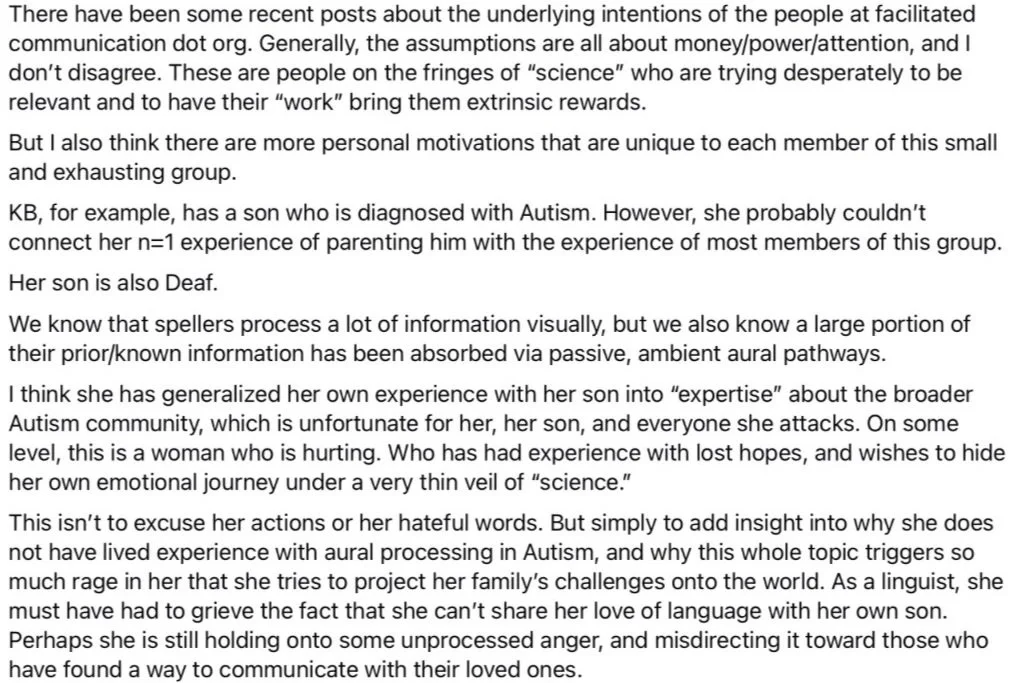
This screenshot also shows additional accusations re money, power, attention, and being on the fringes of science that I believe are transparent in their falsity and not worth addressing here, but readers are invited to let us know otherwise.
Here are my responses:
My son was never language delayed: he started using sign language shortly after being introduced to it at 9 months after being diagnosed as profoundly deaf. It was delightful to watch him acquire it; I’d never before seen sign language acquisition up close.
He received a cochlear implant when he was one and a half years old and so has had access to spoken language for nearly three decades.
He’s long been very clever with language, a delight to my linguist’s ears. One of my favorite examples is how, at age three, reacting to a clear night with a full moon, he said “It’s moony outside!”
Children with cochlear implants and no additional diagnosis that affects language acquisition achieve close-to-normal vocabularies (see this recent study).
Huge numbers of studies find that receptive language skills are significantly diminished in autism (see this recent meta-analysis).
My son’s present-day vocabulary includes words like “hypothesis,” “indication",” “interestingly,” and “capacitor”; where it’s lacking, as with all individuals with moderate autism, is in (1) words relating to social and emotional phenomena and (2) words that tend to be picked up in informal social contexts and from highly social (and therefore challenging) texts, including novels like Upward Bound.
