Thoughts About “Epistemic Violence” and Criticizing Facilitator-Dependent Techniques: Review of Schlosser and Prabhu 2024
In today’s blog post, I want to highlight a 2024 article titled “Interrogating Neurotypical Bias in Facilitated Communication, Rapid Prompting Method, and Spelling 2 Communicate Through a Humanistic Lens.”
As always, I encourage people to read the article in full.
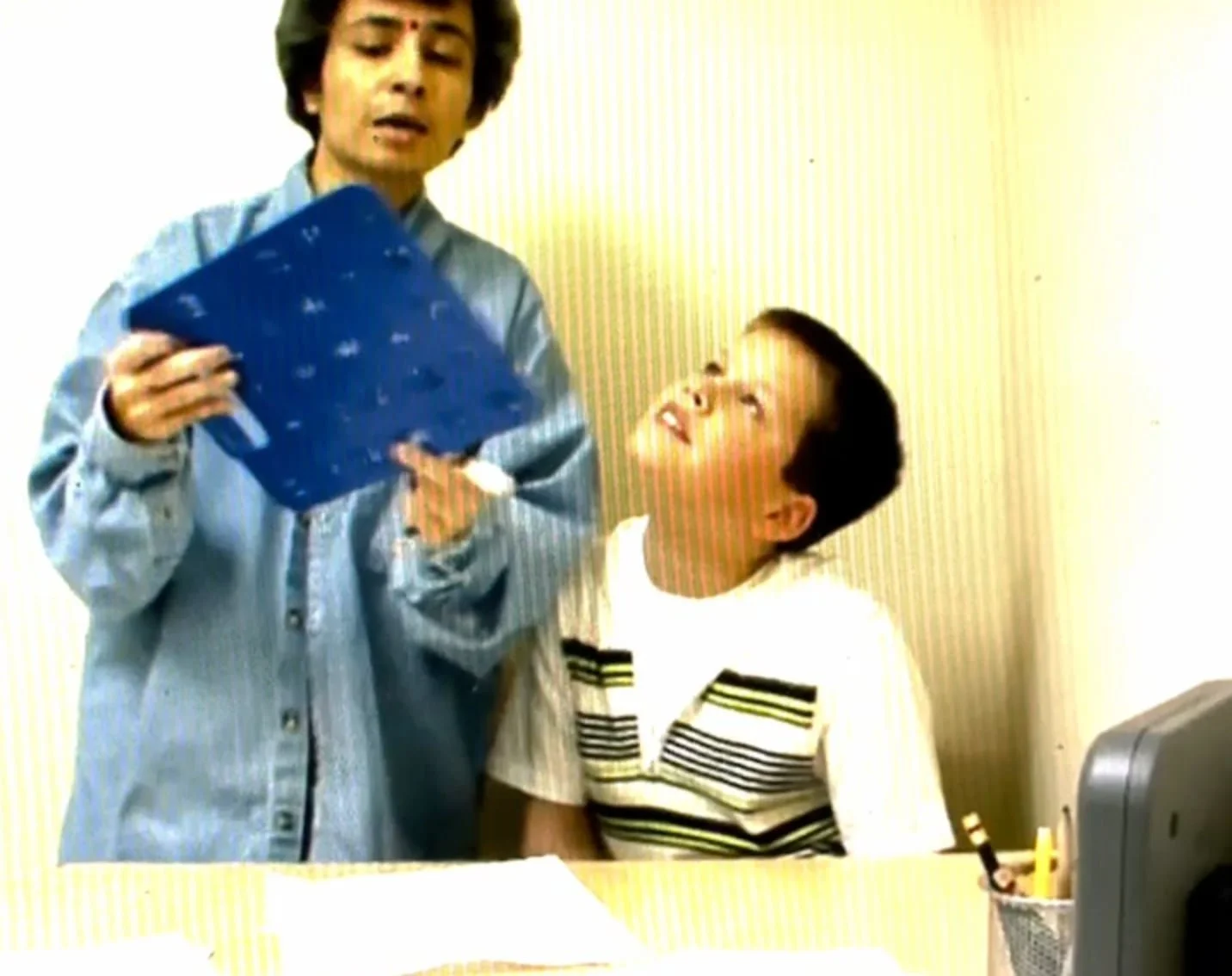
RPM “inventor,” Soma Mukhopadhyay, with a student who is staring at the ceiling. She controls access to the letter stencil and to the pencil during the “spelling” session. Keli’s FC-generated responses are in English (the language his facilitator speaks and writes), even though, according to the narration in the film, he is from Iceland and was never directly taught to speak or write in English. (Screenshot from A Mother’s Courage, 2009)
The first time I’d ever come across the term “epistemic violence,” a concept that Schlosser and Prahbu discuss in the article I’m reviewing today, I was reading a pro-FC article (Heyworth et al., 2022). The authors of the article, to back up their claim, cited an article that William Simmons, Todd Landman, and I co-wrote called Facilitated Communication, Neurodiversity, and Human Rights. This caught me off guard for a minute, since our article argued for the human rights of nonspeaking individuals to have access to legitimate, evidenced-based forms of Augmentative and Alternative Communication (AAC). Yet, Heyworth, et al. accused us of committing “epistemic violence” because we criticized facilitator-dependent techniques such as FC/S2C/RPM—techniques that rely on the presence of a facilitator to “work” and that have no proven scientific validity.
While Heyworth et al. made it seem like the mere act of speaking out against FC/S2C/RPM and their variants was an act of “epistemic violence,” Schlosser and Prabhu defined this term as “distorting the will and desire” of nonspeaking autistic individuals. By using facilitator-dependent communication techniques such as FC/S2C/RPM, they argue, neurotypical facilitators are (wittingly or unwittingly) in danger of imposing their own biases onto their nonspeaking family members or clients.
In addition, Schlosser and Prabhu point out the power-differential between a literate, speaking and often neurotypical individual who “facilitates” the words of their nonspeaking often profoundly autistic client or family member.
Even while intending not to, facilitators can and do control letter selection. As controlled authorship testing has shown, facilitators spell out the words that they think their client or loved ones want to say despite a belief that they (the facilitators) are not controlling letter selection. It’s not uncommon to see claims of unexpected literacy skills being made by facilitators even when their clients are not looking at the letter board when the “spelling” is happening.
Despite claims to the contrary by FC/S2C/RPM proponents, Schlosser and Prabhu (in word and in practice) advocate for the rights of nonspeaking or minimally speaking individuals to “express their will and to amplify their voices using evidence-based AAC methods,” and do not support unproven and/or disproven facilitator-dependent techniques.
As they point out in their article, AAC methods can include manual signs, non-electronic communication boards, speech-generating devices, and tablets with AAC-specific applications. Matched appropriately to the individual user’s ability, AAC systems allow nonspeaking individuals to interact with the equipment or system independently and without interference from an assistant or facilitator. Spelling is a legitimate form of (alternative) communication for nonspeaking or minimally speaking individuals if they have the comprehension skills to understand and use written language. So, I wonder, how is it independent communication if the person being subjected to FC/S2C/RPM can only “spell” when a facilitator is present, provides cues, and limits or controls access to the letter board, key board, or other device during letter selection?
Schlosser and Prabhu recommend that proponents of FC/S2C/RPM and other disproven, unproven, and/or pseudoscientific techniques stop using the techniques unless and until the veracity of the techniques are tested under conditions designed to rule out facilitator interference with letter selection.
Given the well-documented history of the rise and fall of FC in the 1990s, it seems like proponents of S2C/RPM would be more sensitive—not less—to the problems that arise when a literate facilitator (wittingly or unwittingly) overrides the thoughts and desires of a nonspeaking individual. Facilitator cueing and control over letter selection is, at best, cause for concern and, at worst, a human rights violation (regardless of the content of the FC-generated messaging).
I understand that with S2C/RPM, the impact of the facilitator’s behaviors may be less obvious for the average observer than blatant physical touch. RPM/S2C were (wittingly or not) likely born out of a desire by facilitators to make FC appear more convincing to an observer (See Clever Han(d)s Skepticism and “Ido in Autismland”), but the outcome of these techniques shouldn’t be how convincing the FC session looks to an observer, but how effective the technique is at supporting a nonspeaking person in their growth and development as an independent communicator.

Samples of physical cueing by facilitators using “traditional” touch-based FC and so-called “no touch” and “modern spelling methods” (e.g., S2C/RPM)
And, though physical cueing is reduced in S2C/RPM, facilitators continue to touch their clients’ necks, backs, sides or other body parts and control access to the letter boards. “Resetting” the letter board in the air along with visual cues (e.g., hand signals, head nods, body movements) and/or auditory cues (e.g., verbal cues like “up, up, up” and “right next door”) plays a significant role in signaling where on the letter board the facilitator wants their client to touch.
Proponents continue to insist that S2C/RPM are significantly different from FC despite obvious shared characteristics (e.g., facilitator cueing and control). If true, then why does the facilitator need to continuously look at the letter board for S2C/RPM to “work”? Why do facilitators need to be within auditory and visual range of their clients’ in order for the techniques to work? Why can’t the letter board be placed on a stable surface instead of being held by the facilitator? And why haven’t proponents subjected these so-called “modern spelling methods” to rigorously controlled authorship testing?
Critics of FC/S2C/RPM and the families currently being exposed to these techniques through slick marketing campaigns, films, and documentaries are being told that these “new and improved” facilitator-dependent techniques unlock the silent voices of profoundly autistic individuals—and that raising doubts about facilitator authorship is ableist and an act of epistemological violence against people with disabilities.
But that’s what proponents of traditional touch-based FC were telling us in the 1990s when I first got involved with it and before the controlled studies that proved facilitator authorship were made available to the general public.
Have people not learned from the past?
As ASHA, AAIDD, the May Institute, ASAT and other organizations have pointed out in their statements opposing S2C/RPM, these techniques, to date, have no scientific validity. Calling for reliably controlled authorship testing is not epistemic violence, but an ethically sound part of the process of safeguarding the communication rights of nonspeaking individuals being subjected to these techniques. (See Opposition Statements)
For me, Schlosser and Prahbu’s article and proponents’ reaction to it raises more questions than I have answers:
Given the documented problems with facilitator authorship with FC, why wouldn’t proponents of S2C/RPM (or developers of “modern spelling methods”) want to rule out facilitator influence over letter selection? Why risk repeating the damage that was done by well-meaning, but credulous facilitators who adopted FC in the early 1990s?
Why do proponents want people to take on faith (e.g., without producing the reliably controlled evidence) that facilitator-dependent techniques are legitimate forms of AAC? Are they aware that, according to Schlosser and Prabhu, two of the most comprehensive and authoritative textbooks on AAC don’t consider FC/S2C/RPM legitimate forms of AAC?
Why don’t proponents of FC/S2C/RPM discuss the comprehension skills of individuals being subjected to their techniques or the feature-matching process that’s involved with selecting the appropriate AAC method, equipment and/or devices for nonspeaking individuals? Why promote a seeming one-size-fits-all approach to communication? Doesn’t this run counter to the idea of neurodiversity?
Why do FC/S2C/RPM proponents continue to ignore the lived experiences of the nonspeaking individuals with autism and their families, caregivers, teachers, etc. who have been harmed through false allegations of abuse and facilitator crimes?
Why do FC/S2C/RPM proponents continue to downplay or ignore reliably controlled authorship studies that uncovered serious flaws in the technique (e.g., inadvertent facilitator control over letter selection) as early as the 1980s (before FC was brought to the United States by Douglas Biklen of Syracuse University)?
How do proponents justify the (unethical) decision of not participating in reliably controlled testing while claiming that critics of FC/S2C/RPM are committing “epistemic violence” for simply asking that the testing be done? Why wouldn’t proponents want to make certain that the voices of nonspeaking individuals are not overridden or silenced (wittingly or unwittingly) by facilitators who are often unaware of the extent to which they control letter selection? Given the power dynamic between a literate facilitator and a nonspeaking individual with autism, whose interests are the facilitators protecting by not participating in authorship tests—their clients or their own?
We know from pro-FC/S2C/RPM videos that the existing spoken language and non-verbal communication abilities of individuals being subjected to these techniques are often ignored in lieu of the spelled, facilitator-dependent messages. How is it “protecting the rights of individuals to communicate” when facilitators regularly ignore all forms of communication besides that which is generated via FC/S2C/RPM?
What meaningful adaptations and procedural safeguards have proponents of FC/S2C/RPM put in place to minimize the risk of facilitator cueing and control over letter selection? Rather than ensure that facilitators don’t cue their clients, they promote the idea that facilitators should instead “prompt their hearts out.”
There appears to be no legitimate reason why a letter board or keyboard display should be held by the facilitator in mid-air (essentially creating a moving target for individuals with purported motor planning difficulties). Why do proponents of FC/S2C/RPM continue to insist on having a facilitator control access to the board?
In today’s blog post, I’ve highlighted some issues that were raised in the Schlosser and Prabhu article and asked some questions of my own. I agree with the authors that “the onus of proof for novel interventions falls squarely on their proponents” and, since the original developers of these techniques (e.g., Douglas Biklen (FC), Rosemary Crossley (FC), Soma Mukhopadhyay (RPM), Elizabeth Vosseller (S2C), Dawnmarie Gaivin (Spellers Method), Dana Johnson (Spellers Method)) have failed to provide reliably controlled evidence of communication independence for individuals subjected to their techniques, it’s up to critics to continue to call for these controls to be put into place and risk committing what proponents see as “epistemic violence” rather than bending to the bullying tactics of FC/S2C/RPM proponents who want not only to silence their critics, but to continue controlling the written output of the nonspeaking individuals being subjected to their pseudoscientific techniques.
Note: I understand from one if the authors of “Interrogating Neurotypical Bias in Facilitated Communication, Rapid Prompting Method, and Spelling 2 Communicate Through a Humanistic Lens” that this article has been cited in proponent literature to support the use of FC/S2C/RPM. How that can happen is nearly beyond my comprehension because, clearly the authors of this article argue against the use of FC (which has been resoundingly discredited since the mid-1990s) and for testing the veracity of claims being made by the developers and proponents of S2C/RPM that these techniques are significantly different than FC. Did proponents read beyond the title?
References and Recommended Reading
Beukelman DR, Light JC. Augmentative and alternative communication: supporting children and adults with complex communication needs. 5th ed. Baltimore: Paul H Brookes; 2020.
Fuller DR, Lloyd LL. Principles and practices of augmentative and alternative communication. West Deptford: Slack Inc.; 2023.
Hemsely, Bronwyn, Beals, Katharine, Lang, Russell, Schlossers, Ralf W., Shane, Howard, Simmons, William, Skinner, Sharon, and Todd, James. (2025, October 1): Safeguarding the communication rights of minimally- or non-speaking people who are vulnerable to Facilitated Communication, Rapid Prompting (Spellers Method) and variants, Research and Practice in Intellectual and Developmental Disabilities. Research and Practice in Intellectual and Developmental Disabilities. DOI: 10.1080/23297018.2025.2544116
Heyworth M, Chan T, Lawson W. Perspective: Presuming Autistic Communication Competence and Reframing Facilitated Communication. Front Psychol. 2022 Mar 10;13:864991. doi: 10.3389/fpsyg.2022.864991. PMID: 35360599; PMCID: PMC8960292.
Schlosser, R.W. and Prabhu, A. (2024). Interrogating Neurotypical Bias in Facilitated Communication, Rapid Prompting Method, and Spelling 2 Communicate Through a Humanistic Lens. Current Developmental Disorders Reports. Vol. 11; 41-51
Simmons, W..P., Boynton, J., and Landman, T. (2021, February). Facilitated Communication, Neurodiversity, and Human Rights. Human Rights Quarterly. Volume 43 (1), 138-167. DOI: 10.1353/hrq.2021.0005