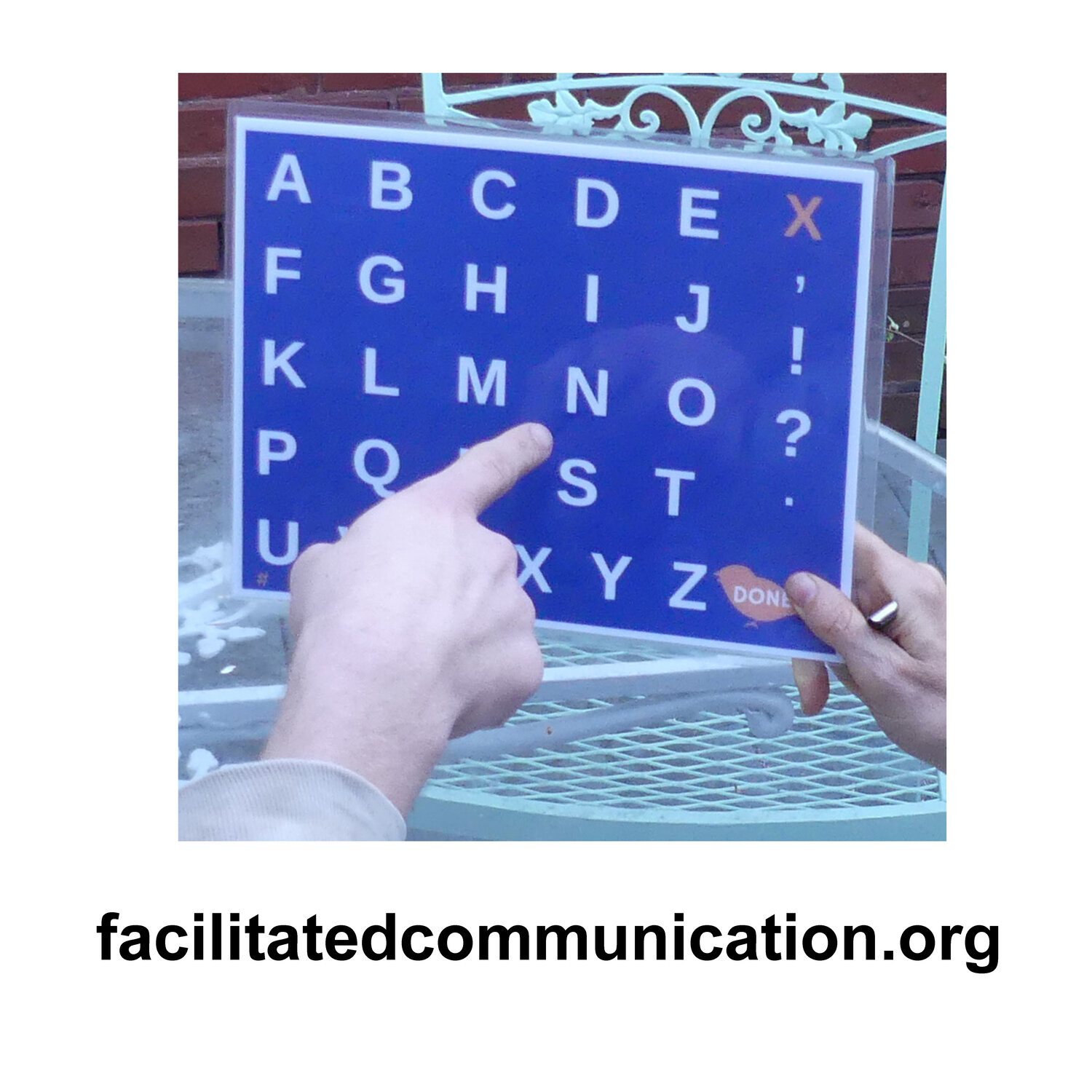
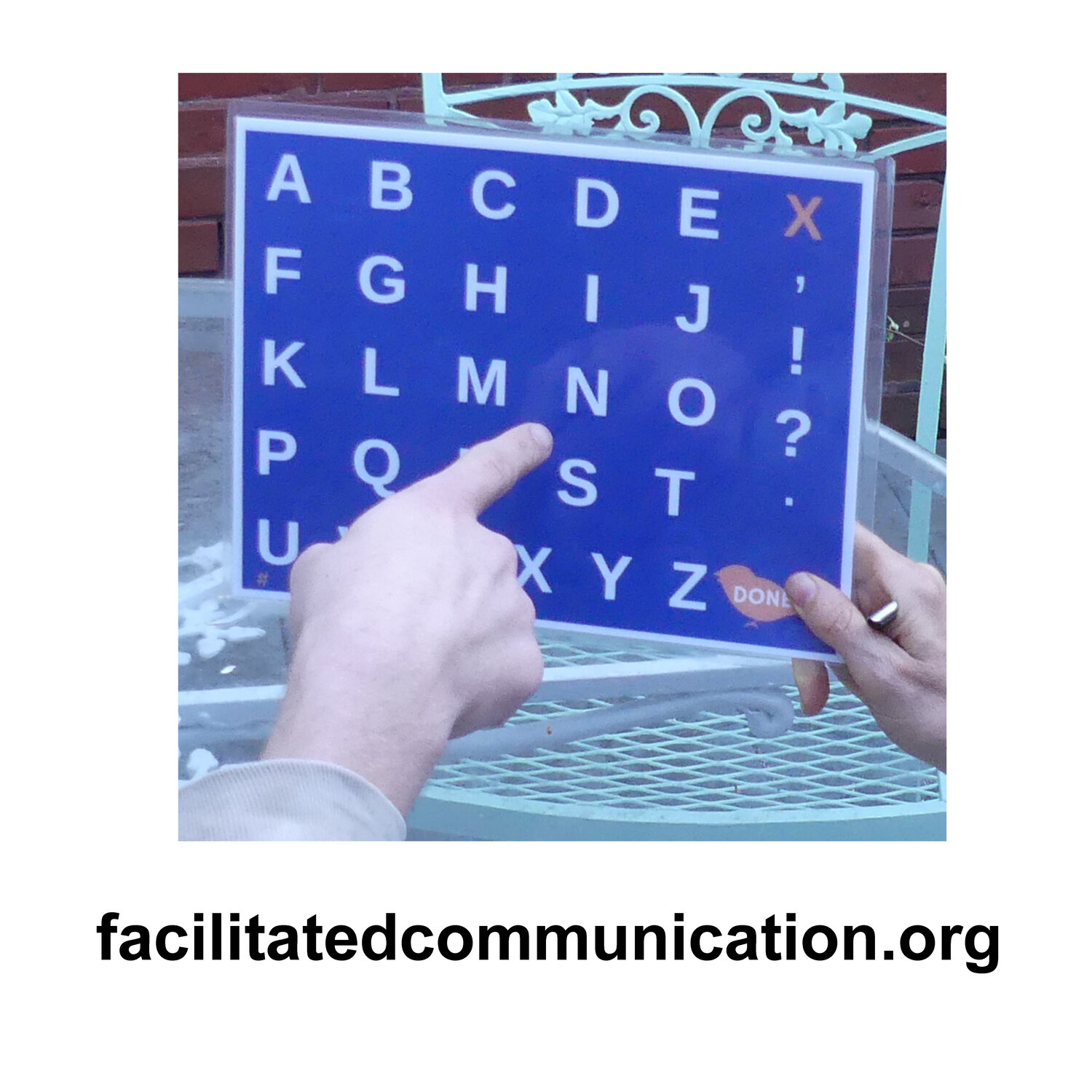
Autism Spectrum News Issue platforms FC—with tacit approval from (some of) its esteemed editorial board
This isn’t the first time Autism Spectrum News (ASN) has platformed FC. Back in December, 2024, it published a piece about a non-speaker who “found her voice” through Spelling to Communicate (S2C). But this is the first time that ASN has platformed multiple pro-FC pieces: multiple, as in over two dozen. The occasion was a special summer issue entitled Giving Voice to Nonspeakers: Communication, Advocacy, and Inclusion Across Life, released on July 10th. Out of the 38 articles in this issue, 27 articles, just over 70%, are pro-FC. The authors these articles are attributed to, moreover, are a virtual Who’s Who of FC practitioners, promoters, and victims. Some people are credited with multiple articles, some articles are credited to multiple authors, and some people belong to multiple categories, but here’s the general breakdown:
Non-speakers who are subjected to FC (10 total):
Gregory Tino, Elizabeth Bonker, Matthew Cramer, Noah McSweeney, Jace Pooley, Isaiah Grewal, James David Savarese (Deej), Ben Crimm, Alex LePape, and Grant Blasko.
Parents of non-speakers (5 total)
Ralph Savarese, Andrea Palerino, Jared Hansen, Susan Nisinzweig, and Dawnmarie Gaivin
High-profile FC practitioners/promoters (3 total):
Pascal Cheng (a master facilitator of the old school variety); Susan Nisinzweig of Abilis Life Services; and Dawnmarie Gaivin of Spellers Freedom Foundation.
High-profile non-practicing promoters (4 total):
Barry Prizant, Morgan D. Barense, Ren Koloni of CommunicationFIRST , and Vikram Jaswal
Other FC-adjacent professionals:
Nicole Reimann (the lawyer for the plaintiffs in the Lower Merion S2C Case)
Judith Croen, Amy Laurent, Beth Rosenwasser, and Manley Ghaffari (respectively, a psychotherapist, occupational therapist, behavior therapist, and psychiatrist who have worked with autistic non-speakers who are subjected to FC)
Janie and John Burke, two FC-friendly autism behaviorists I’d never heard of before.
How did this come to pass?
According to Barry Prizant on a recent episode on the Uniquely Human Podcast:
We just approached the editor-in-chief, David Minot, and just said, “Is this a topic that you think your readers would be interested in?” And he said, yes. And he took it from there, you know? So we basically made this suggestion, gave a little bit of feedback about the range of topics, but then stepped back and we submitted our articles just like anybody else submitted articles to the issue.
Prizant does not specify how this topic was characterized to David Minot, who, by the way, is listed on the ASN website as the founder and publisher of ASN; not its editor-in-chief. Prizant makes no mention of ASN’s editorial board, which has appeared to include some scientifically inclined autism professionals, some of whom would surely have raised concerns. I’ll address this later.
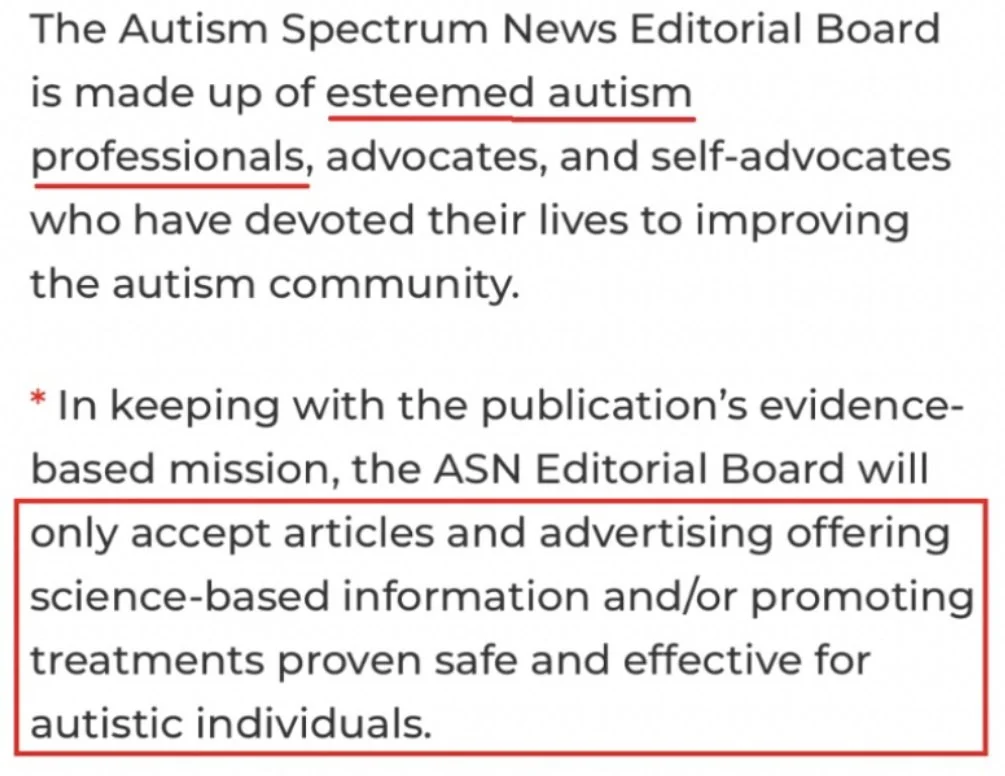
Here’s a screenshot (with my underscores in red) of what ASN says about its editorials and its editorial policies:
I’ll begin by summarizing some of the common themes in these 27 articles. Then I’ll take a closer look at the 9 of them that contain the most interesting and/or novel material. Finally, I’ll return to the issue of ASN’s editorial board.
Most of the 27 articles repeat things we’ve heard many times before:
Comparisons of the treatment of FCed individuals to that of Helen Keller and Steven Hawking
neither of whom had facilitators touching their bodies or holding up letterboards while they communicated.
Circular reasoning: using FC-generated messages to validate FC
In particular, treating FC-generated messages as valid expressions of the FCed person’s actual preferences and/or lived experiences.
But if those FC-generated testimonials, as all the available evidence suggests, actually come from the facilitators, such conclusions about preferences, already invalidated by circularity, completely fall apart.
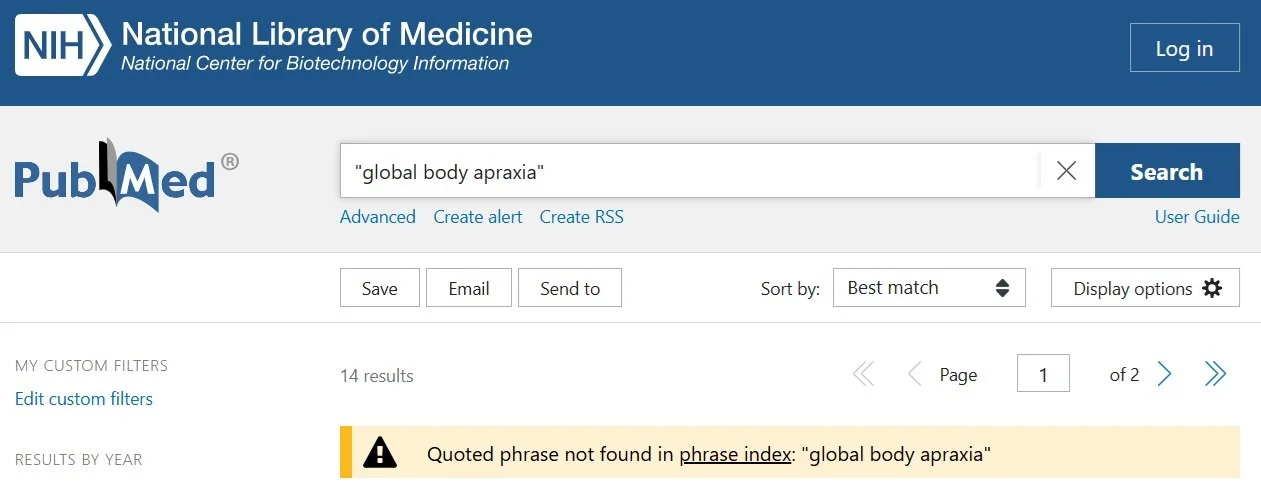
Claims that autistic non-speakers are afflicted with a brain/body disconnect or “whole body” apraxia/dyspraxia—claims based not on empirical studies, but on FC-generated testimonials.
Claims that message-passing tests (where you ask the non-speaker to describe a picture that their facilitator didn’t see) are invalid.
In addition to all the usual objections that date back 30 years (they stress out and/or dysregulate non-speakers so much that they’re unable to go through the process of retrieving the right words and typing them out), we hear multiple repetitions of the latest claim that such tests haven’t been validated by the Mental Measurements Yearbook (a claim I discuss here). Curiously, the consistent citation for this last claim is David Kaufer, who in turn credits Barry Prizant.
Claims that some FCed non-speakers have achieved independence
despite the fact that there’s no documented evidence of such individuals communicating spontaneous, unrehearsed messages at the same level of linguistic sophistication as their FCed messages on stationary keyboards with their facilitators out of visual, tactile, and auditory cueing range.
Exhortations to “presume competence”
but with slippery, subtly inconsistent definitions of what the term means, extending beyond the reasonable “presume potential to learn” to presuming that the person is paying attention and understands what’s going on around them, even if they appear not to.
In addition, we also see:
Many ads and links to pro-FC advocacy sites and to some of the authors’ for-profit FC service providers.
Zero mention of telepathy.
In fact, one of the narratives attributed to one of the non-speakers (Isaiah Grewel) contains this sentence: “But nonspeakers are neither omniscient nor psychic.”
As we’ll see below, one of the articles attempts a non-telepathic account of how a facilitated individual might type something that only the facilitator saw during a message-passing test.
Now let’s turn to some of the more unusual and noteworthy claims in some of these articles.
1. We Shall Overcome: Why I Am Certain Nonspeakers Will Win Our Rights to Communicate, attributed to non-speaker Elizabeth Bonker, the Executive Director of Communication 4 All.
Among other things, this piece discusses the New York States Communication Rights Bill, which purportedly was “gutted” with “amendments that actually took away our rights and violated federal law” thanks to “corporate interests including ABA and the American Speech-Language-Hearing Association (ASHA),” which “have infiltrated state agencies across the country.” What actually happened to the bill was that a provision was added stipulating that:
the communication method used is evidence-based, empirically supported, and has demonstrated results in autonomous communication on the part of the person communicating.
Nonetheless, Communication 4 All is “confident that the Communication Bill of Rights will pass next year, led by Assemblyman Angelo Santabarbara and a new Senate Disability Chair.”
This article ends with another aim of Communication 4 All: “empowering occupational therapists (OTs) to teach typing to nonspeakers,” with the goal of having “expert OT typing coaches in every school.”
2. You Are the Expert on Your Preferred and Effective Communication – “Le Pape v. Lower Merion School District,” a Landmark Civil Rights Case, an article by Nicole Reimann, the plaintiff’s lawyer in the Lower Merion S2C Case.
Characterizing the case as a “landmark case,” Reimann recounts how
a three-judge-panel of the United States Court of Appeals for the Third Circuit concluded that “[t]here is ample evidence from which a reasonable jury could conclude that the School District violated the ADA’s effective communication requirement by denying Alex [the son of the plaintiffs] his preferred method of communication without providing an effective alternative.
Reimann doesn’t mention what happened after the case went back to the Federal District Court (see my posts on this, starting here) or, in particular, why it is that we never find out whether a jury would in fact have decided in the plaintiff’s favor.
Reimann also leaves out the biggest reason why “Lower Merion refused to allow Alex to communicate with a letter board”—namely, that his teachers observed that he wasn’t able to type out correct answers to a U.S. history midterm until his facilitator had the answers. Instead, Reimann finds Lower Merion’ refusal “remarkable” given the many students who have been successful using letterboards in colleges and universities. The possibility that these successes, just like Alex’s eventual successes on his U.S. history test, were the result of facilitator control is something that Reimann either cannot wrap her mind around or would rather not address.
We also learn of a couple of heavyweights who supported the Lower Merion plantiffs:
Professor Michael Ashley Stein, Ph.D., J.D., Executive Director of the Harvard Law School Project on Disability and one of the co-drafters of the UN Convention on the Rights of Persons with Disabilities (CRPD) wrote a letter in support of Alex’s case. Dr. Stein observed “the CRPD structurally recognizes persons with disabilities as experts about their own lives. As such, both the letter and spirit of the CRPD privilege individuals’ preferences over those of professionals, however well-intentioned. Starting with its general principles, its provisions repeatedly validate that persons with disabilities have a right to choose their own destinies, whether that’s with regard to where they live, how they move, how they learn, what health care they access, how they vote, or how they express themselves, regardless of whether persons with disabilities use complex or nonstandard forms of communication.
Of course, any conclusions about FC-generated preferences for FC are highly problematic, given the circular reasoning and what all the available evidence tells us about facilitator control. Indeed, given what we know about facilitator control, both the letter and spirit of the CRPD are grounds, not for sanctioning the use of FC in schools and elsewhere, but for individualized message-passing tests before it is sanctioned anywhere for any particular individual.
We also learn from Reimann that “Dr. Barry Prizant... confirmed the effectiveness of Alex’s letterboard communication after interviewing him and reviewing 185 minutes of video.” No matter that cues can be appear too subtle to control letter selections and yet still manage to do so, as we are reminded, most recently, by observer reactions to some of the videos associated with the Telepathy Tapes podcast.
3. Lessons From Listening to a Typer: Stony Brook Medicine School of Social Welfare Leadership Education in Neurodevelopmental and Other Related Disabilities (LEND) Fellowship Program, attributed to Isaiah Grewal and Michelle S. Ballan.
Here we learn that the LEND Fellowship program at Stony Brook has embraced FC. This, perhaps, is related to something else we learn: namely, that FC proponent Vikram Jaswal is on Stonybook’s LEND program faculty. I’m happy to report that the LEND program at the University of Pennsylvania, where I’ll be speaking in two weeks, has not embraced FC.
At Stonybrook the LEND fellows learn, via FC-generated messages attributed to autistic non-speaker Isaiah Grewel, about “apraxia, clinical strategies and research regarding nonspeakers who can and cannot type.” Refreshingly, we also learn from such messages, as noted above, that “nonspeakers are neither omniscient nor psychic.”
4. Why Message-Passing Tests Are Unethical, by Jared Hansen, Parent of a Speller.
Repeating the usual claims that message-passing tests are unreliable (these, again, simply amount to asking the non-speaker to describe a picture that their facilitator didn’t see), Hansen argues that
A “blinded” experiment on a non-speaker is an unethical request. Message-passing for Spellers is not a neutral test. The consequences for the non-speaker are incredibly high.
Indeed they are. Hansen doesn’t acknowledge that one of the likely consequences of a message-passing test is the revelation that the person’s communication rights have been repeatedly and routinely violated.
But Hansen seems to think that the validity of FC is well-established by the fact that non-speakers:
“routinely spell out grammatically correct and insightful paragraphs, and may communicate readily with multiple aides”
“are communicating with their doctors, choosing from the restaurant menu, and participating in college classes by spelling on a letterboard or keyboard”
routinely “share a unique insight, past experience, or something that is unknown to their communication partner”
Hansen doesn’t address the possibility that correct grammar and insightful paragraphs can be generated, however unwittingly, by facilitators, as can messages in doctor’s offices, restaurants, and college classes; that multiple facilitators often share enough common ground as to allow consistency across the messages that they facilitated; and that the subconscious nature of facilitator control can result in messages that are both controlled by, and surprising to the facilitator—at times even seemingly unknown to them.
This is why message-passing tests are the only ethical way to validate FC—and to uphold the communication rights of these highly vulnerable individuals.
5. Rethinking Evidence-Based Practice for Supporting Nonspeaking Individuals by Barry Prizant and Jessica Teixeira.
Arguing that there’s a role for lived experience in evidence-based practice, Prizant and Teixeira argue that evidence-based practice with non-speakers should take into account their FC-generated testimonials. The problem, of course, is that all the available evidence indicates that such testimonials are authored, however unwittingly, by the non-speakers’ facilitators. The authors point out that “Such qualitative evidence is routinely accepted as credible within research on human and animal communication.” In the case of a testimonial that is generated by FC, however, only a message-passing test can tell us whether it actually represents the lived experience of the person to whom the message is attributed. Message-passing tests, in other words, are a prerequisite for the authentic inclusion of the lived experiences of autistic non-speakers who are subjected to FC.
While acknowledging the possibility that a message-passing test could show that a person’s communications are controlled by their facilitator, the authors place much more emphasis on the alternative possibility: that of “failing to recognize genuine competence.” They add that “An ethical approach to evidence-based practice requires balancing these risks, rather than allowing one to dominate the conversation.” The implication is that asking a non-speaker to describe a picture that his or her facilitator didn’t see is somehow risky and that this risk needs to be balanced with other possible risks. But the authors neither explain what the risks are, nor why it’s ever a good idea to avoid asking non-speakers about pictures that their facilitators didn’t see.
Instead, they move on to the familiar defamatory ad hominems against their detractors:
It is well known that the primary naysayers disseminating their position that assistive communication approaches should be prohibited [sic] have been actively engaged for years benefiting from fiscal rewards they earn in expert witness work supporting such prohibitions, with no conflict of interest disclosures in publications and presentations.
If Prizant were to ask us, he’d learn that most of us earn very little from our expert witness work and that we do much of it pro bono.
6. Studying Understanding Without Speech: Neuroimaging Minimally Speaking Autistic Individuals, attributed to Isaiah Grewal, along with Morgan Barense and Karen Chenausky.
Claiming that “Traditional tests of language comprehension and intellectual ability” are unreliable because they require motor responses that non-speakers may struggle with, the authors cite speech, which is obviously a difficulty for non-speakers, though not necessarily because of motor-based challenges. But they also cite pointing and pressing buttons, for which there is no evidence, in autism, of motor-based difficulties (autistic non- and minimial-speakers routinely push and point to navigate YouTube). Certain, nonetheless, that “reliable motor responses are precisely the challenges [in non-speaking autism] that make assessment difficult,” the authors, along with other researchers in multiple partner institutions, have turned to fMRI measurements of brain signals as an easier, more reliable alternative:
Our team from the Kennedy Krieger Institute, the University of Toronto, MGH Institute of Health Professions, Washington University Medicine, and Stony Brook University recently co-designed two neuroimaging studies.
Their collaborators also include non-speakers:
Our minimally speaking colleagues helped shape many aspects of the study design, such as limiting imaging sessions to one hour, including time to become comfortable with the equipment and practice the experimental tasks.
Comfort is definitely an issue: “Participants must lie still inside a narrow scanner while loud sounds are produced by the MRI system.” And while the authors mention taking steps to make things more comfortable, they mention nothing that would eliminate the inherent and highly aversive business of lying still in a narrow scanner:
[W]e worked closely with MS [minimal speakers] and their families to develop accommodations that reduced sensory and motor demands. We closed our facility so that only the minimally speaking participants, their family members, and the research team were present. Family members accompanied participants into the scanner room to hold their hand or provide regulation support during the scan.
The researchers also allowed the participants to “decide whether they wished to continue”—but this raises additional questions. First, how were these wishes expressed? Second, how was consent for these experiments obtained in the first place? The authors write that “Legal guardians or participants themselves provided informed written consent,” but how would the written consent have been provided other than through FC—and with the unwarranted assumption that these individuals have any understanding of what they are consenting to? The standard comprehension tests that the authors consider to be so unreliable have found that comprehension skills in non-speaking autism are too low for participants to understand descriptions, say, of fMRI procedures; as the authors themselves note, Isaiah’s scores on the Peabody Picture Vocabulary Test results showed his receptive vocabulary to be “below the first percentile.”
Nor do these fMRI methodologies sound more reliable than the Peabody Picture Vocabulary Test (which involves pointing to pictures): “Even small head movements can degrade data quality,” even with the “state-of-the-art motion-correction technology” that was used “to reduce the impact of movement during scanning.”
The second methodology, a tight-fitting cap with electrodes on it, may address some of these concerns. As to the experiments themselves, these included “listening to understandable and acoustically degraded speech” and then looking at the “brain activation patterns.” While the authors report that these patterns, in their initial experiments, indicate that minimal speakers “use more of their brains” than the non-autistic groups, they don’t explain what, if anything, these patterns indicate about speech comprehension (comprehension of the meaning of the words that were spoken), as opposed to mere speech perception (perception of the acoustics of speech).
The authors ultimately admit, furthermore, that “imaging studies can only supplement direct tests of language comprehension”—thus raising the question of why they are subjecting these vulnerable individuals to such uncomfortable procedures in the first place. Isn’t lying still in a narrow scanner or wearing a tight-fitting cap at least as bad as being asked to describe a picture of something that your facilitator didn’t see?
7. Core Learning Characteristics of Autism and Their Implications in Typing to Communicateby Janie Burke, MA, MS and John Burke, PhD, BCBA-D, LBA Dr. John Burke and Associates, LLC
There are two points of interest in this article. One is the authors’ explanation for why spoken language is difficult for autistic individuals:
Verbal speech is dynamic, ephemeral, and fleeting; it disappears the moment it is uttered and requires rapid, simultaneous processing of facial expressions, vocal tone, and acoustic shifts.
While the authors offer this as the cause of lack of speech, it could just as easily be a cause of lack of comprehension. But lack of comprehension calls into question the validity of FCed messages: written language is based on spoken language, and if you aren’t able to make sense of speech, you’ll struggle to make sense of written language. If you aren’t able to make sense of written language, you can’t be the author of sophisticated written messages.
The second point of interest is the authors’ alternative explanation for evidence of facilitator control in message-passing tests. To its credit, their explanation distinguishes itself from other recent explanations by not invoking telepathy. It does, however, rely on several faulty assumptions: that non-speakers suffer from “severe dyspraxia”; that message-passing tests are conducted in “highly artificial” environments; and that describing a picture involves “formulating an idea”:
When an autistic individual with severe dyspraxia is placed into a highly artificial, high-stakes testing environment, the neurological loop required to formulate an idea, locate it on a board, and physically execute the strike breaks down. Under intense stress, the motor system defaults to the nearest available external visual or physical cue (the facilitator’s gaze or subtle muscular tension).
Furthermore, the authors are forced here to acknowledge that subtle facilitator cues are, in fact, powerful enough to control letter selections. Yet they assure us that this is somehow something other than facilitator control:
What early researchers reflexively labeled “facilitator control” was frequently an involuntary motor manifestation of echopraxia (involuntary imitation of another’s movements) or stimulus-boundness triggered by an acute apraxic breakdown. Early studies did not disprove the user’s literacy; they inadvertently documented the severity of their neuromotor dysregulation under stress.
These two passages inadvertently point to ways in which facilitators can completely control messages—whether or not hypothetical events like “apraxic breakdowns” and “neuromotor dysregulation” actually occur.
8. Mental Health Care for People Who Use AAC: Rationale and Practice, attributed to Alex Le Pape and two of his mental health care providers.
In a passage credited to Alex Le Pape, the question is implicitly raised of how privacy is maintained when facilitated individuals receive psychotherapy:
Regarding my mom as my CRP for therapy, I am glad that mom hears my thoughts but never asks for more. Her silence is a different kind of gift. I like that we are working together to find workarounds to challenges, like when mom mutes my zoom while I am verbally stimming while Beth is talking so that I can hear Beth...
What about muting Alex’s voice, as heard by his mother, so that he can have some privacy with his therapists? But that, of course, might make facilitation impossible.
9. Training Communication Partners for Nonspeaking Spellers: A Replicable, Evidence-Informed Framework, by Dawnmarie Gaivin, parent of two FCed non-speakers and co-founder of the variant of FC known as “Spellers Method.”
One of the most interesting things about this article is in how it treats facilitator influence. Most FC proponents conflate facilitator influence (influences on letter selections) with conversational influence (e.g., how speakers are influenced by how their listeners react; or how people sometimes interrupt and/or finish each other’s sentences). Gaivin rightly points out the key difference: “when influence flows from CP [communication partner] to speller during open communication, it doesn’t color the message – it replaces it.”
But Gaivin goes on to leverage the risk of CP influence for her own professional advancement. It’s possible, she claims, to “recognize and actively counter that risk” through a “distinct, trainable competency.” This competency doesn’t involve message-passing tests, but does involve training services that Gaivin herself offers, and that “Schools can fund... through IDEA funds and state assistive technology grants.” The article ends with a plug for Gaivin’s business: “Information about Spellers Method Communication Partner training and certification is available at www.spellers.com.”
Also of interest the guidelines Gaivin provides here about how to reduce influence. Once the non-speaker has reached “open-ended” communication (but only at this point), the communication partner should avoid:
Moving the board during spelling. “The board must remain still unless the speller has completely shifted their body position, in which case the CP should lift the board and reset it – centered in front of the dominant spelling hand.”
Selectively confirming letters. “Confirmation must be consistent and non-selective, which means calling out typos as well.”
Gesturing toward a particular area on the board. “Any hand movement, gaze shift, or postural lean toward a portion of the board constitutes a cue. CPs learn stillness as a discipline: neutral posture, neutral gaze, neutral breath.”
Completing anticipated words.
Asking leading questions.
The last two items aren’t specific to FC. The first three—moving the board, body language cues, selectively confirming letters—are not only FC-specific; they are routinely violated by FC practitioners, including by Gaivin herself, as we see in Spellers and as I discuss in my review of that documentary.
What about the ASN editorial board? How did they allow this issue to go forward?
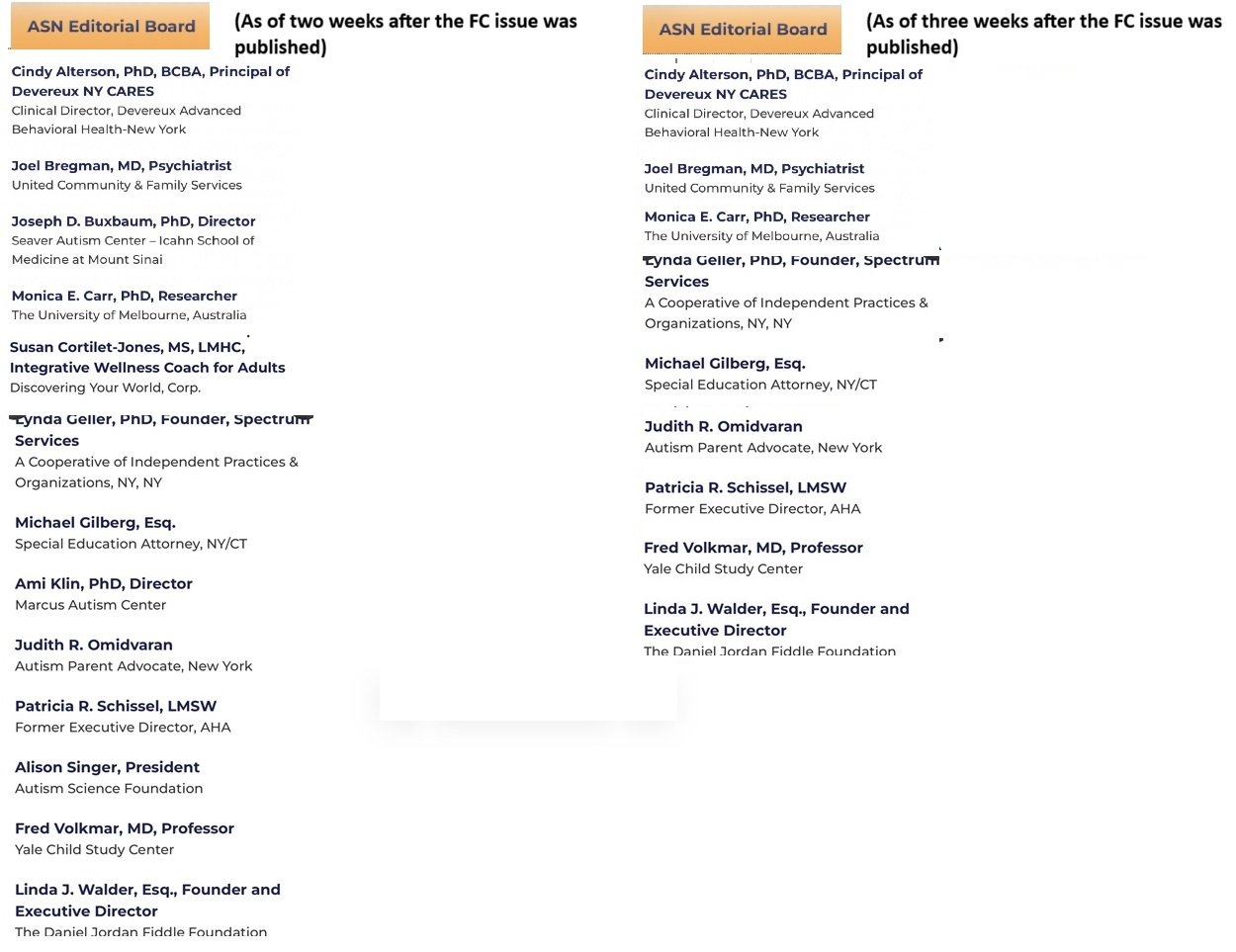
Even if some members of the board are pro-FC, surely not all of them are. Indeed, some of them—Alison Singer and Fred Volkmar, for example—have made statements against FC.
And even if some members of the board were asleep at the wheel when this issue came out, surely not all of them were.
And surely at least some members of the board who don’t support FC and who were asleep at the wheel when this issue came out would later become aware of it—aware of the fact that 27 pro-FC articles were just published by a journal that derives much of its credibility (the credibility that it is now rapidly spending down) from having their names on its editorial board.
It seems that some of these people did eventually wake up and quietly do something. On the left-hand side is the editorial board as it appeared on the website within the first two weeks after the issue came out, as compared with what it looks like right now:
It would have been nice if they’d been more coordinated and public about it, and it would have been nice if more than 4 members had resigned. But this sudden 31% reduction in the size ASN’s editorial board will, hopefully, prompt some introspection and caution going forward by some of the more responsible influencers in the world of autism pseudoscience.