Can a Blind Person Successfully Use RPM?: The Challenges of learning to make requests with tangible objects in individuals with multiple disabilities including visual impairments
Since the Telepathy Tapes came onto the scene at the end of 2024, we at facilitatedcommunication.org have periodically received emails from proponents and critics alike asking our opinion about the claims that nonspeaking individuals with profound autism have telepathic abilities. Since these (purported) telepathically gifted individuals also happen to be subjected to FC/S2C/RPM, we have thoughts.
Katharine and I have both written critiques about the Telepathy Tapes podcast. We’ve also collected critiques from others. The links to the articles and blog posts can be found in The Telepathy Tapes section of our website..
In today’s blog post, I want to address the claims that RPM (or any form of FC) can be used with blind, nonspeaking autistic individuals. Setting aside for a moment that 1) there is no reliably controlled evidence to prove proponent claims that FC/S2C/RPM lead to communication independence and 2) there is no reliably controlled evidence that telepathic abilities exists in anyone (let alone non-speaking individuals with autism), the question then becomes: is a text-based form of Augmentative and Alternative Communication (AAC) a suitable match for someone who is blind?

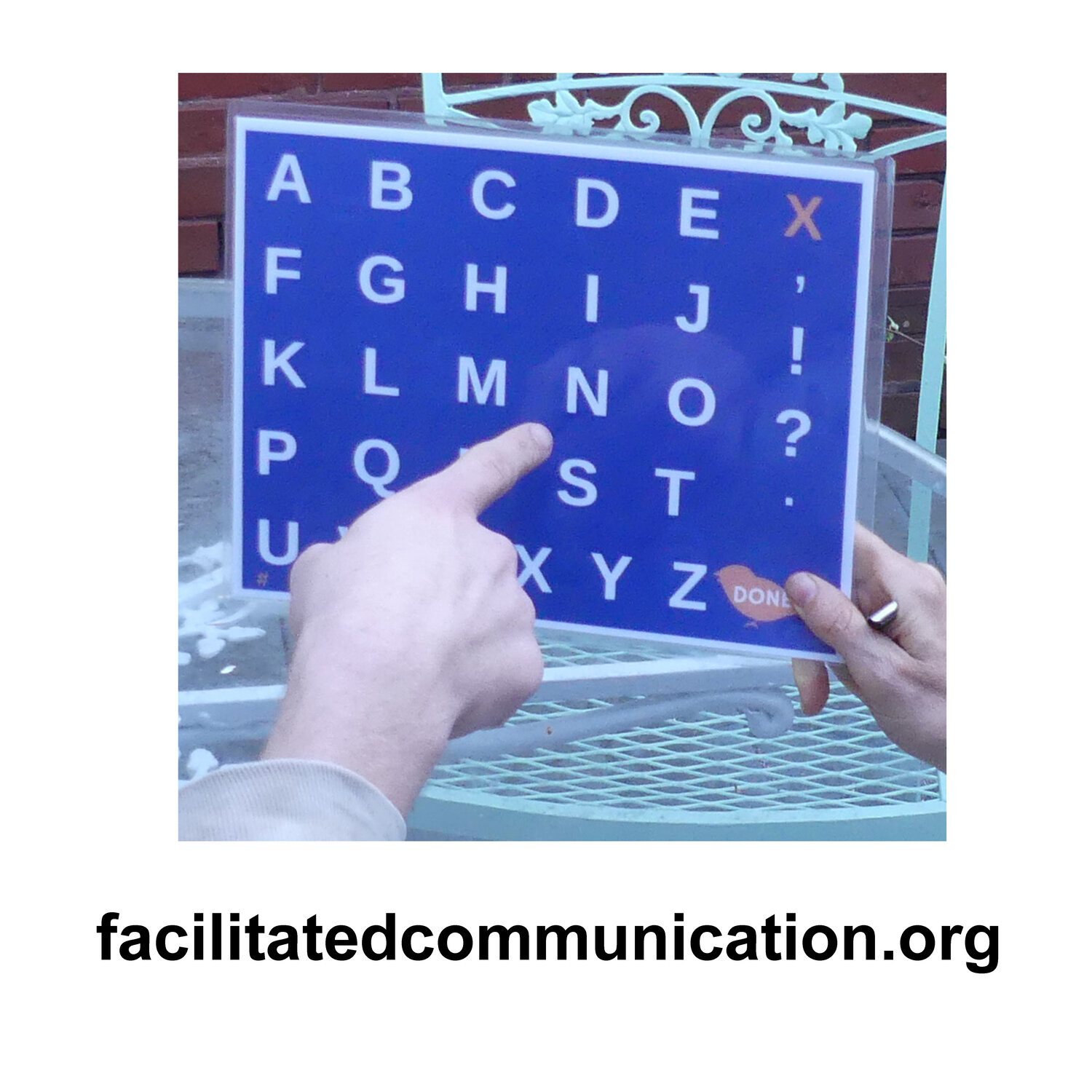
A collection of images showing FC/S2C/RPM and facilitator touch, even in the so-called “no.-touch” forms of FC.
I’m not talking about the types of vision problems I discussed in a previous blog post—vision problems that potentially could be corrected through prescription glasses, prisms, surgery, or other vision therapies. Rather, I’m talking about people who are totally blind and being subjected to FC/S2C/RPM.
In one case discussed in publicly available videos, news articles, and substack posts, a mother is using RPM with her adopted son whose retinas are completely detached. He also, purportedly, spent his formative years being neglected in an orphanage in either Bulgaria or Croatia (I’ve seen references to both) and was never directly taught to speak, read, or write in his native language (presumably Bulgarian or Croatian) or in his adoptive mother’s native language, English. When questioned about how a blind nonspeaking profoundly autistic individual can see the letter board and select letters, the mother’s explanation is that her son can see through her eyes to spell using “remote viewing.”

Image by Aron Visuals
I looked up the definition of remote viewing on Wikipedia:
…the practice of seeking impressions about a distant or unseen subject, purportedly sensing with the mind. There is no scientific evidence that remote viewing exists, and the topic of remote viewing is generally regarded as pseudoscience. A remote viewer is expected to give information about an object, event, person, or location hidden from physical view and separated at a distance.
FC/S2C/RPM proponents, it seems, have adopted the term and changed its meaning (which isn’t a surprise; they also think “independent” communication means “with facilitator cueing and control” instead of “by oneself”). Remote viewing, as was explained in a pro-FC video I watched, means that the nonspeaking individual somehow teleports into the body of the person who’s facilitating and holding the letter board and looks out his or her eyes to select letters.
A simpler explanation would be that the blind person can’t see the letter board and the facilitator, who maintains constant eye contact with the letter board and waves it in the air, is selecting the letters on their client or loved one’s behalf. But as the topic of facilitating while blind keeps coming up on social media threads and in the Telepathy Tapes podcast (Season 1 Episodes 9 and 10), I thought I would look at some studies involving teaching skills to blind individuals who have limited spoken language abilities and multiple disabilities to learn more about the intricacies of learning to communicate when blind and profoundly affected by autism.
Because I do not have experience working with the population outlined in this blog post, I reached out to a licensed speech/language pathologist who does. The person sent me two articles to review.
The first study, titled “Effectiveness of Combining Tangible Symbols with the Picture Exchange Communication System to Teach Requesting Skills to Children with Multiple Disabilities including Visual Impairment,” follows the progress of four individuals as they’re introduced to a modified form of the Picture Exchange Communication System (PECS) to identify (through touch and/or limited visual abilities) a tangible representation of a favored object or activity (e.g., food, drink, music, dancing and jumping). The students in the study were at the pre-Braille stage of education.
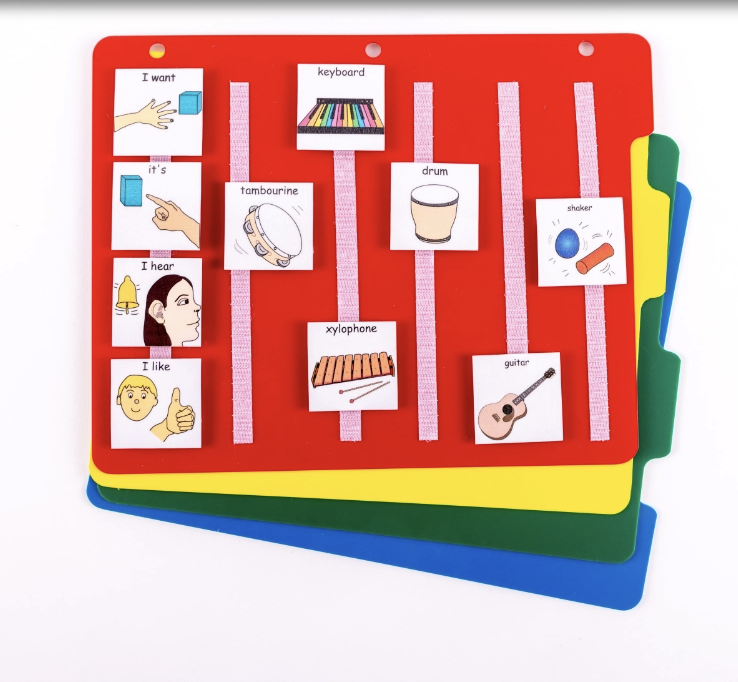
Screenshot of a PECS board (PECS USA 2026)
PECS is an evidence-based form of Augmentative and Alternative Communication (AAC) used with non-speaking or minimally speaking individuals and involves specific steps to follow in teaching individuals to identify and use pictures that represent a desired object or activity. For example, if a person is thirsty, he or she might select a picture from a collection of images velcroed into a communication notebook that represents a glass of water (or milk or juice or other kind of beverage) and hand it to their caregiver or teacher. The caregiver would then get a glass of water for the child, and the “exchange” would be complete.
As today’s study indicates, teaching object/symbol recognition to someone who is blind adds a layer of complexity when using PECS, particularly with individuals who have not yet learned to initiate communication with others. The authors of the study were trained in PECS and adapted the six phases of the training program for four students with vision problems in their program. I’m not going to go into detail about PECS, but I will provide information in the References and Recommended Reading section below for those who would like to explore this topic further.
Note: In one (anecdotal) account I read of a facilitator using RPM and a PECS-style set up with her blind non-speaking autistic child, the facilitator claimed the child learned PECS and Braille in the same day. But, this is likely a gross exaggeration, given the practicalities of teaching a blind, non-speaking or minimally speaking autistic person what a symbolic representation of a desired object or activity feels like (or, in the case of individuals with some vision, looks like up close) and then, in turn, offer it to a communicative partner as a request for that particular object or activity. In later phases of PECS, students learn to select between two (or more) desired tangible symbols when making a request for a desired object or activity.
Image by Judy Beth Morris
In the adapted PECS study I read for today’s blog post, the four participants met the following criteria:
Diagnosed with multiple disabilities including visual impairment
Little or no verbal communication skills
Identified as having difficulties in overall communication skills
No prior PECS training
All the participants had multiple disabilities including blindness. Two of the participants were diagnosed with autism, along with other visual and cognitive disabilities.
The conditions the researchers took into consideration when designing the study included:
Whether the student(s) could fixate on an object for a specified amount of time (e.g., 10 seconds) and at what distance (e.g., 6 inches)
Whether the student(s) could shift their gaze from one object to another and at what distance (e.g., shifting from a 1-inch object to another of similar size 3 inches away)
The intentional communicative acts by the participants (e.g., verbal utterances, gestures)
The extent of their vision loss (e.g., could they detect highly contrasted, colorful materials up close or at a distance?)
Whether the student(s) needed physical as well as verbal cues
Language comprehension skills
Ability to follow simple requests
Ability to detect the differences in objects through textures, smell, size of object, etc.
The materials and reinforcers used in the study were determined by each person’s visual acuity (or lack thereof), recognition skills, comprehension skills, and personal interests.
Note: In contrast with the PECS study, in the video I watched of a blind, autistic, nonspeaking individual being subjected to RPM, the facilitator did not appear to take any of these conditions into consideration, including reinforcers and the individual’s verbal and nonverbal communications. Instead, she held the individual, at different points during the RPM session, with one hand by the arm, shirt, neck and/or hair to keep the person from bolting. She also tapped him on the face with the letter board (held in her other hand) presumably to get his attention even though he, literally, could not see the board. I found the session difficult to watch as he continuously struggled to get away.
The facilitator claimed to have been trained in RPM and had been using it with her child for a year and a half. It makes me sad to think of the progress the child might have made if he’d been appropriately matched to evidence-based forms of AAC designed to address his visual and language needs.
The researchers in the PECS study, however, focused on and documented the progress of each of the four participants as they were introduced to each phase of the PECS system. As the participants gained success in identifying the objects and making requests at close range (e.g., holding the object out to their communicative partner), the tasks were made more complex by increasing the distance between the participants and their communicative partners. These training sessions were meant to help prepare the students for making requests when their communicative partners were out of arm’s reach.
Depending on which phase the participants were in the process, physical and verbal cues were allowed or withheld, with the goal of having the participants complete the tasks independently and without assistance of any kind. Once mastery was achieved at one phase, the participants moved to the next phase. If they had difficulty at any stage, the instructors would revert the activity back to the phase where the participants had the most success for retraining before again moving forward. The goal for these participants was to get them to a level where their skills for selecting desired objects and activities could be generalized from a structured setting to their classrooms. Ultimately, the participants would be able to use these skills spontaneously and in a variety of settings (e.g., playground, cafeteria, home environment), but that was beyond the scope of the study.
The result of the study was that each of the students progressed from no correct responses at baseline to correct responses in the generalization opportunities (e.g., in the classroom vs. in a more structured setting). The overall results were positive for adapting PECS to teach requesting skills to students with multiple disabilities and visual impairments, but this was a small study and some of the students had difficulty selecting and discriminating among tangible symbols that were similar in shape, color or size, especially for the student with complete vision loss. The next most common area of difficulty involved the blind and visually impaired students seeking out their communication partner from a distance.
The researchers also noted that, for the scope of this study, the focus was teaching students to identify and “exchange” a tangible item in response to a prompt. More instruction and training would be needed to reach the stage where students were initiating requests without prompts from their communicative partner. And, as I mentioned earlier, further study would be needed to document if the students could generalize their skills to different settings and how long they could maintain their requesting skills over long periods of time (e.g., months, years).
In addition, the study emphasized requesting skills, but not other communication skills (e.g., questioning, conversational vocabulary, and joint attention). The authors noted that “any communication system developed for students with disabilities needs to be based upon their individual abilities, learning contexts, and experiences and adapted to meet their communicative needs.” They recommended pairing PECS with other (evidence-based) forms of communication systems to “achieve the most effective communication functions for people with disabilities in varied situations.”
This study was not an FC/S2C/RPM authorship study. However, given the considerations the authors discussed in adapting the PECS materials and procedures for teaching basic requests to the participants, it seems impossible for visually impaired and blind individuals who depend on size, shape, and textures to identify common tangible items and make simple requests to think that they could select letters on a flat surface using a one-finger hunt-and-peck method with no tactile feedback or visual cues to help them identify target letters.
And, as for the claim about learning PECS and Braille in one afternoon, it appears that would be highly unlikely. Even in the most basic, early stages of PECS, the researchers of this study indicated that it took many trials over many days of practice for participants to master the targeted skills (e.g., select desired objects and make requests without physical or verbal prompting from their communicative partners).
If proponents are going to be making these extraordinary claims about the use of FC/S2C/RPM in people who are blind or who have severe visual difficulties, then the ethical way to address these issues in blind, nonspeaking or minimally speaking autistic individuals with limited language comprehension and literacy skills is to conduct reliably controlled testing that includes comprehensive vision and speech/language evaluations to rule in or rule out the efficacy of using FC/S2C/RPM with this population. I suspect that resolving the issue of authorship through reliably controlled testing would also answer any questions regarding remote viewing or telepathic abilities.
I’ll continue exploring this theme in my next blog post as I review the second article sent to me by the licensed speech/language pathologist titled “Using the Picture Exchange Communication System with Students with Visual Impairment.”
Note: trained PECS practitioners follow strict protocols to maintain the integrity of the communication method and standardization of the technique. If FC/S2C/RPM practitioners are adapting some or all of the PECS steps for their own purposes and are untrained in PECS, they are also negating the effectiveness of the method. In other words, If facilitators go “off script” and only pick and choose parts of the PECS protocols to use during FC/S2C/RPM sessions, the method they are using is no longer evidence-based. Nor is it PECS. In theory, proponents could develop an evidence-based practice if they could prove their claims and the effectiveness of their methods under reliably controlled conditions, but to date, they have failed to do so.
References and Recommended Reading
Ali, Emad, MacFarland, Stephanie Z., and Umbreit, J. (2011 September). Effectiveness of Combining Tangible Symbols with the Picture Exchange Communication System to Teach Requesting Skills to Children with Multiple Disabilities including Visual Impairment. Education and Training in Autism and Developmental Disabilities, Vol. 46 (3), pp. 425-435
Beals, K. (2022). Cutting-Edge Language and Literacy Tools for Students on the Autism Spectrum. IGI Global. ISBN: 9781799894438
Beals, K. (2022). Students with Autism: How to Improve Language, Literacy, and Academic Success. John Catt Educational. ISBN: 9781915261373
Bondy, A. (2001). PECS: potential benefits and risks. The Behavior Analyst Today, 2, 127-132.
Bondy, A., & Frost, L. (1993). Mands across the water: a report on the application of the picture exchange communication system in Peru. The Behavior Analyst, 16, 123-128.
Bondy, A., & Frost, L. (1994). The picture exchange communication system. Focus on Autistic Behavior, 9, 1-19.
Bondy, A., & Frost, L. (2001). The picture exchange communication system. Behavior Modification, 25, 725-744.
Frost, L., 8c Bondy, A. (2002). The picture exchange system training manual. Newark, DE: Pyramid Educational Products.
Shane, Howard C., White, Leigh Anne. (2026, February 27). An Educator’s Guide to AAC: Supporting Communication and Language Learning. Brookes Publishing. ISBN: 978-1681257433