Skeptical Inquirer Weighs in on The Telepathy Tapes Podcast
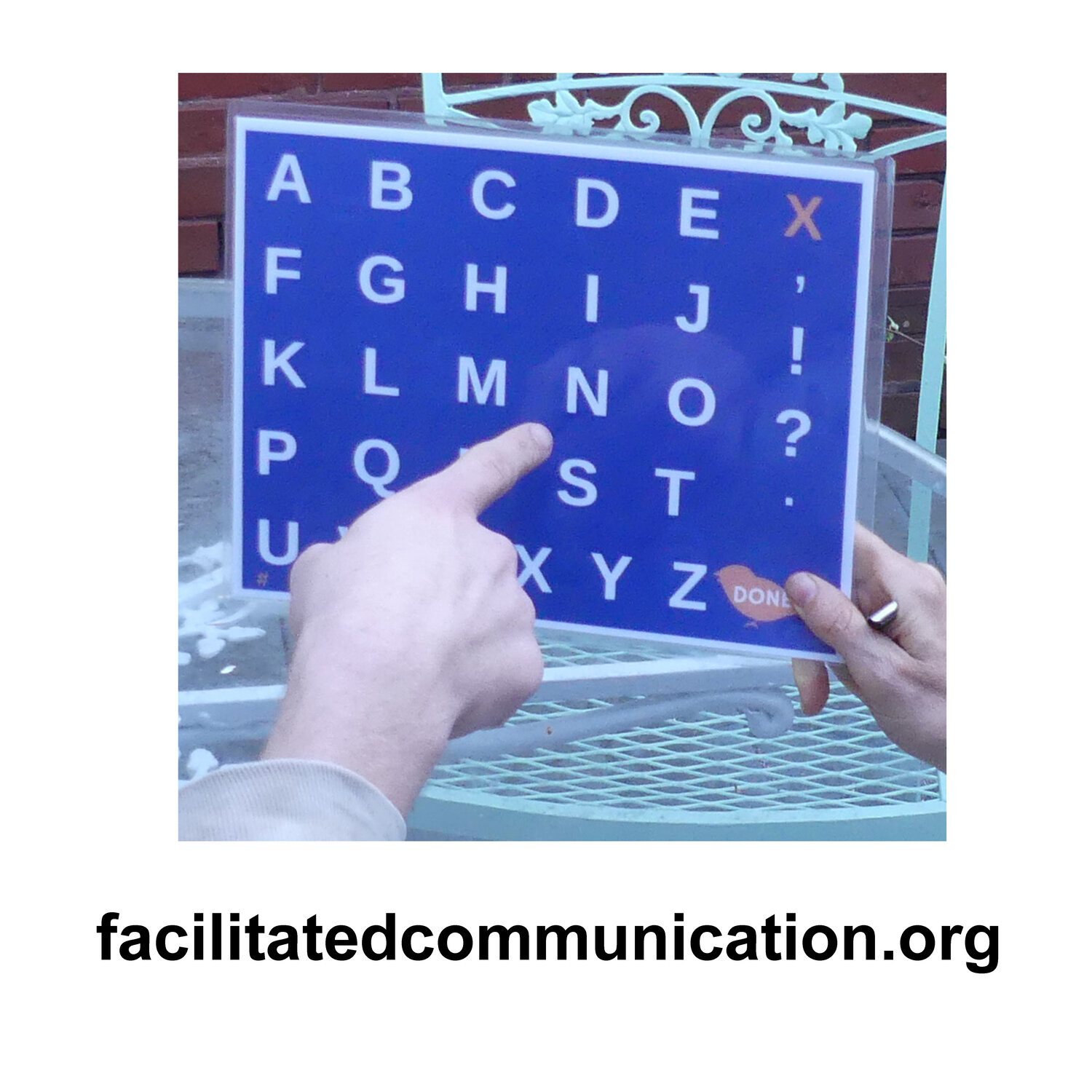
In today’s blog post, I want to draw attention to the Center for Inquiry’s (CFI) September/October 2026 issue of the Skeptical Inquirer that features several articles critiquing The Telepathy Tapes podcast.. As CFI director Stephen Hupp points out in his article How The Telepathy Tapes Silences Voices, sometimes nonspeaking individuals with autism, cerebral palsy, and other developmental disabilities benefit from the aid of augmentative and alternative communication (AAC) methods and techniques to express their thoughts, wants and needs in ways that replace and/or enhance spoken language. But he points out that “if another person is always needed to ‘facilitate,’ ‘assist,’ or ‘support’ in the pointing and typing, then there’s a big problem.”
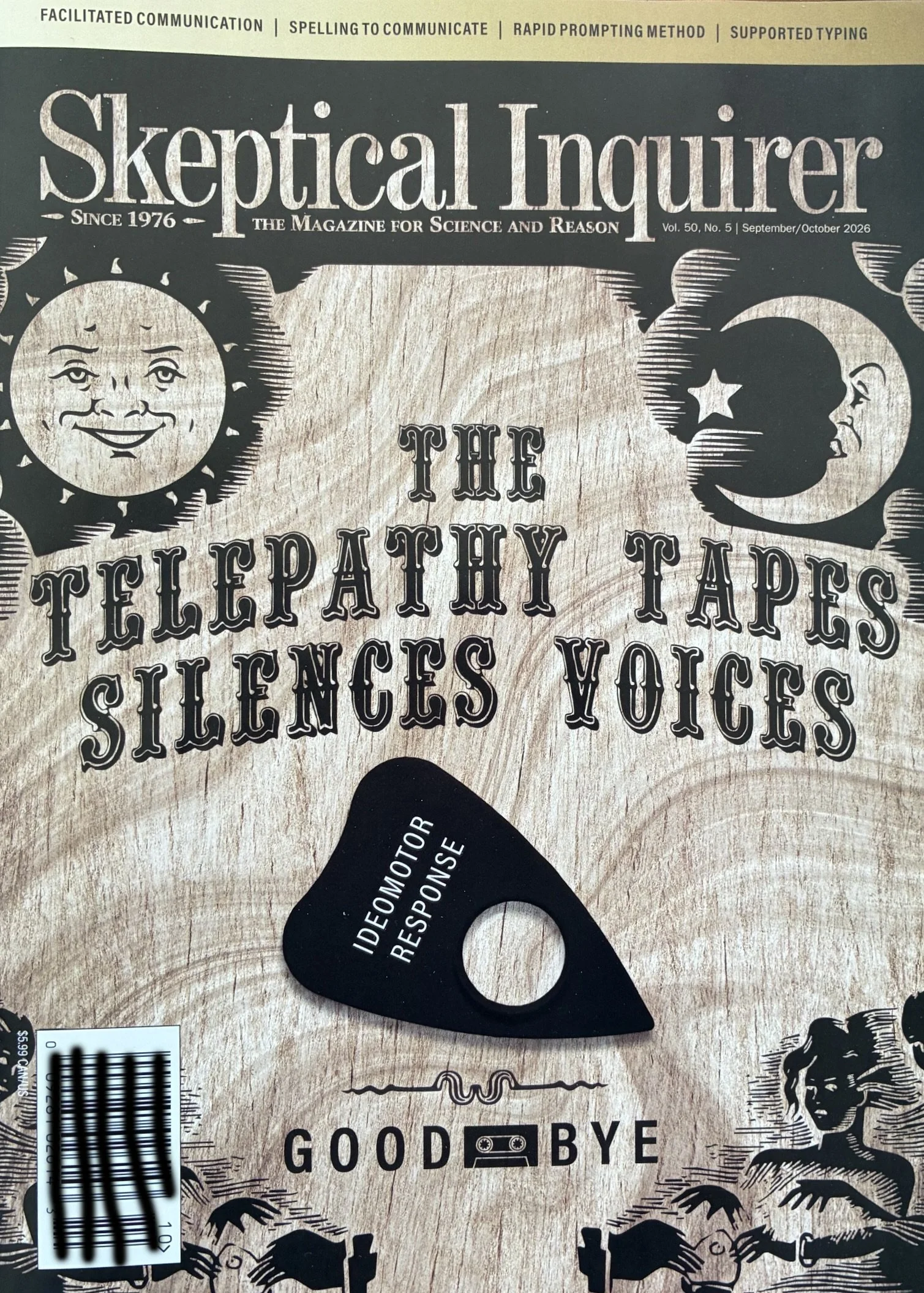
Screenshot of the cover of Skeptical Inquirer: The Telepathy Tapes Silences Voices (September/October). I’ve highlighted some of the articles in today’s blog post, but I encourage people to read the articles in full. (Links provided within the blog post and below).
The “big problem” Hupp alludes to is facilitator authorship through (witting or unwitting) cueing and control over letter selection. Reliably controlled testing, dating back to as early as the 1970s, has shown that facilitators, not their nonspeaking clients or loved ones, are likely (to a high degree of certainty) authoring the messages when facilitator-dependent techniques are used to “support” the pointing or typing of nonspeaking individuals. (See Controlled Studies and Systematic Reviews). As I point out in my article for the issue, “Debunking The Telepathy Tapes: The Role of Facilitator Behaviors,” facilitator cues are built into the techniques. And, given that facilitators are taught to presume competence in their clients and not test for authorship, many facilitators are unaware of the extent to which physical, visual, and auditory cues can and do influence or control letter selection.
Note: I should point out here that it’s the techniques that are flawed, not the individuals being subjected to them. Verbal expression is not the only valid form of communicating. Spelling or using other non-verbal techniques or methods are legitimate ways of expression for non- or minimally- speaking individuals when they have the cognitive abilities to understand and use written language and are allowed to communicate independently and in ways that are free from facilitator cueing and control. There are many problems with FC/S2C/RPM and other facilitator-dependent techniques, but the main issue is with behaviors that are (wittingly or unwittingly) exhibited by the facilitators that interfere with their client’s or loved one’s letter selection.
Throughout the years, the CFI has regularly called out the use of FC as a pseudoscientific practice. I’ll include a sampling of these articles in the references and recommended reading section below. The CFI’s primary focus is on pseudoscientific and paranormal claims, which, I’m guessing, is the reason why The Telepathy Tapes podcast originally caught their attention. The Center for Inquiry Investigations Group (CFIIG) offers a $500,000 prize to anyone who can demonstrate a paranormal ability under scientifically controlled conditions.
It’s my understanding that, in May 2025, James Underdown, executive director of CFI West, reached out to Ky Dickens, producer of The Telepathy Tapes podcast, to offer aid in testing the claims being made on the show that nonspeaking individuals with autism (who were being subjected to FC/S2C/RPM) had telepathic abilities. In the letter he wrote:
We will design and conduct a fair, objective, and impartial test that will determine if any person has the ability – by means of telepathy only – to transmit thoughts into another person’s mind. Anyone passing our tests will win $500,000. If you truly want to be taken seriously, come win our money.
To my knowledge, Dickens didn’t take him up on it. Here’s a link to Underdown’s reactions (written a few months later) to his experience with trying to get Dickens to engage with the scientific process: Telepathy Tapes: 1 Science: 0
As Stuart Vyse points out in his article for this SI issue, The Telepathy Tapes: A Portal into a World of Woo, Dickens received a huge boost from Joe Rogan in advertising the podcast and by January 2025, Dickens had been signed with a talent agency. (Vyse previously covered much of Season 1 of The Telepathy Tapes in a January 2025 article titled “The Telepathy Tapes: A Dangerous Cornucopia of Pseudoscience”). Not only was Dickens not interested in collaborating with CFI to conduct scientifically rigorous authorship/telepathy testing, but she also expanded her mystical/magical offerings in Season Two to include, as Vyse describes, a “long list of gurus, intuitives, and religious and spiritual guides” (e.g., Elizabeth Gilbert, Deepak Chopra) that, for all intents and purposes, demonstrates a continued and stubborn unwillingness to acknowledge or address critics’ concerns about the claims of telepathic abilities or, in some cases, the ability to communicate with the dead, in nonspeaking facilitated individuals (and others) being made in the series.
Katharine, in an article for the SI issue titled Telepathy via Facilitated Communication in Profound Autism: A 21st-Century Delusion, posits that the belief in the telepathic abilities of nonspeaking individuals with autism “stems from forces of modernity so inexorable that, were we to wind the gears of history and try it all again, we’d end up right back where we are.” In other words, the social, familial, educational, medical, political and religious pressures on the parents and educators of these individuals, combined with the (often harsh) realities of living with and raising a child with profound autism without appropriate supports, leave space for pseudoscientific practices, like FC/S2C/RPM. These facilitator-dependent practices can give proponents the illusion of a theoretical solution to “the enormous communication challenges of profound autism that have long resisted established techniques and teaching methods.”
Over time and with anecdotal accounts of the miraculous and sometimes super human accomplishments of individuals with severe communication deficits, proponents of FC/S2C/RPM have convinced themselves (and others) that letter boards and keyboards are imbued with some kind of mystical powers that allow individuals with limited to no functional spoken or written language to write sophisticated poetry, attend college courses and graduate from universities, and, for a select few, become policy makers at the national level on RFK’s Interagency Autism Coordinating Committee (IACC)—but only because they are “supported” by an omnipresent, literate facilitator. (See Katharine’s blog post A Federal Autism Committee uses coded language to call for FC in autism accommodations, cognitive evaluations, school classrooms, Medicaid funding, and research).
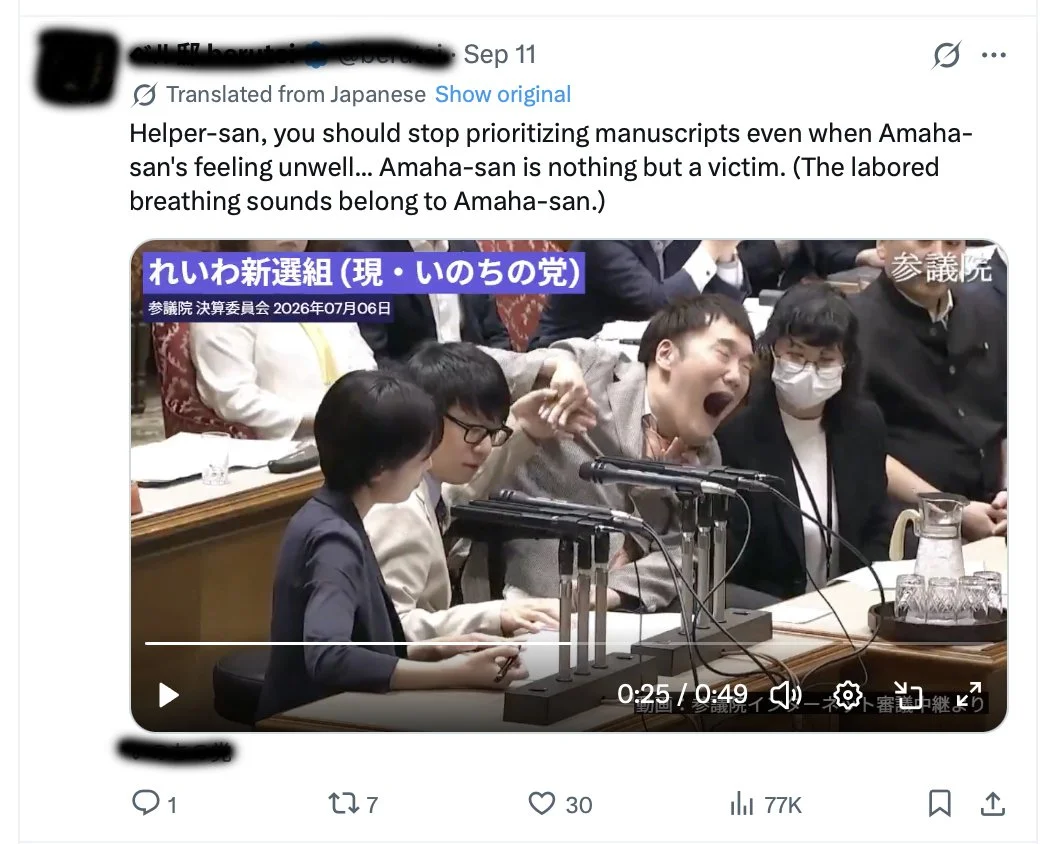
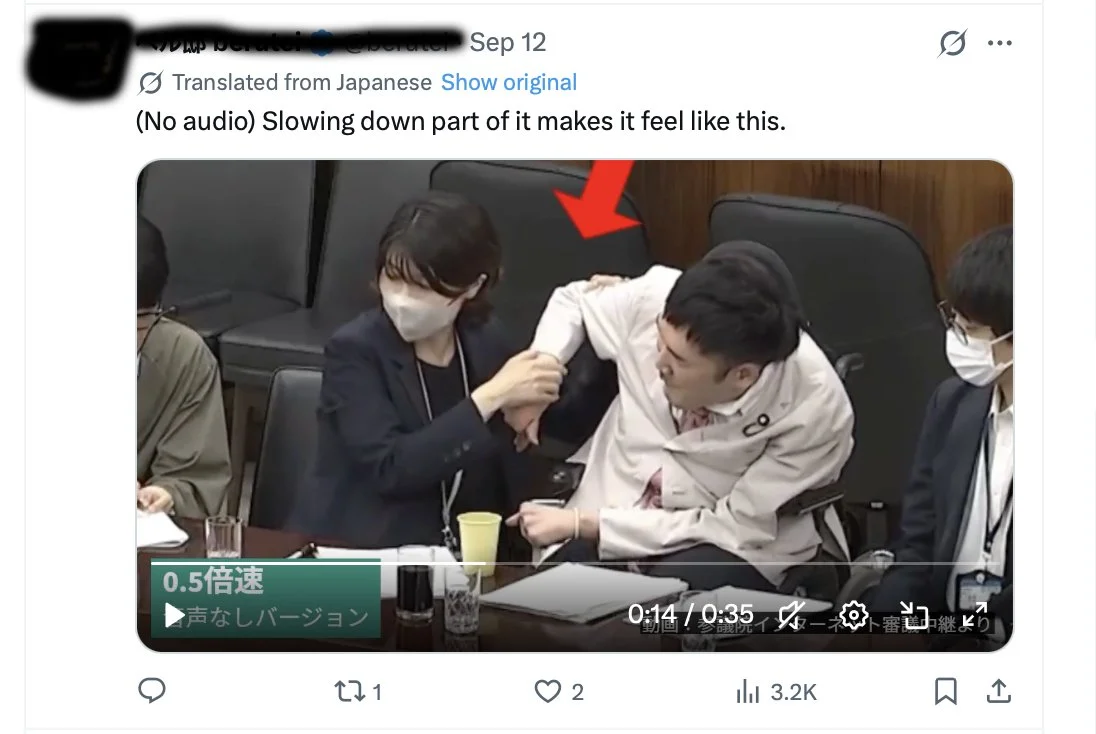
Question: Will they next be running FCed individuals for a U.S. public office like they have in Japan? The following screenshots from videos of a parliamentary session show facilitators holding onto and yanking the wrist and arm of the government official to “assist” in letter selection. How is this independent communication? I
Although the ideomotor phenomenon is only one aspect of facilitator cueing, I was fascinated to read an article included in the Skeptical Inquirer issue by Michael Maldinado and Malorie McKay titled “The Science Behind the Ouija Board: The Neuropsychological Basis of the Ideomotor Response.” The article invokes a facilitator’s need for control in what can often be the overwhelmingly challenging task of caring for and living with nonspeaking or minimally speaking individuals with profound autism. The authors wrote:
“When something is completely out of our hands, it feels cathartic to take what little control we can. We can do this by tricking ourselves into believing we are gaining information. After all, having information is a source of control and divination objects of all types are ways for us to feel as if we are accessing a greater power that can help us take control of our lives when we feel most powerless.”
The article reminded me of a study published in 2019 titled “Predictive minds in Ouija board sessions,” which supports Maldinado and McKay’s observations that movements of a planchette on a letter board are due to small often non-conscious muscle movements. (See my blog post Ouija, FC, and Eye-Tracking Devices: Review of Andersen et al. 2019) and a book written by Herman Spitz in 1997 titled Nonconscious Movements from Mystical Messages to Facilitated Communication (see Katharine’s blog post The under-appreciated power of involuntary muscle movements—a review of Herman Spitz). When the Ouija board or FC/S2C/RPM first start to “work,” it’s easy for humans to trick themselves into believing that something supernatural or magical is happening. It’s much more difficult, I think, for humans witnessing such a seemingly miraculous event to step back in that moment and take a critical look at what might really be happening. Few facilitators want to think that they—not their client or loved one--are moving the child’s hand or moving the letter board in the air, however inadvertently, but according to all reliably controlled authorship tests to date, that’s exactly what is happening
I’ve long considered FC/S2C/RPM as coping strategies, not communication techniques and, in reading the articles in this issue of the Skeptical Inquirer, I’m struck once again at how adept facilitators’ minds are at filling in the gaps—of remembering the “hits” (or successes) and forgetting the “misses” (or failures) when highly motivated by emotion to want FC/S2C/RPM to “work.”
I want to believe that most facilitators start with a sincere desire to help their client or loved one. I want to believe that many facilitators are driven by a desire to make a connection—to reach the person (e.g., their nonspeaking autistic client or loved one) and have a (verbal) two-way conversation.
But I also believe that academics, researchers, and, yes, documentarians like Ky Dickens, have an obligation to protect and safeguard the communication rights of individuals with severe communication deficits by conducting reliably controlled authorship testing—the only proven way to determine who is controlling letter selection. It becomes increasingly frustrating to see facilitators—or potential facilitators—purposefully avoiding any meaningful form of (current-day) authorship testing despite what is quite clearly a problem with FC/S2C/RPM: facilitator cueing and control over letter selection.
I appreciate CFI taking the time to feature The Telepathy Tapes in their September/October 2026 issue of Skeptical Inquirer. Perhaps, in this anti-science world we seem to be living in today, this issue will help draw attention back to the need for reliably controlled FC/S2C/RPM authorship testing as history seems to be repeating itself.
It’s hard to tell if Dickens meant to draw so much attention to the problems of FC/S2C/RPM through her podcast or if she just got caught up in the idea that she’d “discovered” telepathic abilities in individuals with profound autism. But, as evidenced by Dickens’ refusal to collaborate with the CFI, she doesn’t seem eager to put her claims to the test.
Historically, proponents of FC/S2C/RPM as a whole have shied away from scientifically rigorous inquiry—they’re even told by workshop leaders that testing for authorship is “unethical” and that it, somehow, breaks the trust-bond between facilitator and client.
Nonetheless, I hope critics and skeptics take this opportunity to scrutinize the claims being made by Ky Dickens and The Telepathy Tapes, revisit the need for reliably controlled testing of FC/S2C/RPM, and make the procedure mandatory. Clearly, proponents of these techniques can’t (or won’t) regulate themselves.
A list of articles, blog posts, and YouTube videos critiquing The Telepathy Tapes can be found here on our website.
References and Recommended Reading
Andersen, M., Nielbo, K.L., Schjoedt, U. et al. (2018). Predictive minds in Ouija board sessions. Phenomenology and the Cognitive Sciences. DOI: 10.1007/s11097-018-9585-8
Beals, Katharine. (2026 September/October). Telepathy via Facilitated Communication in Profound Autism: A 21-st Century Delusion, Skeptical Inquirer, Volume 50(5).
Betz, W. (2010, February 22). Facilitated Communication with Coma Patient is Fabricated. Skeptical Inquirer.
Boudry, M., Termote, R., and Betz, W. (2010, August). Fabricating Communication. Skeptical Inquirer, 34 (4).
Boynton, Janyce. (2026, September/October). Debunking The Telepathy Tapes: The Role of Facilitator Behaviors. Skeptical Inquirer, Volume 50(5).
Boynton, Janyce. (2021 March/April). Fresh Thinking or Exploitation?Skeptical Inquirer. Vol 45 (2), 60-61.
Burgess, C.A., Kirsch, I., Shane, H., Niederauer, K.L., Graham, S.M., Bacon, A. (January 1998). Facilitated Communication as an Ideomotor Response. Psychological Science, 9(1), 71-74. https://www.jstor.org/stable/40063250
CFI Investigations Group Telepathy Challenge
Dillon, K. (1993). Facilitated Communication, Autism, and Ouija. The Skeptical Inquirer, 17 (3), 281-287.
Gardiner, M. (2001, January/February). Facilitated communication: A cruel farce. Skeptical Inquirer, 17-19
Green, G. (1994). “Facilitated Communication - Mental Miracle or Sleight of Hand?”Skeptic Magazine.
Hupp, Stephen. (2026 September/October) How The Telepathy Tapes Silences Voices, Skeptical Inquirer, Volume 50(5).
Mackey, Malorie and Maldonado, Michael. (2026, September/October). The Science behind the Ouija Board: The Neuropsychological Basis of the Ideomotor Response. Skeptical Inquirer, Volume 50(5)
Mathieu-Sher, Reva and Forbes, Heather. (2025, January 27). [Response to] “The Telepathy Tapes: A Dangerous Cornucopia of Pseudoscience” Association for Science in Autism Treatment
Mulick, J.A., Jacobson, J.W., and Kobe, F.H. (1993, Spring). Anguished Silence and Helping Hands: Autism and Facilitated Communication. Skeptical Inquirer. 17 (3)
Nakajima, S. (2003, May-June). The ‘Miracle Poet’ case: Japanese media fooled by the Doman method and Facilitated Communication (Special Report). Skeptical Inquirer. 27 (3), 12-13.
Spitz, H. (1997). Nonconscious Movements: From Mystical Messages to Facilitated Communication. Routledge. ISBN 978-0805825633
Underdown, Jim. (2025, May 27). An Open Call to the Telepathy Tapes. Center for Inquiry.
Vyse, Stuart. (2026 September/October). The Telepathy Tapes: A Portal into a World of Woo. Skeptical Inquirer, Volume 50(5)
Vyse, Stuart. (2025, January 6). The Telepathy Tapes: A Dangerous Cornucopia of Pseudoscience. Skeptical Inquirer