A Brief History of Core Challenges and Purported Motor Impairments in Autism: Reality vs. FC Promotion
Proponents of facilitated Communication (FC) and its variants (RPM, S2C, “spelling”) have long dismissed decades of clinical consensus and empirical research about the fundamental nature of autism and redefined it in ways that support FC. Decades of clinical consensus and empirical research have established that autism is a sociocognitive disorder involving reduced social interaction and restrictive, repetitive behaviors. FC/RPM/S2C proponents have redefined autism as a motor disorder like Parkinson’s Disease.
While claims about generalized motor impairments (aka “whole body apraxia”) are commonplace in FC Land, particularly when with respect to minimal speakers, there are two types of motor impairment that most FC proponents focus on: oral motor impairments and fine motor impairments. Oral motor impairments purportedly explain the lack of speech—though acquiring speech also requires attending to speech, which research has established is diminished in autism (see Adamson et al., 2021). Fine motor impairments purportedly explain the failure to acquire sign language or the ability to produce written language through handwriting or ten-finger typing—though signing or producing written language also requires language skills. But perhaps no purported fine motor skill is more problematic for FC than pointing is. FC proponents simultaneously claim, falsely, that:
Pointing is a gross motor skill that, as such, is less impaired in autism
such that such variants of facilitated communication as S2C and “Spellers Method” purportedly help “myelinate” “motor pathways” to redirect language from the “fine motor” of speech to the “gross motor” of pointing (pointing is actually a fine motor skill)
Autistic minimal speakers nonetheless have so much trouble pointing to things “reliably” that
they perform poorly on cognitive and language comprehension assessments (even though, purportedly, they have normal-to-superior cognitive and language comprehension ability)
they need facilitators to hold up letterboards and provide “motor coaching” (even though its held-up letterboards inevitably move around, it’s harder to hit a moving target than a stationary one)
It’s interesting, therefore, to go back to the earliest reports on autism and see what these have to say about motor skills vs. the core social impairments and restrictive behaviors. The earliest of these is Autistic Disturbances of Affective Contact, Leo Kanner’s seminal 1943 paper presenting the eleven early childhood cases on which he based his discovery of the condition that we now know as “autism.” Importantly, these eleven cases exhibited a range of language ability; several were minimal speakers and remained so years later.
Throughout this paper, which contains both parent reports and Kanner’s own observations, we see dozens of descriptions pertaining to diminished social interaction. More or less in order, they are:
“happiest when left alone”
“indifferent to visiting relatives”
“completely disregarded the people and instantly went for the objects”
“mostly ignored other people”
“acted as if people weren’t there at all”
“when he had any dealings with persons at all, he treated them, or rather parts of them, as if they were objects”
“objects absorbed him”
“he would regard people as unwelcome intruders”
“he had no contact with people, whom he definitely regarded as interference when they talked to him or otherwise tried to gain his attention”
“behaved as if people as such did not matter or even exist”
“never looked up at people’s faces”
“no desire to please his mother”
“self-absorbed”
“he did not register any change of expression when spoken to”
“ignored persons completely except for her mother”
“shoving intruders away (without even looking at them)”
“entered the office without paying the slightest attention to the people present”
“he was completely absorbed in whatever he did”
“over attachment to the world of objects and failure to develop the usual amount of social awareness”
“prefers to play alone”
“paid no attention to the examiner”
“lone wolf”
“prefers to play alone”
“’terribly engrossed’ in his play, didn’t want other people around”
“he would pay no attention to me and show no recognition of me if I enter the room”
“lives in a world of his own where he cannot be reached”
“when he is with other people, he doesn’t look up at them”
“he paid not the slightest attention to the people present”
“without looking up at anyone he said...”
“he never used language as a means of communicating with people”
“he did not respond to being called or look at his mother when she spoke to him”
“there were no communicative gestures”
There are also many phrases relating to restrictive behaviors and resistance to change. They include, more or less in order:
performing actions “exactly the same way in which they had been performed originally”
“likes to stick to the same thing”
“won’t try new things”
“almost photographic sameness”
“repetitious”
“gets stuck on an idea”
“became upset at any change in an accustomed pattern”
“could not be diverted from his self-chosen occupations”
“when one figure was stealthily removed, he immediately noticed its absence, became upset”
“endless repetition of sentences"
“repetitive questions”
“He wanted to make sure of the sameness of the environment literally by keeping windows and doors closed.”
“Any noise, any interruption, disturbed her”
From all of this, Kanner distilled as the core of autism, a “powerful desire for aloneness and sameness”
But Kanner also had observations pertaining to motor ability. We read about young kids who are able to
spin blocks and pans and cylinders
jump up and down
play simple tunes on a piano
write pages and pages of letters of the alphabet
insert pieces into puzzles,
pick up blocks on request
handle crayons appropriately
draw circles in imitation of other circles
string beads
use scissors to cut paper
tear cardboard boxes into small pieces
enunciate clearly
build a tower of blocks as high as any child his age or even older
imitate speech sounds
Motor milestones, in those case reports where they were included, show no delays: one boy “sat up at eight months and walked at a year”; another “held up his head, sat up, walked, and established bowel and bladder control at the usual age.” Kanner remarks on the “good manual dexterity” or “good motor coordination” of several of the children. He summarizes the motor profiles as follows:
Several of the children were somewhat clumsy in gait and gross motor performances, but all were very skillful in terms of fine motor coordination.
In his 1944 paper, “Autistic psychopathy,” Hans Asperger likewise remarked on gross motor clumsiness; his only examples of fine motor difficulties involved handwriting—a commonly observed difficulty in autism.
Seven to eight decades after Kanner and Asperger, empirical research on motor difficulties in autism starts appearing, and it reports difficulties with fine motor control as well as gross motor. But it also finds that motor difficulties correlate with cognitive difficulties (Bhat et al., 2022; Kaur et al., 2018; Lin et al., 2026; Ramos-Sánchez et al., 2022). This raises the possibility that the empirical findings of fine motor difficulties in autism, most of it dating to the early 2000s, may reflect the expansion of the diagnosis, over the same period of time, to include children who previously would have been diagnosed intellectually disabled.
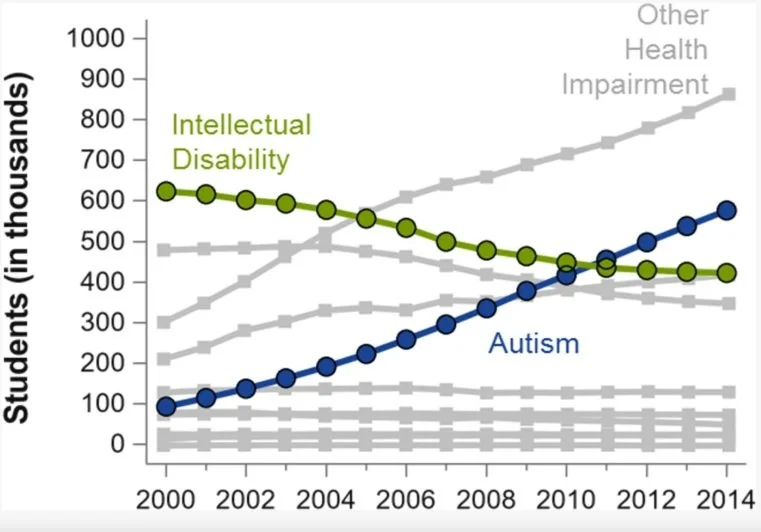
From Thurm et al., (2019). This graph, which shows a very large increase in ASD prevalence, accompanied by a strikingly similar decline in intellectual disability, suggests a trend in recent decades of diagnostic reassignment from intellectual disability to autism.
This, of course, is problematic for FC proponents, who believe that autistic non-speakers are both motorically impaired and intellectual unimpaired.
Also problematic for FC proponents is that none of the empirical research on motor difficulties in autism turns up evidence of a motor-based difficulty in pointing. Nor does Kanner’s work include anything about pointing.
But another early work does. The Siege, written by Clara Park a couple of decades later, in 1967, focuses on a single case: Park’s daughter, “Elly.” Much of The Siege focuses on Elly’s extreme social isolation and her repetitive behaviors, but it also recounts early motor skills like building block towers, drawing shapes, and operating a record player. We read about how Elly navigated through crowds on a beach, grazing people “by a quarter of an inch” but “never touch[ing] them” and how “She did not stumble, did not fall, did not spill or drop things.” But we also learn that Elly didn’t point. Recounting a moment in which she is with Elly, then 19 months old, at a grocery store and they encounter another 19-month-old girl, Clara observes this girl and is struck by the following event:
She turned, she looked up at her mother. As I watched, I saw her point to a box of candy.
I thought then that I had never seen Elly point.
And Park appreciates for the first time the significance of pointing—one that goes far beyond its purely motoric properties:
To stretch out the arm and the finger is, symbolically and literally, to stretch out the self into the world—in order to remark on an object, to call it to another’s attention, perhaps to want it for oneself. From pointing comes the question “What’s that?” that unlocks the varied world. To point, to reach, to stretch, to grab, is to make a relation between oneself and the outside.
Which takes us back to Kanner’s “profound desire for aloneness.”
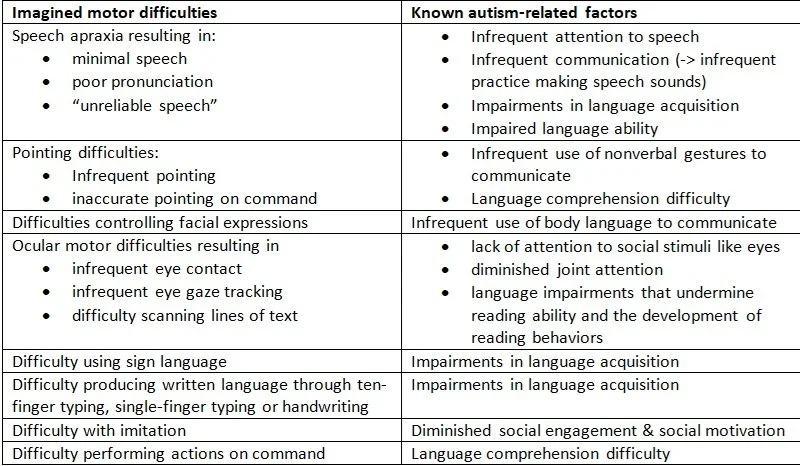
Returning to the more general motor profile of autism, the actual motor difficulties appear to either relate to gross motor difficulties like clumsy gait, or, when they extend beyond these, to correlate with intellectual disability. In contrast, the merely imagined motor difficulties—those dreamt up by FC proponents—are actually the results of known autism-related factors. Factors like the diminished orienting to social stimuli and resultant impairments in language acquisition, and the diminished social motivation and result infrequency of verbal and nonverbal communication.
Here’s a chart summarizing the various imagined motoric difficulties I’ve seen FC proponents make, juxtaposed with the known autistism-related factors that can readily explain them.
REFERENCES
Adamson, L. B., Bakeman, R., Suma, K., & Robins, D. L. (2021). Autism Adversely Affects Auditory Joint Engagement During Parent-toddler Interactions. Autism research : official journal of the International Society for Autism Research, 14(2), 301–314. https://doi.org/10.1002/aur.2355
Asperger, H. (1991). “Autistic psychopathy” in childhood (U. Frith, Trans.). In U. Frith (Ed.), Autism and Asperger syndrome (pp. 37–92). Cambridge University Press. (Original work published 1944).
Bhat AN, Boulton AJ, Tulsky DS. A further study of relations between motor impairment and social communication, cognitive, language, functional impairments, and repetitive behavior severity in children with ASD using the SPARK study dataset. Autism Res. 2022;15(6):1092-1110.
Kaur M, Srinivasan SM, Bhat AN. Comparing motor performance, praxis, coordination, and interpersonal synchrony between children with and without autism spectrum disorder (ASD). Res Dev Disabil. 2018;72:79-95.
Kanner, L. (1943). Autistic disturbances of affective contact. The Nervous Child, 2, 217–250.
Lin LY, Jin YR, Yu WH, Lai PC, Tu YF. Motor and cognitive profiles in children who are 3 to 6 years old and have autism spectrum disorder and other developmental disabilities.
Park, C. (1967). The Siege. Little Brown.
Ramos-Sánchez CP, Kortekaas D, Van Biesen D, Vancampfort D, Van Damme T. The relationship between motor skills and intelligence in children with autism spectrum disorder. J Autism Dev Disord. 2022;52(3):1189-1199.
Thurm, A., Farmer, C., Salzman, E., Lord, C., & Bishop, S. (2019). State of the field: Differentiating intellectual disability from autism spectrum disorder. Frontiers in Psychiatry, 10, Article 526. https://doi.org/10.3389/fpsyt.2019.00526
