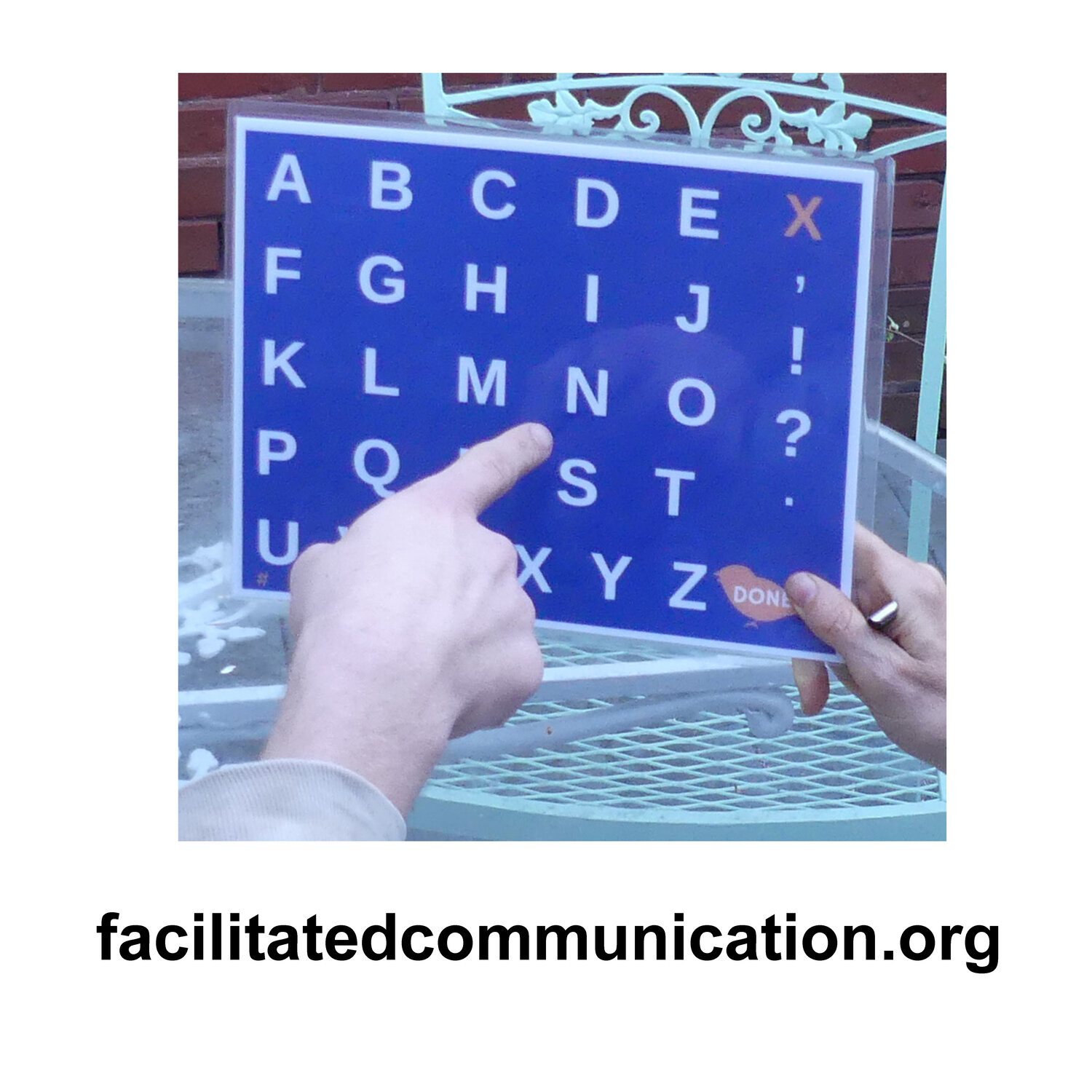
Another study showing the complexities of teaching communication skills to individuals with multiple disabilities and vision impairments (Ruling Out FC/S2C/RPM Use with this Population)
In my last blog post, I started a discussion about the plausibility of the claim that blind, nonspeaking autistic individuals with significant language delays could successfully use a text-based form of communication involving a facilitator holding a flat letter board in the air and a one-finger hunt-and-peck-style typing method.
I’m guessing that to most people outside the FC/S2C/RPM community, this scenario raises immediate questions and red flags about facilitator cueing and control. First, it’s not possible for anyone to accurately select letters on a letter board or keyboard using a one-finger-hunt-and-peck method of typing. A simple demonstration of this from the 1993 documentary “Prisoners of Silence” showed that even a top typist needs to register her fingers on the home row to type without looking at the keyboard.

Screenshot for Prisoners of Silence (1993) a documentary that investigated FC and raised serious questions about authorship in individuals being subjected to the technique.
Second, as we saw in the previous study I reviewed, visually impaired or blind individuals with multiple disabilities require many repetitions to first learn to identify tangible symbols for desired objects and activities (e.g., based on size, shape, texture) and then learn to make requests independently and without assistance from their communication partners. For example, if the individual wanted to hear music, could he or she find the tangible object that represented “music” and hand it to their communication partner without any interference from the other person (e.g., without physical or verbal cueing)?
Many factors go into learning these skills, including but not limited to the extent to which the individuals with visual impairments can perceive light, shape, color; whether they have the cognitive skills to identify (by touch, smell) the objects and make requests; whether they are able to find their communication partner when the person is out of arm’s reach; and whether they are able to generalize these skills from structured to unstructured situations.
But proponents of FC/S2C/RPM, it seems, don’t take any of these factors into consideration. It takes many repetitions at each stage of learning to master these skills using evidence-based methods and procedures.
Anecdotal accounts coming out of the FC/S2C/RPM community are that blind profoundly autistic individuals are able to spell using “remote viewing” (e.g., by seeing through their facilitators’ eyes). Sometimes, it’s reported, these individuals achieve mastery in as little as a few hours. These are stories viewed by proponents as evidence that these children can “spell” using remote viewing without taking into consideration the extent to which a sighted, neurotypical, literate facilitator controls access to the letter board.
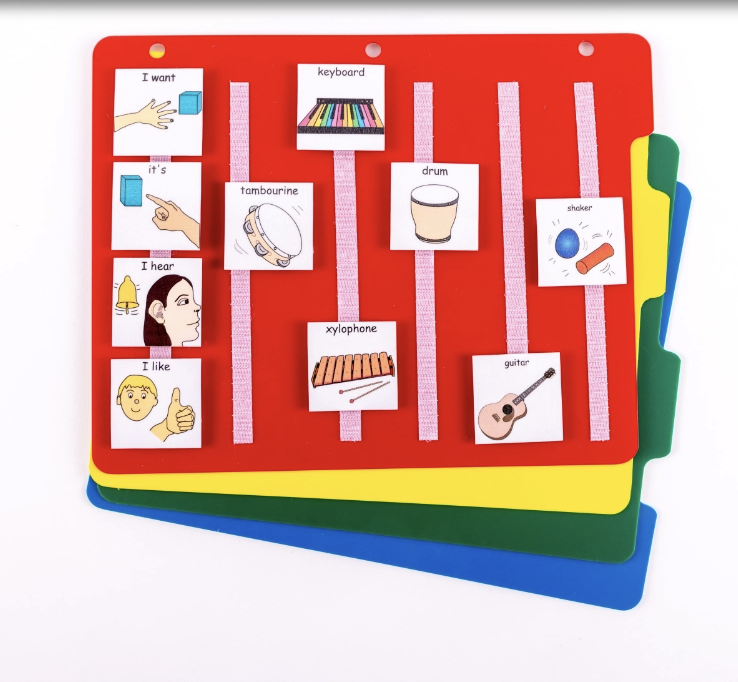
PECS activity board used with individuals with no visual impairments. (Screenshot from PECS US, 2026).
In today’s blog post, I’m reviewing a study titled Using the Picture Exchange Communication System with Students with Visual Impairment. Rather than discuss the merits of PECS (which is just one evidence-based form of AAC), I want to highlight some aspects of the study that I hadn’t thought much about until delving deeper into the topic of communication systems with individuals with multiple disabilities and vision problems.
As the authors of this study point out, to use PECS correctly, the communication partners (e.g., educators, parents, caregivers) must follow a specific protocol that guides the child or client through a series of activities.
The goal of PECS is to teach nonspeaking or minimally speaking individuals to identify pictures or symbols that represent desired objects or activities and to make requests. In this study, the PECS protocols were adapted for use with individuals with impaired vision. And, although PECS in its original form is an evidence-based form of AAC, these adaptations change the status. To be considered an evidence-based form of AAC for individuals with multiple disabilities and vision problems, researchers must set up studies to identify if these adaptations lead to independent communication or request-making for this specific population.
I’m impressed by how early in the process the researchers discussed fading the assistants’ support. The goal is independent communication for these individuals as quickly as possible and is built into the training. In fact, the students cannot proceed to the next level of difficulty in a six-phase program without first achieving independence at the lowest level (e.g., starting with phase 1 and moving through the steps to phase 6). These phases include:
Teaching the physically assisted exchange
Increasing the distance between the student and communication partner
Discriminating between two or more symbols
Building sentence structure
Responding to “what do you want?”
Commenting in response to a question
The authors of this study wrote:
Researchers working with learners with visual impairment are challenged to employ a system of prompts that do not violate the PECS principle of teaching to independence. They have to consider how to cue participants to the presence of a communication partner and availability of a desired object using natural cues that encourage spontaneity. (p. 475)
In contrast, proponents of FC/S2C/RPM talk about fading support, but I’ve never seen protocols that outline the specific steps as to how this is supposed to be achieved. Proponents are taught to “prompt their hearts out” but never how to fade physical, visual, or auditory cueing. As far as I know, the stars of the current FC movement—Elizabeth Bonker, Woody Brown, Larry Bissonnette, DJ Savarese, Sue Rubin, Hari Srinivasan, Tito Mukhopadhyay, and others—have been subjected to some form of FC for 20-30 years and still require a facilitator to be within visual and auditory range of the letter board for them to be able to (appear to) “spell” accurately. How is this independent communication? And do they comprehend the FC-generated messages they are producing with their facilitators’ “support”?
I encourage you to read this study in full, but clearly teaching a nonspeaking or minimally speaking student who has multiple disabilities and is blind carries with it extra layers of complexity. The researchers of this study were interested in exploring ways to:
Standardize a set of symbols that could be used for all students (e.g., tangible symbols for objects and desired activities that vary in texture, size, etc. and can easily be discriminated by someone with visual impairments)
More effectively support students in their efforts to generalize their abilities to independently choose objects, seek out communication partners at a distance, and interact with a variety of people (communication partners) in multiple settings
Standardize the training by identifying the optimal number of trials needed for goal attainment, expected error rates, session length, symbols used, etc.
Another characteristic of this study that stood out to me was how the researchers acknowledged, validated, and recorded a variety of students’ verbal and nonverbal responses during the activities. These included:
Rejecting the activity
Showing no reaction to the activity
Reaching for or protesting when an object was taken away
Signs of pleasure
In contrast, FC/S2C/RPM facilitators are taught to ignore the verbal and nonverbal communication of their clients. We often see in pro-FC films and videos students protesting (e.g., crying out, pushing or hitting the facilitator, trying to escape the situation) and facilitators restraining the clients or persisting with “spelling” despite their protestations. (See Katharine’s blog post “No More! No More!”)
The researchers in this study also started to pinpoint the length of total instruction time to begin seeing students attain mastery of the skills required in phase 1 of the PECS protocols. In this case, with four students, it took approximately 1 to 4 hours of total instruction time for the students to learn to independently request (single) preferred items and objects with a single communication partner in a structured setting. In addition, the students maintained their requesting abilities when the adults were within arms’ reach for 1 to 5 months without any direct instruction.
Contrasting this with FC/S2C/RPM, a timeline for expected mastery of skills is left open and indefinite with no protocols in place for testing whether clients have the cognitive ability to understand and use written language and/or for maintaining or generalizing any independent spelling skills should they exist.
The researchers noted that during phase 1 of the adapted PECS protocols, the participants demonstrated a “substantial amount of variability” with generalizing their ability to request a desired object or activity to a new communication partner and, as the tasks became more difficult (e.g., discriminating between two objects of similar shape, size and/or texture), the students tended to need more repetitions and practice to master the desired skills. None of the students in the study successfully completed all 6 phases of the PECS protocols.
As I said at the outset, this study was not an authorship study nor was it directly related to the use of FC/S2C/RPM, but for me, it highlighted some of the special considerations practitioners need to take into account when devising a communication system for individuals with multiple disabilities and visual impairments.
Proponents of FC/S2C/RPM boldly proclaim that their clients do not need to look at the letter board to select letters and spell out sophisticated messages. But, as this and the previous studies I’ve reviewed that focus on vision problems in people with ASD and other disabilities indicate, the type of instruction these individuals require make it highly unlikely, if not impossible, for them to use a flat alphabet board as a primary and immediate form of communication.
Even in this study, where the researchers were hopeful that a modified version of PECS using tangible symbols to represent desired objects and activities could be used successfully with individuals with multiple disabilities and vision impairments, more research is required to identify the specific students who may benefit from this type of instruction.
If proponents of FC/S2C/RPM want to market their techniques as beneficial for individuals who are blind and/or exhibit other visual impairments, then they will need to conduct similar, peer-reviewed studies to standardize protocols and prove communication independence with their techniques. To date, there are no such studies, as this recent systematic review of S2C/RPM reveals:
Schlosser, R.W., Shane, H., Bryant, L. et al. Systematic Review of Authorship in Rapid Prompting Method, Spelling to Communicate, and Variants: Outcomes, Significance and Clinical Implications. Review Journal of Autism Development and Disorders (2026). https://doi.org/10.1007/s40489-026-00569-7
References and Recommended Reading
Ali, Emad, MacFarland, Stephanie Z., and Umbreit, J. (2011 September). Effectiveness of Combining Tangible Symbols with the Picture Exchange Communication System to Teach Requesting Skills to Children with Multiple Disabilities including Visual Impairment. Education and Training in Autism and Developmental Disabilities, Vol. 46 (3), pp. 425-435
Ivy, Sarah E., Hatton, Deborah D., Hooper, Jonathan D. (2014 Summer). Using the Picture Exchange Communication System with Students with Visual Impairment. Exceptional Children, Vol. 80 (4), pp. 474-488.
Perna, J. et al. (2023, July 26). Association between Autism Spectrum Disorder (ASD) and vision problems. A systematic review and meta-analysis. Molecular Psychiatry. Vol. 28 (12); 5011-5023.
Blog Posts Regarding Vision Problems in Individuals with ASD or other disabilitites
So That’s why FCed individuals don’t look at the letter board! A review of the article “Association Between Autism Spectrum Disorder (ASD) and Vision Problems”