News Roundup: January-July 2026
Most of the many FC/RPM/S2C news stories published since my last news roundup in January are the usual fare: miraculous stories of individuals originally considered cognitively disabled, but whose parents always knew they were smart, not getting far with evidence-based therapies and communication tools because of some form of “apraxia,” only to have literacy skills unlocked by some form of what’s now most often called “spelling.”
But I want to start with an article that came out over a year ago that somehow slipped past our radar: an article in Lehigh Valley Public Media that dates back to April 27, 2025. Entitled Empathy is essential: Bethlehem teen advocates for autistic nonspeakers, leads acceptance walk, it showcases a 16-year-old non-speaker named Jace Pooley.
One reason we missed this article is that it doesn’t explicitly mention RPM or S2C or even “spelling.” Instead, it tells us that “[m]ost of the time, [Pooley] types out his thoughts on an iPad, writes them down on a piece of paper or spells out his words with a letter board that has the alphabet accessible for him to point at” and that he’s a member of the Spellers’ group Spellers Empowering Education for Nonspeakers.
One reason why this news item is important enough to include so belatedly in our news roundup is that it contains this subheading: “Jace Pooley, 16, recently wrote an article about his experience with autism for Pediatrics, a scholarly journal.” (The article is here). Given that the American Academy of Pediatrics is one of the many organizations with an opposition statement opposing Facilitated Communication, with its opposition statement updated as recently as 2008, it is unfortunate that they didn’t properly vet the article’s authorship. The Pediatrics article credited to Pooley, incidentally, was also cited by Vikram Jaswal in the recent pro-FC Commentary I discussed in my last post.
Now to this year that is.
January 26th
Online news item on local CBC News (Kitchener–Waterloo) entitled He deserves to be heard': Mother fights for non-verbal son to use preferred communication method at school showcases a mother and son who use Rapid Prompting Method (RPM).
The boy had his first RPM session when he was nine, and
was asked why he chewed gum. According to Valant [the boy’s mother], he spelled out "it relieves boredom."
Valant’s reaction?
"That confirmed for me what I've always known about our boy," she said. "How incredibly capable, bright and brilliant he is."
But, as journalist Diego Pizarro reports, the Waterloo Regional District School Board does not recognize RPM as an approved method. Refreshingly, he adds:
The WRDSB’s approach aligns with the direction and guidance of experts, professional organizations and regulatory bodies, including Speech-Language & Audiology Canada (SAC) and the American Speech-Language-Hearing Association (ASHA).
He also quotes extensively from someone qualified to know the problems with RPM:
Sari Risen, a speech-language pathologist and behaviour analyst, says there is no reliable evidence showing that messages produced through RPM come from the person using the method.”
...
Risen explained that small movements, such as shifting the letter board or changing its position, can unintentionally guide a person toward certain letters or words, without the partner realizing they are doing it.
...
.. She warns that if a student appears to produce advanced messages through RPM that aren’t actually their own, educators might mistakenly place them in higher-level classes, such as advanced science.
"If they actually don't have these advanced science skills, we're now wasting their time and potentially creating interfering behaviours or problem behaviours," she said.
The boy’s mother makes the familiar claim that evidence-based AAC tools, in this case Proloquo2Go, limit users to basic thoughts (in fact, these devices include keyboards that, like RPM letterboards, can potentially spell any thought).
The mother also states that her son refuses to use his Proloquo2Go and that
They also tried Predictable, a text-to-speech app, which uses word prediction and saves frequently used phrases but Jude’s skills are not strong enough to use it effectively.
It’s unclear what skills she’s talking about, but presumably what she has in mind are the motor skills that supposedly prevent non-speakers from typing independently using evidence-based tools and relegate them to some form of FC.
Undermining the article’s message about the problems is its return at the end to the mother’s perspective, which includes an uncritical reference to the debunked notion of learning styles:
"We differentiate all of our teaching," she said. "For those kids that are kinesthetic or tactile or auditory or visual, we put things in place to support them."
But most of all she wants her son to be able to enjoy his remaining time in school.
“He deserves to be heard," she said.
Nonetheless, this article is much more responsible than most of the U.S. news articles (see below), which don’t even mention the controversy.
January 30th
An article in the Ventura County Star entitled What It’s Like to Have Nonspeaking Autism, and What Has Helped Me, attributed to Spencer Austin and later reprinted in both The Good Men Project and the California Health Report, claims that “full-body apraxia” affects “millions of non-, unreliable and minimal speakers living with autism.”
If you Google “full body apraxia” and “global body apraxia,” you’ll find it mostly turning up in the context of facilitated communication and telepathy (more on telepathy below). Searches of scholarly databases turn up little to nothing.
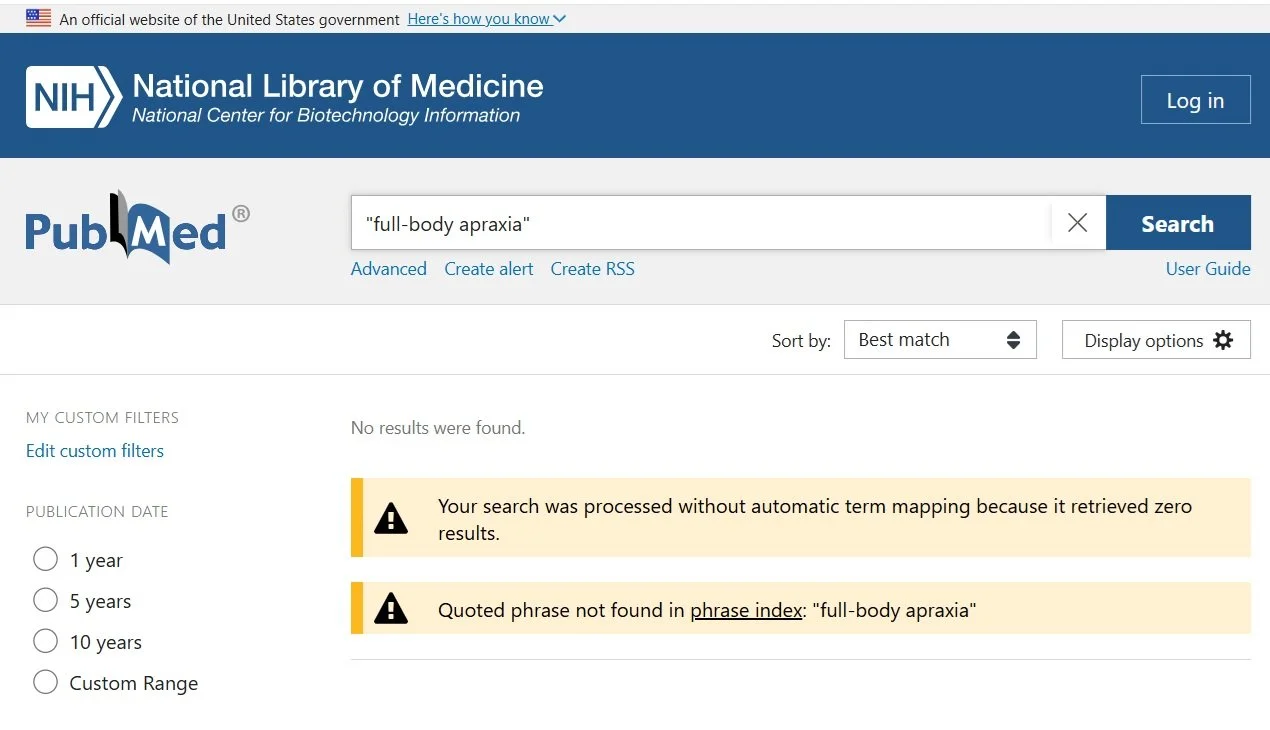
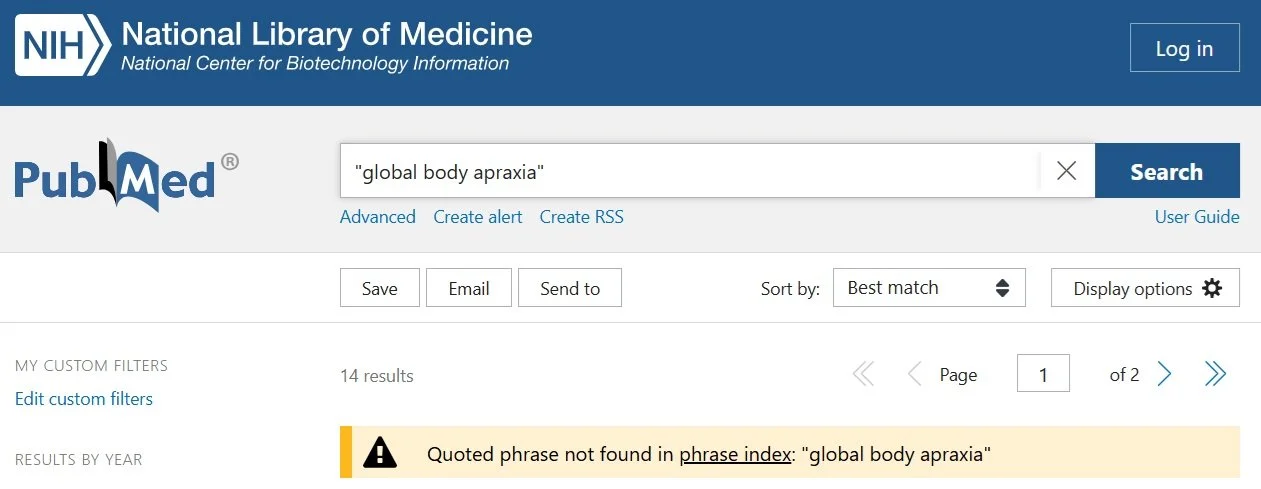
There is, in fact, no evidence that autistic non-speakers have anything resembling this condition. Nor do the various pro-FC, pro-telepathy articles provide a consistent definition of what this purported condition purportedly involves. This article makes it sound especially creepy:
You’re thirsty, but your hand refuses to reach for your cup. You see the traffic but can’t stop your feet.
...
We are burdened... with bodies that not only fail to move how we want, but in many cases, take over and do what they want.”
Here, “full body apraxia” isn’t just a mind-body disconnect; bordering on demonic possession, it’s a body with a mind of its own.
The piece characterized as “inaccurate and dangerous” the assumption that an autistic non-speaker’s inability to complete assigned tasks “are due to either a behavioral or cognitive impairment”: it “lead[s] to children with autism enduring hours of dehumanizing and at times abusive therapies” and being deprived “an adequate education” and “access to and acceptance of alternative therapies” Presumably, the abusive therapies are ABA (which seems to be universally loathed by FC proponents); and we can guess what the “alternatives therapies” are.
One might counter that the most dangerous assumption about autistic non-speakers is the notion that they have so little control over their bodies that all their behaviors (except those elicited by their facilitators) are essentially meaningless—especially when these behaviors include those that commonly communicate wants, needs, aversions, and emotional distress.
Also vilified and caricatured by FC proponents are special education placements; the author of this piece, whoever that might be, is no exception:
Educators and doctors repeatedly told my parents that I had the intelligence of a 4-year old, and I was relegated to living out my days in a windowless warehouse called a day program.
Then Spelling to Communicate saved the day. In addition to the usual claims that it helps with motor movements and regulation, the author adds this:
It taught me how to coordinate my eyes with my hand in order to accurately point to letters on a letterboard to spell my thoughts.
Though “within a year, [S2C] had changed my life beyond recognition,” it sounds like the first sessions were torture:
The prospect of finally being able to communicate overwhelmed my system with excitement. I spent the first several months screaming and shaking uncontrollably.
The article concludes on a promotional note:
I’m writing this article, pointing one letter at a time to my letterboard in the hopes of reaching the parents of nonspeaking autistics.
March 2nd
An article in a community newspaper in Germany entitled Heidelberg Autism Centre hails S2C Summit as breakthrough for non-speaking learners reports that an “inaugural Spelling to Communicate Summit” was held on February 20 and 21. S2C “inventor” Elizabeth Vosseller was present, appearing in several photographs.
This made me wonder whether there are German-specific letterboards. It took me two seconds to find this:
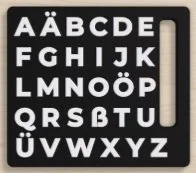
There’s also one for Spanish.
March 5
A segment on Live 5 News in South Carolina entitled Spellers Method helps nonverbal Charleston children find their voice (subheading “They’re all in there”) describes the opening of a Spellers Method branch in Charleston. It recounts the usual S2C/Spellers Method talking points, including “whole body apraxia,” along with anecdotes about two “spellers.” It closes with an announcement about a screening of Spellers, a documercial for Spelling to Communicate.
March 11
An article in a local Westport, Connecticut news website entitled Jocelyn Cutie: Non-Speaker Finds Her Powerful Voice
The unlocking of an autistic non-speaker with purported “apraxia”, defined here as involving “motor function” as opposed to “cognition.” The dad explains:
“She understands every word you’re saying. She just can’t respond verbally, vocally.”
Reporter Dan Woog writes:
Until 2 years ago, Jim and Chris had no idea what was going on in their daughter’s brain.
But when she began to use a spelling board to communicate at the Mouth to Hand Learning Center in Mount Kisco, New York, her world has joined theirs.
In that short span of time Jocelyn has taken college-level poetry, literature and biology classes. She started a blog.
And she has become an advocate, speaking on panels about the use of spelling to communicate. Her words are insightful, smart — “even sarcastic,” Jim says.
Alarmingly:
Jocelyn’s story is not unique. Jim and Chris now know more than 50 spellers.
This is the second article to bring up eye tracking as part of the training. This notion traces back to at least to Dana Johnson, one of the “co-inventors” of Spellers Method, but it seems to be picking up momentum.
Mouth to Hand founder/director Judy Chinitz showed Jocelyn 3 boards (fewer letters makes eye tracking easier than only one)
Naturally, Stephen Hawking, everyone’s favorite example of the dysjunction between motor challenges and genius, makes an appearance:
[Chinitz] read her a story about Stephen Hawking and disabilities. As Judy asked questions, Jocelyn answered.
“Chris and I wondered, ‘how did she know all this stuff?'” Jim recalls. “She’d been listening all those years.”
If only listening were all it took to learn stuff. Then you could, say, blast Turkish language radio at me all day long for years, and I’d learn all there is to know about Turkish politics and culture.
Through Jocelyn’s extended index finger, Chinitz’s S2C clinic comes in for some heavy promotion:
Before spelling there was nothing. There sometimes was the slightest glimmer of light in whatever hell I inhabited...
But I was totally one of the lucky ones. Had Mom and Dad not taken me to see Judy, the nightmare would never have ended. I am getting so teary now, just thinking about then and now.
Indeed, the clinic seems to have benefited the family in multiple ways: Jocelyn’s mom now works there, and Jocelyn
has become particularly close to another non-speaker, Judy’s 32-year-old son Alex.”
March 18
A news Five Cleveland segment entitled Spelling opening doors for those without a voice is one of the few U.S. articles to acknowledge the controversy. It nonetheless opens with the clear presumption that “spelling” effectively unlocks intact language skills and communicative goals:
Imagine having so much to say—but no way to say it.
That was life for one man, until things started changing, one letter at a time. Now, with a simple keyboard, he and other non-speakers are able to share their thoughts, personality and voice through spelling to communicate.
Each letter becomes a word, and each word can open up a whole new world.
Following this introduction, reporter Nadeen Abusada gives us the usual narrative, with claims that the child’s evidence-based AAC tool, TouchChat, limited what he could communicate, and that when the family discovered the local S2C provider, Access S2C, and “everything changed.”
“I knew that he was smart. I didn't know he was as smart as he really is,” said Megan Velotta.
Alarmingly, we also learn that
Since opening three years ago, they’ve worked with about 100 families.
And that
State Sen. Casey Weinstein has seen the impact firsthand.
Weinstein is quoted as saying, “I think any technique or tool that helps people have a voice and feel heard is valuable”; such tools, Abusada reports, could become “more accessible” under Winstein’s new “AAC coverage bill”—a bill that sounds similar to the New York State communication rights bill, one version of which supports S2C and other forms of FC.
But Abusada also reached out to ASHA (the American Speech-Language-Hearing Association) and got this reply:
“You can’t tell whether the words being spelled out belong to the autistic child—or to their aide. The aide holding the alphabet board may move the board unintentionally in the direction of the letter that they think the child should select next.”
But then Abusada quickly returns to the mother’s perspective:
That’s something Megan doesn’t agree with, especially after seeing the impact on her son.
“You go to a restaurant and for so many years, you just order what you think he wants.” Megan continued, “Now he’s like, ‘No, I’d like a hamburger with french fries,’ or 'I don’t want that. Mom, today I’d like some pasta marinara with a meatball, please.'"
Of course, facilitators don’t merely project their own thoughts onto their clients; they typically create independent personas that don’t always agree with them. If Megan wanted to know for sure whether her son was communicating independently, there’s a simple test she could do.
And it also ascribes communicative agency to the boy:
While we were there, Charlie had a lot to say, typing by himself, with his mom and Paros [his facilitator].
In the accompanying news video, we never see Charlie typing by himself; during one brief moment we see him typing on a keyboard on a surface with his mother right next to him.
The article ends with two promotional notes. A message attributed to Charlie:
“I dreamed of an opportunity like this one and it would have never been possible without the life changing method of spelling to communicate.”
And an invitation to click on the Access S2C website:
“To learn more about S2C click here.”
March 28
The first of the celebratory Woody Brown articles in a major newspaper appears in the Guardian: ‘I was in the pit of despair’: Non-speaking autistic novelist Woody Brown on his journey from write-off to writer
March 30
The second of the celebratory Woody Brown articles in a major newspaper appears in New York Times: ‘’I Thought I Would Be Caged My Whole Life’
April 1
The now-infamous Woody Brown episode is broadcast on the Today Show: Author of Read With Jenna Book Club Pick Shines Light on Autism
April 12
The third of the celebratory Woody Brown articles in a major newspaper appears in The London Times: Want to know what it’s like to be autistic? Read this novel
April 24th
The first critical article in a major newspaper appears in the Telegraph: The awkward case of the ‘miracle’ autistic author Woody Brown. Its subheading is
The 28-year-old writes by pointing at a board held by his mother. But with no evidence to support this method, his credentials are in doubt.
April 24th
A segment on CFJC radio in Kamloops, British Columbia entitled Kamloops’ Verhoeff earns Jim and Ginette Munson Autism Leadership Award, will shape national strategy takes us back to Canadian non-speakers and to non-speaker Luke Verhoeff, who also appeared in one of our earlier news roundups.
This article announces Verhoeff as the winner of an Autism Leadership Award, adding this:
Trapped in his mind until he was 19, Verhoeff found his voice two years ago, finally able to express himself using Spelling to Communicate and rapid prompting methods.
We also learn of Verhoeff’s many public appearances:
on Season 1 and 2 of CBC’s The Assembly
on the National Autism Network Autistic Advisory Council, along with “his friend Damon Kirsebom,” as its first non-speakers
This was the first time I’d heard of a Canadian analog to our Interagency Autism Coordinating Committee—and that it, too, has two FCed non-speakers serving on it.
May 6
An NBC News segment entitled Families of non-speakers push to protect their right to communicate discusses how users of Spelling to Communicate are fighting against an amendment to the New York State communication rights bill (see the mention of its Ohio analog in the March 18 item) that stipulates that communication methods be evidence-based.
Reporter Vicky Nguyen’s opener, like so many other openers, assumes these methods are effective:
At the Mouth to Hand Learning Center in Mount Kisco, New York, students learn how to communicate.
She then showcases a family that “tried everything,” and nothing worked, until they turned to what she describes, not as “pointing to letters on a held-up letterboard, a non-evidence-based technique that purportedly supports communication,” but as “spelling, a debated form of communication.” A naïve listener would be forgiven for thinking, in what sense is spelling a debated form of communication? Don’t writers use it all the time?
This piece eventually hints at what the “debate” is, via a two-sentence, 15-second fragment of an interview with Diane Paul, one of the directors at the American Speech-Language-Hearing Association. Only 12 words from Paul make it onto the show: “it’s not independent communication”; “there’s the risk of influence by another person.” This is immediately followed up with a return to the Mouth to Hand Learning Center and co-founder Judy Chinitz:
But Chinitz says she’s seen the method work for hundreds of students, including her own son Alex.
The possibility that Chinitz might have one or two more vested interests than Paul is not entertained. Instead, we see a sped-up video of Judy’s son typing on a held-up keyboard (apparently, he’s now a college sophomore majoring in math), followed by an impassioned declaration from Chinitz:
We are freeing some of the most amazing, beautiful, empathic people that you could ever come across; we’re freeing them from what we call the silent cage.
Not just empathetic, but superlatively empathetic. Once again we see FC promoters redefining autism away from the social disorder that 8 decades of clinical observation and empirical research have found it to be. And I say that as the mother of a moderately autistic son.
For the other mother profiled here, who says that spelling has changed their lives, “my daughter is evidence.”
Earlier in the segment, which spends much of its time showcasing the Hand to Mouth clinic, we get a glimpse of this evidence. We see Chinitz holding a letterboard in front of the daughter’s finger, shifting it in ways that move each target letter closer to the index finger, and calling out most (but not all) of the letters she points to and some that she doesn’t. Like many FCed individuals, this girl speaks the names of the letters after she points to them, raising questions about why she’s being called a non-speaker, and why, instead of learning how to speak more than letter names, she’s being subjected to a much more laborious and questionable communication method.
The version of the New York communication rights bill favored by the individuals in this news segment, and pretty clearly by reporter Vicky Nguyen as well, is, per Nguyen, in the hands of assemblyman Angelo Santabarbara, the father of an autistic non-speaker. The bill is awaiting a co-sponsor in the Senate.
At the end of the segment, Nguyen addresses the question of whether any of these individuals can type without the keyboard being held? “Some can,” she claims, but quickly adds this:
The way the advocates put it is, think how when you were little and learning how to ride a bike, you’re doing fine until you realize someone wasn’t holding on anymore. You might have wobbled. You might have fallen. They say that’s why non-speakers need that communication partner there. It helps them to regulate, to stay calm.
Nguyen continues for several sentences, with great conviction. By itself, this closing statement contains over 5 times as many words as those excerpted from the one critic she interviewed about this “debated form of communication.”
May 17th
An op-ed in the New York Daily News by S2C-promoter Lenore Skenazy, entitled Let mute New Yorkers speak: Albany must let people with disabilities communicate how they choose, reinforces much of the content of Vicky Nguyen’s May 6th piece. Senkazy seems to have learned nothing from the backlash (here and on X) against her previous piece How a miracle tool enables severely autistic kids to communicate for the first time. Nor has she considered how these “mute” individuals are expressing what they “choose”—let alone the possibility that the choice for S2C is coming from the facilitator, not the vulnerable individuals whose communication rights may be further violated if their purported choices are written into law.
June 10th
An article in a local Westport news website (same one as the March 11th entry) entitled Wynston Browne: “Staples Can Do Better For Students Like Me” showcases Wynston Brown, an autistic non-speaker who communicates by “spelling.”
The address to the Westport Board of Education attributed to Brown discusses the need to presume competence “so all students can fully participate in the decisions that shape their education.” The address also makes reference to apraxia:
My outward physical movements, due to severe apraxia, do not reflect my intellectual ability.
And, recalling the earlier news items that mention challenges with eye tracking, it also makes reference to “ocular planning challenges”:
When I was denied accommodations that supported my ocular planning challenges, my grades suffered. Yet when I demonstrated how materials could be organized in a way my brain could process, my grades became As.
But these challenges don’t explain the purported need for a Spanish-speaking facilitator for Spanish:
I experienced similar challenges in Spanish. Although I demonstrated fluency, I was placed in a B level class and denied access to a Spanish-speaking Communication and Regulation Partner (CRP). This left me feeling underestimated, dismissed, and intellectually stifled.
Or why “The way questions are asked directly impacts my ability to access and express higher level thinking.”
This article, which functions mostly as an informercial for “spelling,” contains a link to a short moving staring Winston (the password is Chance).
June 12th
An article in Special Education Action entitled Student Who Uses a Letterboard Wins Rare Due Process Case Against Fairfax County Public Schools (VA) describes an outcome that has been widely celebrated in pro-FC social media groups. As reporter Callie Oettinger explains:
Hearing Officer Polly Chong issued a decision in VDOE Case No. 26-016 finding that Fairfax County Public Schools denied a student a free appropriate public education, or FAPE, under IDEA.
As far as I can make out, the issue was the student’s June, 2023 IEP, which
stated that, because of the student’s disability-related needs, his primary preferred communication method required a letterboard to spell his communication, and that his fluency required support from a trusted and familiar individual trained in that communication method.
The real question is how this language made it into the student’s IEP in the first place.
And the main lesson here is to ensure that it doesn’t happen elsewhere.
Interestingly, none of these articles say one word about the giant elephant in the room: telepathy! Given how many non-speakers are turning out to be telepathic, why are no reporters covering this?
The only news article on telepathy that crossed my radar is this one: a February 7th article in the New York Post article entitled DOJ emails reveal Jeffrey Epstein was asked to fund telepathy experiments — and met with ‘spoon bender’, in which we learn that
New Age guru Deepak Chopra discussed weird science experiments with Jeffrey Epstein — including tests on telepathy in autistic kids.
As it turns out, the last few months have also brought out a number of more analytical, and in some cases more critical, commentaries about FC, which I’ll discuss in my next post.
