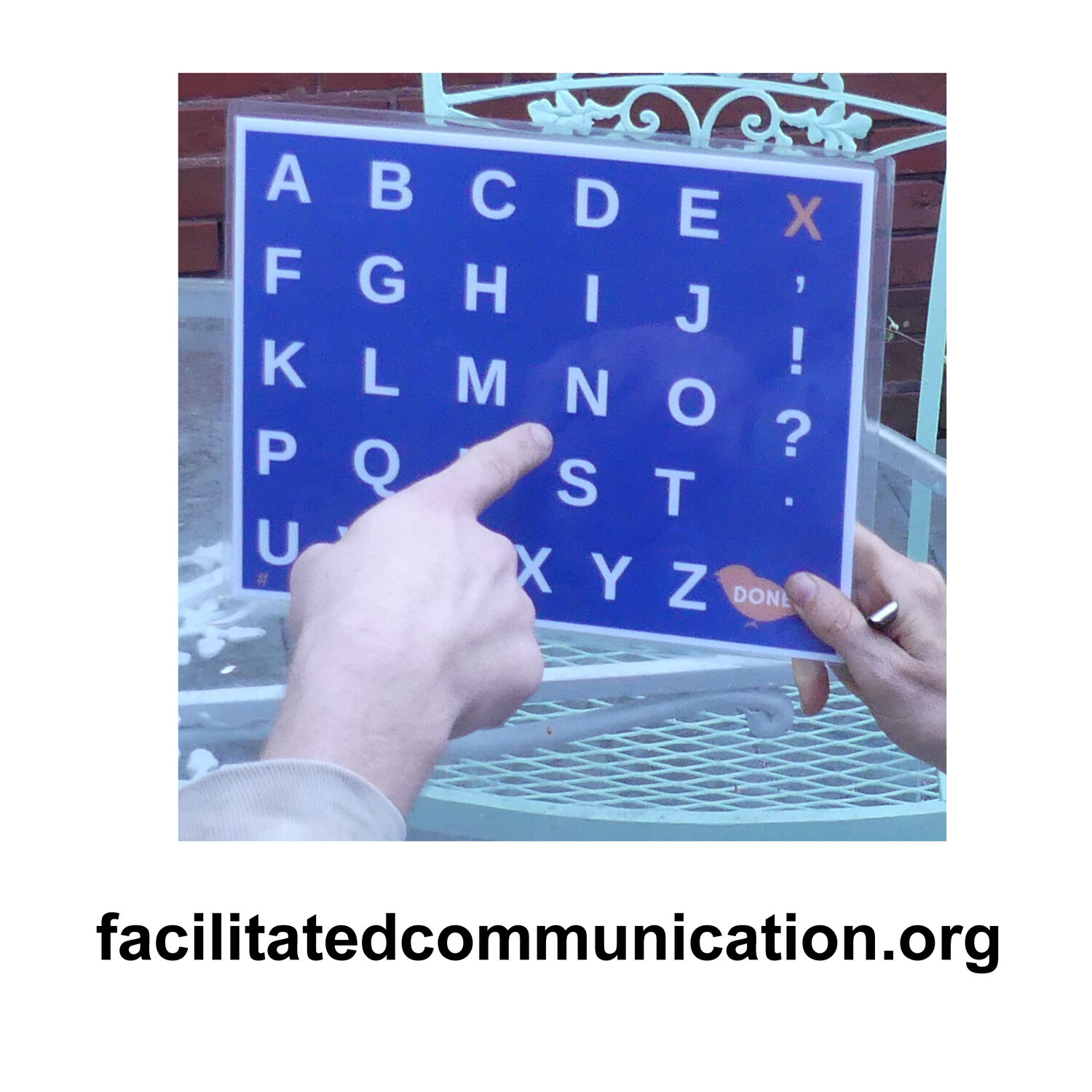
In response to a social media post that featured a YouTube video of an 8-or-9-year-old boy using a letter board tattooed to his facilitator’s arm to “spell” out a message, I asked: How is this independent communication? Is the facilitator supposed to follow the child everywhere he goes?
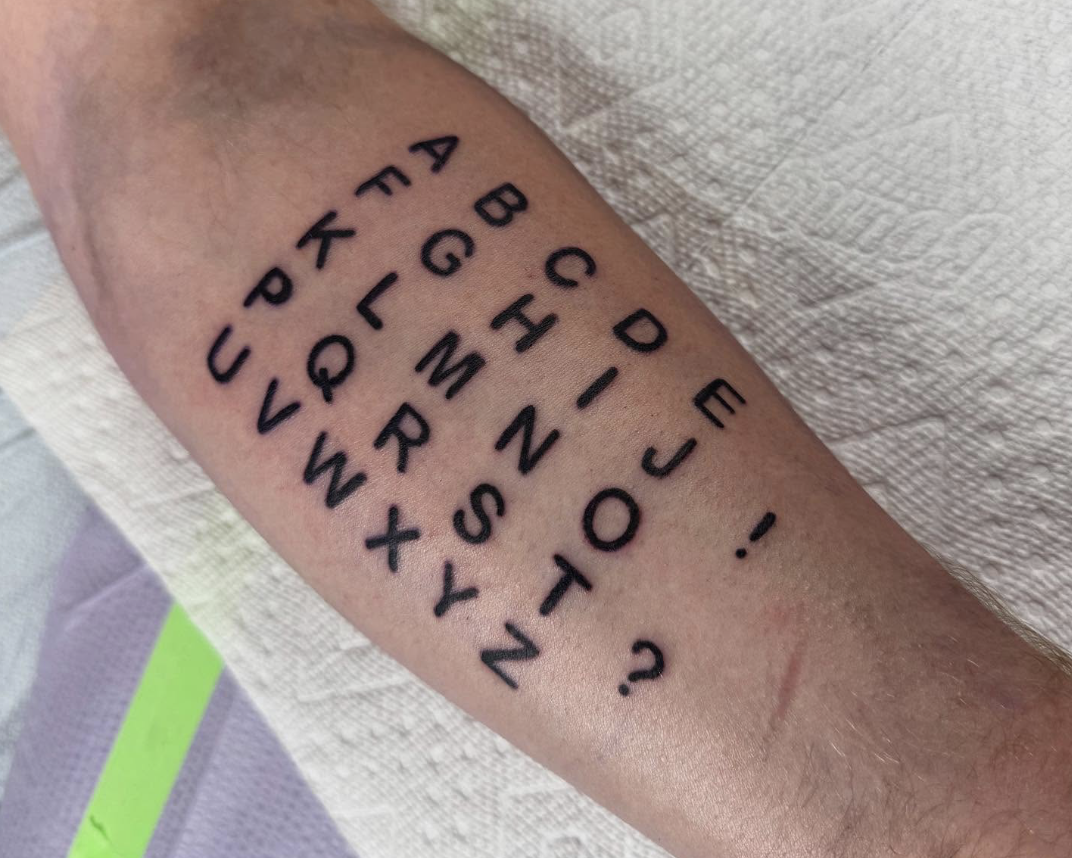
Screenshot from an Instagram post by The Black Labyrinth Tattoo Syndicate (2026)
My response, in turn, received this reply:
It walks the kid up to a point where independent [sic] is more likely with enough practice. It can’t be “broken” in the traditional sense, which offers more counter opportunities to help handle frustrations and overwhelm that rapidly turn over into a meltdown. This is a very good method.”
I asked the person for citations that would back up the person’s claim that “this was a very good method.” At this point in the exchange, the person had not yet admitted openly to supporting FC/S2C/RPM authorship, but since our X account focuses almost exclusively on the fact that FC is not science, it was not a huge leap to figure out the that the exchange I was having was with a supporter of these techniques. Also, I’ve never met an AAC expert who recommended that people walk around with letter boards tattooed to their forearms..
Anyway, the person quickly provided me with links to two articles:
Mishra, Avinash. (2024). Notes on a Randomized Controlled Trial Comparing Face-to-Face Versus Remote Delivery of Low-Tech Augmentative and Alternative Communication in Nonspeaking Children with Autism Spectrum Disorder. Journal of Speech, Language, and Hearing Research. Volume 67, pp. 1478-1489.
Ulriksen, L.B., Bilet-Mossige, M., Moreira, H.C., Larsen, K., and Nordahl-Hansen, A. (2023). Reading intervention for students with intellectual disabilities without functional speech who require augmentative and alternative communication: a multiple single-case design with four randomized baselines. Trials. 24:433 https://doi.org/10.1186/s13063-023-07452-4
The first article, which I’ll review today, was a study inspired, in part, by COVID-19 and the need for care providers (in this case, Speech/Language Pathologists) to find a way to continue treating their clients within the constraints of a world-wide pandemic.
My impression from the social media exchange was that, according to the commenter, the use of a letter-board tattooed on the facilitator’s arm served to increase the “face-to-face” efficacy of the intervention (I found out later, S2C) and that the Mishra article would support this claim.
Let’s take a look.
As I mentioned, the purpose of the Mishra study was to explore the efficacy of providing low-tech AAC instruction to nonspeaking individuals with autism when the services were provided remotely (e.g., using electronic systems) versus in person, face-to-face instruction. Unlike in the YouTube video with the tattooed letter board (which promoted FC/S2C/RPM), the researchers in the study focused specifically on the use of the Picture Exchange Communication System (PECS). And, while remote services were already becoming a viable treatment option around the time this study took place, the COVID-19 policy restrictions most likely sped up the process.
Mishra posited that there would not be a significant change in client outcomes, but because remote vs. face-to-face instruction changed the PECS protocols (which are strictly enforced by practitioners trained in the method), the researcher wanted to make sure, through objective measures, that the integrity of the PECS method was upheld despite the change in service delivery.
Since my social media feeds are filled with AI-generated articles attempting to redefine communication difficulties in autism as solely a motor planning problem, I appreciate that the study defined autism spectrum disorder (ASD) as a “neurodevelopmental disorder characterized by delayed and atypical social communication as well as restricted, repetitive patterns of behavior.”
The article also briefly discussed that Augmentative and Alternative Communication (AAC) systems range from low-tech (i.e., no electronic interface) to high-tech (i.e., speech-generating devices). A tattooed letter board, though unusual, I guess could qualify as a low-tech device, though I wonder how this teaches an individual to responsibly take care of his or her own communication devices and equipment.
Note: There is a difference between an AAC device (e.g., letter board, keyboard, speech generation device) and a communication technique or method, which is the strategy an individual uses to interact with the device to communicate his or her thoughts (e.g., signing, pointing to pictures, typing).
For me, the tattooed letter board itself as a low-tech device isn’t necessarily the issue, but I’m unclear on how this “device” builds communication independence, especially when the nonspeaking individual is being subjected to facilitator-dependent techniques like FC/S2C/RPM.
In the study I’m reviewing today, PECS was chosen as the AAC method for treating the children in the cohort because of its accessibility, the fact that it was commonly employed, and the existing research that supported PECS as an evidence-based method with proven outcomes in enhancing the communication skills of nonspeaking individuals with ASD.
Briefly, PECS instruction involves 6 levels, starting with single pictures to request desired objects or activities and gradually increasing in complexity. Trained PECS instructors follow a strict protocol, and clients don’t advance in levels unless they demonstrate mastery of the skills (independently and without cues from the assistant) at set accuracy levels over a set period (e.g., 80% accuracy on trials over 3 consecutive 15-trial blocks).
The study, approved by the institutional review board of Sacred Heart University, included 60 children, and spanned 2 years (from June 2020 – June 2022). Not all start times were the same. Each child was randomly assigned to receive face-to-face (PECS-F) or remote (PECS-R) treatment, with 30 children in each group.
I encourage people to read the study in full for inclusion and exclusion criteria, (as well as other details that I’ve left out in my summation) but, briefly, the participants in the study met the following criteria:
All were diagnosed with autism
Had a chronological age of between 18 and 30 months
Had a developmental age of at least 12 months
Exhibited an absence of expressive vocabulary
Exhibited gross and fine motor skills within normal limits
Had no prior exposure to PECS
Had no prior exposure to teletherapy (e.g., remote therapy)
Were able to attend 30-minute treatment sessions for a 3-month protocol
It should be noted that all the caregivers who assisted with the PECS-R group had an undergraduate degree or higher, were within a certain socio-economic range, and primarily spoke English. The researchers involved with this study noted that because of this limited demographic, the research data was also limited in scope and lacked the diversity reflected in the researchers’ daily clinical practices.
Screening measures were used to establish a baseline and then to assess any changes at the end of the study. These measures and assessment schedules are detailed in the original report, which showed that both groups benefitted from face-to-face and remote instruction with the following caveats:
Caregivers in the PECS-R (home-based) group required a lot of support, especially in the beginning stages of the study. The intense staffing needs might make this treatment option prohibitive in some circumstances.
The PECS-R group were also required to print out and laminate their own materials and have HIPAA-compliant software installed. Again, costs and technical considerations may be prohibitive in some circumstances, though the home-based, familiar environment was seen as a definite plus.
Children in both groups (PECS-F and PECS-R) showed similar gains and mastery of skills in Levels 1-3, with no statistically significant differences between the groups. Slightly more children in the PECS-R group showed competency at Level 4, but the PECS-F group showed more competency at Levels 5 and 6 where more complex language structures are introduced. The researchers posited that this difference could be attributed to the general clinical strategies that the expert clinicians brought to the situation (e.g., above and beyond basic PECS training that was given to all the caregivers and instructors in the study). Mishra wrote: “We cannot expect caregivers to possess such knowledge, which is why extensive instruction and modeling was provided to caregivers of children in the PECS-R group during treatment.” (Emphasis mine)
However, given the high participation of caregivers under the supervision of expert clinicians and the overall improvements in both groups, the study supported the use of PECS (an evidence-based form of low-tech AAC) in both service models (e.g., face-to-face and remote).
See the original study for researcher comments about possible improvements and areas of further study that generally touched upon follow-up assessments at 3- and 6-month intervals, expanding the diversity of the children served, addressing the intensive staffing issues (e.g., 3 clinical researchers per family), expanding the study to include other low-tech systems (e.g., visual scene displays), and assessing dosage, maintenance, and generalization for implementation of AAC (PECS) interventions.
In closing, I appreciate when proponents of FC/S2C/RPM provide me with studies to back up their claims. I’m happy to review and read them. I learn a lot when they do, but, sadly, this study didn’t address the question I asked about the video: How is this independent communication? Is the facilitator supposed to follow the child everywhere he goes?
But this study does give me food for thought.
I’m struck by the fact that fading support is built into each of the 6 PECS phases, unlike with FC/S2C/RPM where years can go by before the process of “fading” facilitator support begins and, to date, no one being subjected to FC/S2C/RPM has achieved independence under reliably controlled conditions.
And, yet, with the appropriate supports by trained caregivers and professionals, the 60 participants in the study (ages 18-30 months) had achieved mastery at the minimum of levels 1-3 with PECS during a (intensive) 3-month protocol. And, while I understand their communication may still be severely limited (especially when compared with the reported unexpectedly sophisticated language output of their facilitated counterparts), at least their communication was independent and free from facilitator cueing and control.
Next time, I’ll be reviewing the second article. Perhaps my questions will be answered then.